
Berkeley PitButte MontanaMontana historycopper mining
Berkeley Pit: Montana’s Toxic Mile-Long Lake
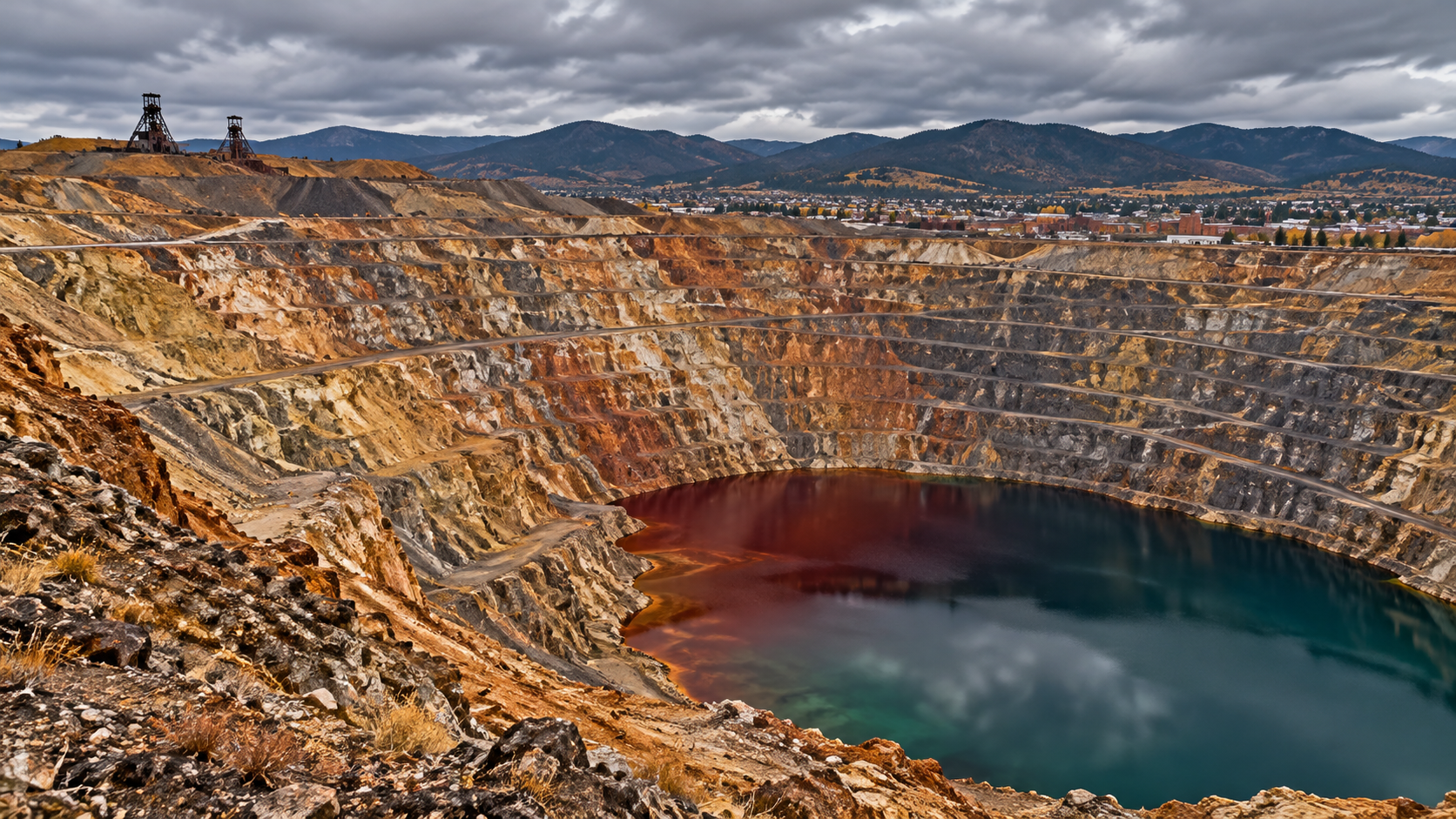
The Berkeley Pit in Butte, Montana, filled with acidic, metal-laden water after mine pumps shut off in 1982. Treatment now holds it below a set limit.
Every claim sourced
24 claims · 24 sources
0 disagreements logged
4 editorial corrections
Last checked Oct 8, 2026
The story
The numbered claim log below connects facts in this story to their sources.
Butte was once called “the richest hill on earth,” and in July 1955 the Anaconda Copper Mining Company began digging it out from the top. The Berkeley Pit grew for decades. In the 1970s, its expansion swallowed whole neighborhoods, including Meaderville, McQueen, East Butte, Dublin Gulch and Finntown. The mine was always fighting water. Pumps deep in the Kelley Mine, about 3,800 feet below the surface, kept groundwater out of the workings. On April 22, 1982, under owner Atlantic Richfield, mining stopped and the pumps were turned off. Water began pouring back in, at first about a foot a month. As it moved through the exposed rock, it picked up sulfuric acid and dissolved metals: copper, arsenic, cadmium and zinc. The pit, about a mile long and half a mile wide, slowly became a lake roughly 900 feet deep, with a pH of about 4.1 to 4.5. The site became part of a federal Superfund cleanup. Regulators set a hard limit: the water could not rise above 5,410 feet, the point where it could start flowing into the surrounding groundwater. Wildlife showed what was at stake. In 1996, researchers recovered 342 dead snow geese from the pit. In November 2016, a huge flock landed there, and thousands died. In October 2019, a treatment plant began pumping out pit water, cleaning it and releasing it into Silver Bow Creek. By April 2025, about 9 billion gallons had been treated, and the level had held steady at 5,356 feet, about 54 feet below the limit. The lake has stopped rising for now, but the pumps can never stop.
Last corrected: Oct 8, 2026.
Grew up near here?
Get the free Montana guide: every Hidden Current place in the region, with what you can still see and how to get there.
State guides are coming soon. Email signup is not available yet.
Watch the short documentary
Berkeley Pit: Montana’s Toxic Mile-Long Lake
Claim log
| # | Claim | Sources | Status |
|---|---|---|---|
| 1 | Berkeley Pit coordinates are 46.02°N, 112.51°W. |
| Sourced |
| 2 | Open-pit mining began in July 1955. |
| Sourced |
| 3 | The pit was operated by Anaconda Copper Mining Company and later Atlantic Richfield. |
| Sourced |
| 4 | During the 1970s, pit expansion consumed Meaderville, McQueen, East Butte, Dublin Gulch, and Finntown. |
| Sourced |
| 5 | The mine closed on April 22, 1982. |
| Sourced |
| 6 | The Kelley Mine pumps, about 3,800 ft below the surface, were turned off after closure. |
| Sourced |
| 7 | Groundwater began refilling the pit at roughly 1 ft per month. |
| Sourced |
| 8 | The pit is about 1 mile long and ½ mile wide. |
| Sourced |
| 9 | The pit's maximum depth is about 1,780 ft. |
| Sourced |
| 10 | Water fills the pit to about 900 ft. |
| Sourced |
| 11 | The water has a pH of 4.1–4.5. |
| Sourced |
| 12 | The water contains dissolved copper, arsenic, cadmium, zinc, and sulfuric acid. |
| Sourced |
| 13 | The pit was added to the federal Superfund list in 1987. |
| Sourced |
| 14 | The Record of Decision sets the maximum pit water level at 5,410 ft above sea level. |
| Sourced |
| 15 | Water above 5,410 feet could seep into groundwater. |
| Sourced |
| 16 | In 1996, researchers recovered 342 snow goose carcasses. |
| Sourced |
| 17 | On November 28, 2016, up to 60,000 geese landed in the pit and three to four thousand died. |
| Sourced |
| 18 | A water treatment plant has operated at the site since October 2019, releasing treated water into Silver Bow Creek. |
| Sourced |
| 19 | Since 2019, about 9 billion gallons of pit water have been treated and pumped into Silver Bow Creek. |
| Sourced |
| 20 | The water level was 5,356 feet in April 2025. |
| Sourced |
| 21 | The pit has not risen since pumping began, after previously rising six to seven feet a year. |
| Sourced |
| 22 | If pumping stopped entirely, it would take about four and a half years for the level to reach 5,410 feet. |
| Sourced |
| 23 | The viewing stand is on the southwest rim and is managed by the Butte Chamber of Commerce. |
| Sourced |
| 24 | The viewing stand is open May through October, daily from 10 a.m. to 5 p.m., weather permitting. |
| Sourced |
Disagreements logged
No approved disagreements are logged on this page yet.
Submit a disagreement
Disagree with a fact in this story? Submit a source-backed note for editorial review. It stays private until approved and does not automatically become a correction.
Sources
- Wikipedia
- ktvh.com
- pitwatch.org
Corrections
| # | Correction | Sources |
|---|---|---|
| 1 | The lake no longer "still rises today": since water treatment began in 2019, the level has held steady at about 5,356 feet. |
|
| 2 | The rise has been stopped by ongoing pumping and treatment, not by the pit stabilizing on its own. |
|
| 3 | The pumps shut off in 1982 were in the Kelley Mine, about 3,800 ft below the surface, not in the pit itself. |
|
| 4 | The first mass snow goose death is dated 1996 with 342 carcasses, not 1995 as often repeated. |
|