
Hidden LandscapesLake Nyoslakedeadly threat
Lake Nyos: The Lake That Released a Deadly Cloud in One Night
On the night of August 21, 1986, Cameroon's Lake Nyos released a cloud of carbon dioxide that killed 1,746 people in nearby villages as they slept.
Every claim sourced
12 claims · 12 sources
0 disagreements logged
2 editorial corrections
Last checked Oct 2, 2026
The story
The numbered claim log below connects facts in this story to their sources.
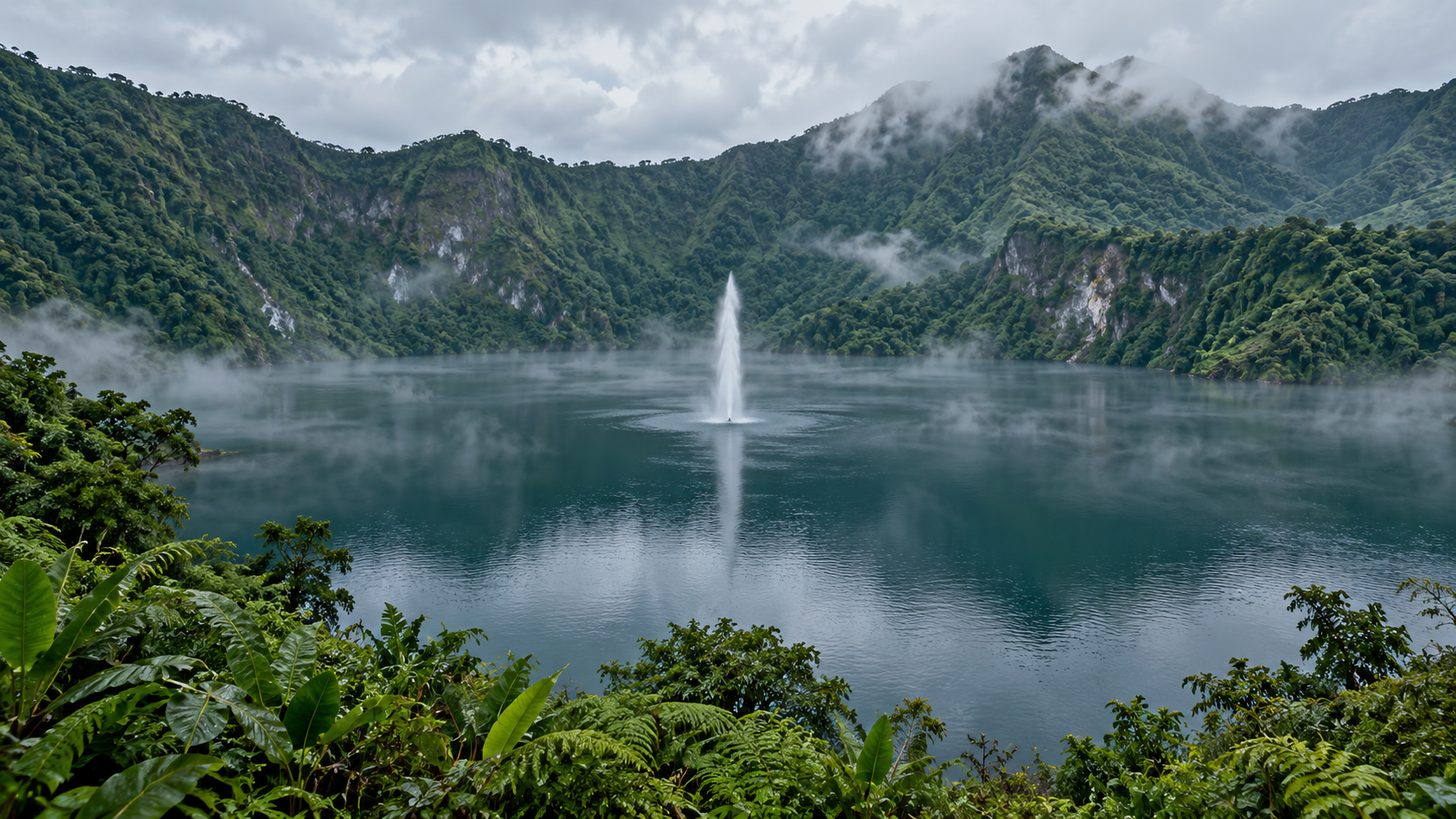
Lake Nyos looks like any quiet mountain lake. It sits in the crater of an old volcano in the highlands of northwest Cameroon, surrounded by green hills and small farming villages. But deep beneath the lake, carbon dioxide seeps up from magma far below, and it dissolves into the cold bottom water. Because the lake's layers rarely mix, that gas builds up for years, held in place by the weight of the water above it. It works like a sealed bottle of soda. On the night of August 21, 1986, the bottle opened. Something disturbed the lake's deep water. Scientists still don't know exactly what. As the bottom water rose, the pressure dropped, and the dissolved gas came out of solution all at once. The lake released an estimated 100,000 to 300,000 tons of carbon dioxide in a single burst. Carbon dioxide is invisible and heavier than air. Instead of rising, the cloud poured over the crater rim and flowed down the valleys, displacing the air in its path. It swept through the villages of Nyos, Kam, Cha and Subum while most people were asleep. By morning, 1,746 people were dead, along with about 3,500 cattle and other livestock. In the village of Nyos, almost no one survived. It took scientists time to understand what had happened. The event is called a limnic eruption, and it is extremely rare. The only other one recorded in modern history happened two years earlier at Lake Monoun, about 100 km away, and killed 37 people. The danger at Nyos didn't end in 1986, because the gas kept building. So researchers came up with a way to vent it safely. In 2001, a team installed a pipe running from the deep water to the surface. Once gas-rich water starts rising through the pipe, it keeps flowing on its own, spraying a plume of water into the air and releasing the gas slowly. Two more pipes were added in 2011, and the concentration of gas in the lake has dropped substantially since. The lake is still there, still quiet, and still releasing its gas, now a little at a time.
Last corrected: Oct 3, 2026.
Grew up near here?
Get the free state guide: every Hidden Current place in the region, with what you can still see and how to get there.
State guides are coming soon. Email signup is not available yet.
Watch the short documentary
Lake Nyos: The Lake That Released a Deadly Cloud in One Night
Claim log
| # | Claim | Sources | Status |
|---|---|---|---|
| 1 | Lake Nyos is at 6.44°N 10.30°E; the eruption caused 845 injuries |
| Sourced |
| 2 | Lake Nyos is at 6.44°N 10.30°E; the eruption caused 845 injuries |
| Sourced |
| 3 | On August 21, 1986, 1,746 people and 3,500 livestock died, and 100,000–300,000 tons of CO2 were released |
| Sourced |
| 4 | The UN death figure is 1,746 |
| Sourced |
| 5 | Lake Nyos is a crater lake where CO2 from magma dissolves into the water, like a soda bottle |
| Sourced |
| 6 | The trigger was a disturbance to the lower lake |
| Sourced |
| 7 | CO2 is 50% denser than air and flowed down the valleys |
| Sourced |
| 8 | The cloud reached the villages of Nyos, Kam, Cha and Subum |
| Sourced |
| 9 | Almost no one in Nyos survived |
| Sourced |
| 10 | Lake Monoun's eruption on August 15, 1984, killed 37 people about 100 km away; these are the two recorded limnic eruptions |
| Sourced |
| 11 | The first degassing pipe was installed in 2001, and two more in 2011 |
| Sourced |
| 12 | The Northwest Region is rated Level 4: Do Not Travel, for any reason |
| Sourced |
Disagreements logged
No approved disagreements are logged on this page yet.
Submit a disagreement
Disagree with a fact in this story? Submit a source-backed note for editorial review. It stays private until approved and does not automatically become a correction.
Sources
- Wikiwand
- Wikipedia
- Atlas Obscura
- All That's Interesting
- WorldAtlas
- U.S. State Department
Corrections
| # | Correction | Sources |
|---|---|---|
| 1 | The disaster killed 1,746 people, not thousands |
|
| 2 | The disaster killed 1,746 people, not thousands |
|
More Hidden Landscapes places
- The Desert Hidden Between These Mountains
- Ruby Falls: The Waterfall Hidden Inside Lookout Mountain
- Thor's Well ("the drainpipe of the Pacific")
- Lost Lake, Oregon: The Lake That Drains Into a Hole Every Summer
- Lost River, Indiana: The River That Disappears Underground
- Lake Kaindy: The Sunken Forest Drowned by an Earthquake