
Places That Shouldn't Existairportbeachaviation
Barra Airport: Where Scheduled Flights Land on a Beach
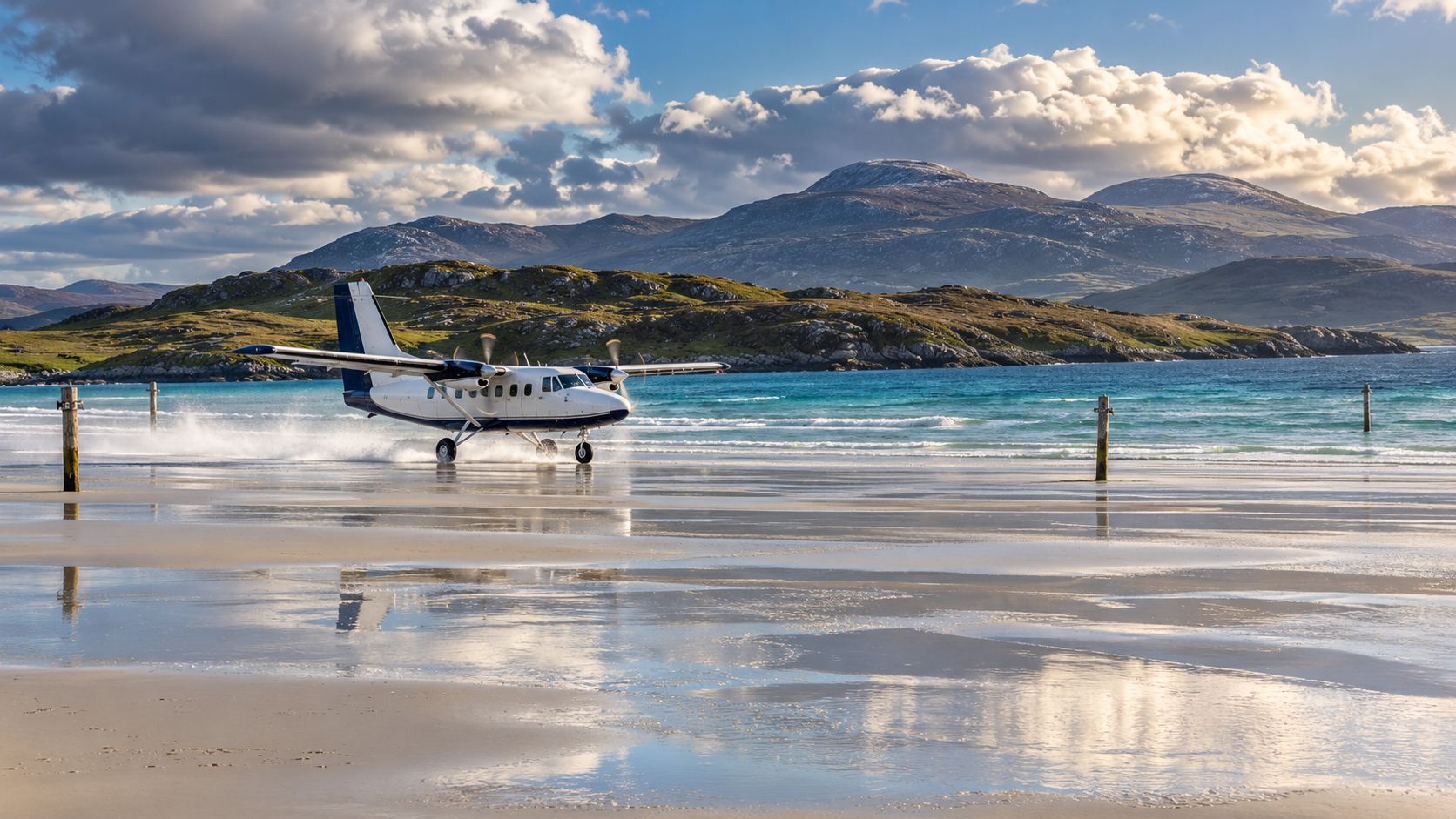
On the Scottish island of Barra, Loganair flights land on Traigh Mhòr beach. The runways vanish at high tide, so the flight schedule follows the sea.
Every claim sourced
24 claims · 24 sources
0 disagreements logged
4 editorial corrections
Last checked Oct 4, 2026
The story
The numbered claim log below connects facts in this story to their sources.
At the northern tip of the Isle of Barra, in Scotland's Outer Hebrides, there's a wide, shallow bay called Traigh Mhòr, the "big beach," also known as the Cockle Strand. For generations it was best known for its cockles. Then, on June 14, 1933, aircraft started landing on it. Scheduled air services began on August 7, 1936, and they've continued ever since. Barra Airport is believed to be the only airport in the world where scheduled passenger flights use a tidal beach as their runway. There's no concrete. Instead, three runways are laid out on the sand in a triangle, their ends marked by wooden posts that stay in place while the tide washes over them twice a day. Having three runways lets the planes almost always land into the wind. The longest is about 2,776 feet. That's short by airport standards, but the de Havilland Canada DHC-6 Twin Otters that Loganair flies here need very little room to take off and land. The runways disappear at high tide, under the sea. That means the airport can't run on a fixed clock. Flight times shift from day to day to match the tides, and the only scheduled route is to and from Glasgow. The beach is still a beach while all this happens. Cockle pickers and walkers share the sand with the airport, watching the windsock: when it's flying, the airport is operating and people stay clear of the runways. At night, the airport can still be used for emergency flights, including air ambulance helicopters. Pilots then rely on reflective strips laid on the sand and the headlights of vehicles parked along the beach to find the runway. The airport is run by Highlands and Islands Airports Limited, a public corporation owned by the Scottish Ministers. In 2024, HIAL invested £1.5 million in refurbishing the airport, while keeping the famous beach runways. For the people of Barra, it's a lifeline to the mainland, and for many visitors it's the only place they'll ever land on a beach.
Last corrected: Oct 4, 2026.
Grew up near here?
Get the free state guide: every Hidden Current place in the region, with what you can still see and how to get there.
State guides are coming soon. Email signup is not available yet.
Watch the short documentary
Barra Airport: Where Scheduled Flights Land on a Beach
Claim log
| # | Claim | Sources | Status |
|---|---|---|---|
| 1 | Barra Airport is at 57.0228, -7.4431 |
| Sourced |
| 2 | Barra Airport is at 57.022800, -7.443060, with an elevation of 5 ft |
| Sourced |
| 3 | Barra Airport's postcode is HS9 5YR |
| Sourced |
| 4 | Barra Airport is believed to be the only airport in the world where scheduled flights use a tidal beach as the runway |
| Sourced |
| 5 | Barra is the only beach airport anywhere in the world to be used for scheduled airline services |
| Sourced |
| 6 | Traigh Mhòr ("big beach") is also known as Cockle Strand |
| Sourced |
| 7 | The bay of Traigh Mhor was famous primarily for its cockles until aircraft started to use the beach on 14 June 1933 |
| Sourced |
| 8 | Scheduled air services to and from Barra Airport began on 7 August 1936 |
| Sourced |
| 9 | Barra Airport opened in 1936 and the first airliner to use it was a de Havilland Dragon |
| Sourced |
| 10 | Three runways are designated on the beach, and their ends are marked by posts that stay in place during the twice-daily tide |
| Sourced |
| 11 | The beach is set out with three runways in a triangle, marked by permanent wooden poles, so the DHC-6 Twin Otter aircraft can almost always land into the wind |
| Sourced |
| 12 | At high tide the runways are under the sea, and flight times vary with the tide |
| Sourced |
| 13 | The airport's only destination is Glasgow |
| Sourced |
| 14 | De Havilland Twin Otters of Loganair connect Barra with Glasgow |
| Sourced |
| 15 | The flight to Glasgow takes 1 hour and ten minutes |
| Sourced |
| 16 | Runway 07/25 is 2621 ft long, 11/29 is 2231 ft long and 15/33 is 2776 ft long |
| Sourced |
| 17 | For emergency night flights, pilots rely on reflective strips laid on the beach and vehicle headlights |
| Sourced |
| 18 | The airport can be used for operations by Scottish Ambulance Service helicopters |
| Sourced |
| 19 | Cockle collectors are advised to remain outside the marked runway areas, and visitors can tell if the airport is operating by checking the windsock |
| Sourced |
| 20 | Barra Airport is operated by Highlands and Islands Airports Limited, a public corporation wholly owned by the Scottish Ministers that operates 11 airports |
| Sourced |
| 21 | In 2024, HIAL invested £1.5 million in refurbishing Barra Airport |
| Sourced |
| 22 | Visitors can watch the flights land on the beach from a café |
| Sourced |
| 23 | Local bus route W32 connects the airport with Castlebay |
| Sourced |
| 24 | Taxis should be pre-booked, as they do not typically wait at the terminal |
| Sourced |
Disagreements logged
No approved disagreements are logged on this page yet.
Submit a disagreement
Disagree with a fact in this story? Submit a source-backed note for editorial review. It stays private until approved and does not automatically become a correction.
Sources
- lfs.aero
- metarcentral.com
- thegreatbritainguide.com
- Wikipedia
- Undiscovered Scotland
- bitesizedbritain.co.uk
- isleofbarra.com
- airportroutes.com
Corrections
| # | Correction | Sources |
|---|---|---|
| 1 | Barra is not "one of the only" beach airports with scheduled flights; it is believed to be the only one in the world |
|
| 2 | Barra Airport is at 57.0228, -7.4431, not 57.00611, -7.44306 as listed on a Wikipedia mirror |
|
| 3 | Barra Airport is at 57.022800, -7.443060 |
|
| 4 | Barra Airport's only scheduled destination is Glasgow, not Glasgow and Benbecula |
|
More Places That Shouldn't Exist places
- Parícutin: The Volcano That Was Born in a Farmer's Cornfield
- Ferropolis: Germany's City of Iron Built From Giant Mining Machines
- Reelfoot Lake: The Tennessee Lake Created by an Earthquake
- Hashima Island: Japan's Abandoned Battleship Island
- Lake Resia: The Bell Tower of the Village Beneath the Water
- Salton Sea: California's Accidental Lake and Its Fading Resorts