
Places That Shouldn't ExistvolcanoParícutinMexico
Parícutin: The Volcano That Was Born in a Farmer's Cornfield, Mexico
In 1943, a farmer in Mexico watched his cornfield split open. Within nine years, a volcano 1,391 feet tall stood there, and two towns lay under its lava.
Every claim sourced
8 claims · 8 sources
0 disagreements logged
0 editorial corrections
Last checked Oct 2, 2026
The story
The numbered claim log below connects facts in this story to their sources.
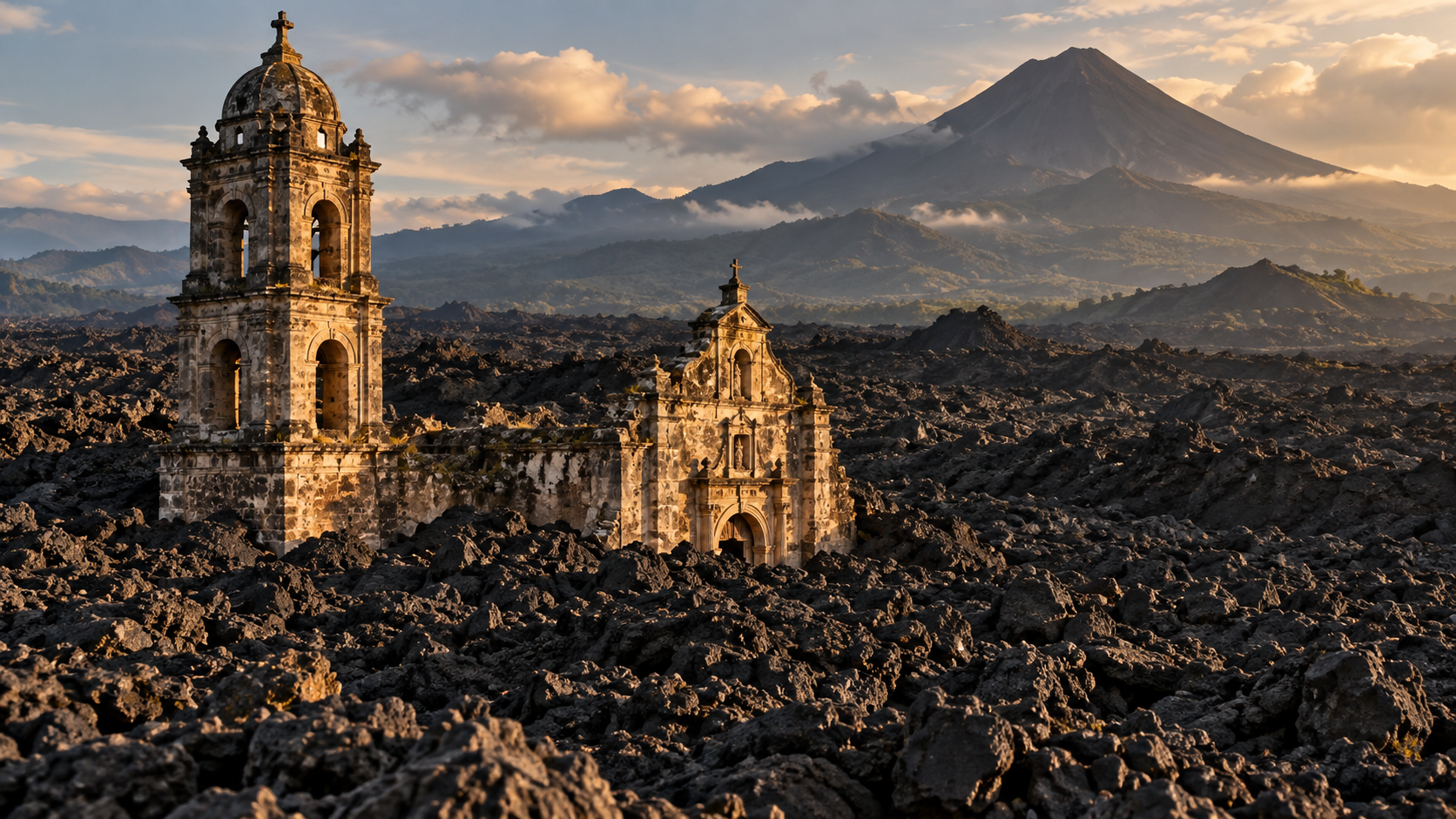
On the afternoon of February 20, 1943, a Purépecha farmer named Dionisio Pulido was preparing his cornfield near the village of Parícutin, in the highlands of Michoacán, Mexico. His wife Paula was with him. Then the ground in front of them began to swell and crack. A fissure opened. Steam, sparks and hot ash began spurting out of the earth. Pulido tried to cover the openings, then realized there was nothing he could do, and ran. He had just witnessed the birth of a volcano. It grew with astonishing speed. By the end of the first day, the cone was about 50 meters (160 feet) tall. Within a week it stood 100 to 150 meters high. Glowing bombs of molten rock burst into the night sky, and lava began pouring across the surrounding farmland. Most of the volcano's growth came in its first year. The lava kept coming. The village of Parícutin, which gave the volcano its name, was buried. So was the larger town of San Juan Parangaricutiro. By 1944, nearly all that remained visible of San Juan was its church, its towers rising out of a field of black rock. Three people were killed, two towns were completely evacuated and buried, and three others were heavily damaged. Hundreds of people had to relocate permanently, and new towns were built to take them in. Before leaving, Pulido reportedly put up a sign in what was left of his field: "This volcano is owned and operated by Dionisio Pulido." For scientists, Parícutin was a once-in-history opportunity. For the first time, modern science could watch a volcano of this type from its first moment to its last. Over nine years, geologists mapped it, sketched it, sampled it and photographed it. The eruption finally ended in 1952, leaving a cinder cone 424 meters (1,391 feet) above the cornfield where it began, and damaging more than 233 square kilometers (90 square miles) of land. Parícutin is now quiet, though the region around it is still volcanically active. In 1997, CNN named it one of the Seven Natural Wonders of the World. Today the most famous sight is the church of San Juan Parangaricutiro: its bell tower and facade rising from the hardened lava, and inside, an altar where people still leave candles and flowers. A cornfield became a mountain in a matter of years, and a farmer who went out to plant his crops found himself standing at the birth of a volcano.
Last corrected: no editorial corrections on this page yet.
Grew up near here?
Get the free Mexico guide: every Hidden Current place in the region, with what you can still see and how to get there.
State guides are coming soon. Email signup is not available yet.
Watch the short documentary
Parícutin: The Volcano That Was Born in a Farmer's Cornfield, Mexico
Claim log
| # | Claim | Sources | Status |
|---|---|---|---|
| 1 | The summit is at 19.49306, -102.25111; the cone is 424 m; 233 km² were damaged; three people died; towns were buried or affected; residents were relocated; it was the first full scientific record; CNN named it a natural wonder in 1997 |
| Sourced |
| 2 | Pulido was a Purépecha farmer; the ground quaked and spurted steam; he tried covering the holes; the church is 3 km from Angahuan; offerings are left at the altar |
| Sourced |
| 3 | Paula Pulido was present; a fissure opened; the church towers were visible by 1944 |
| Sourced |
| 4 | The cone was 50 m on the first day and 100–150 m in the first week; Pulido put up a sign; the cone still smolders |
| Sourced |
| 5 | Most growth came in the first year |
| Sourced |
| 6 | The region is still volcanically active |
| Sourced |
| 7 | Michoacán is rated Level 4 |
| Sourced |
| 8 | Angahuan guides offer horses |
| Sourced |
Disagreements logged
No approved disagreements are logged on this page yet.
Submit a disagreement
Disagree with a fact in this story? Submit a source-backed note for editorial review. It stays private until approved and does not automatically become a correction.
Sources
- Wikipedia
- Lonely Planet
- Amusing Planet
- Mexico News Daily
- EPFL Wikipedia 2007 selection
- U.S. Embassy Mexico
- Outdoor Revival
Corrections
No editorial corrections are logged on this page yet.
More Places That Shouldn't Exist places
- Ferropolis: Germany's City of Iron Built From Giant Mining Machines
- Barra Airport: Where Scheduled Flights Land on a Beach
- Reelfoot Lake: The Tennessee Lake Created by an Earthquake
- Hashima Island: Japan's Abandoned Battleship Island
- Lake Resia: The Bell Tower of the Village Beneath the Water
- Salton Sea: California's Accidental Lake and Its Fading Resorts