Places That Shouldn't Existexcavatorscoal fieldsmining
Ferropolis: Germany's City of Iron Built From Giant Mining Machines
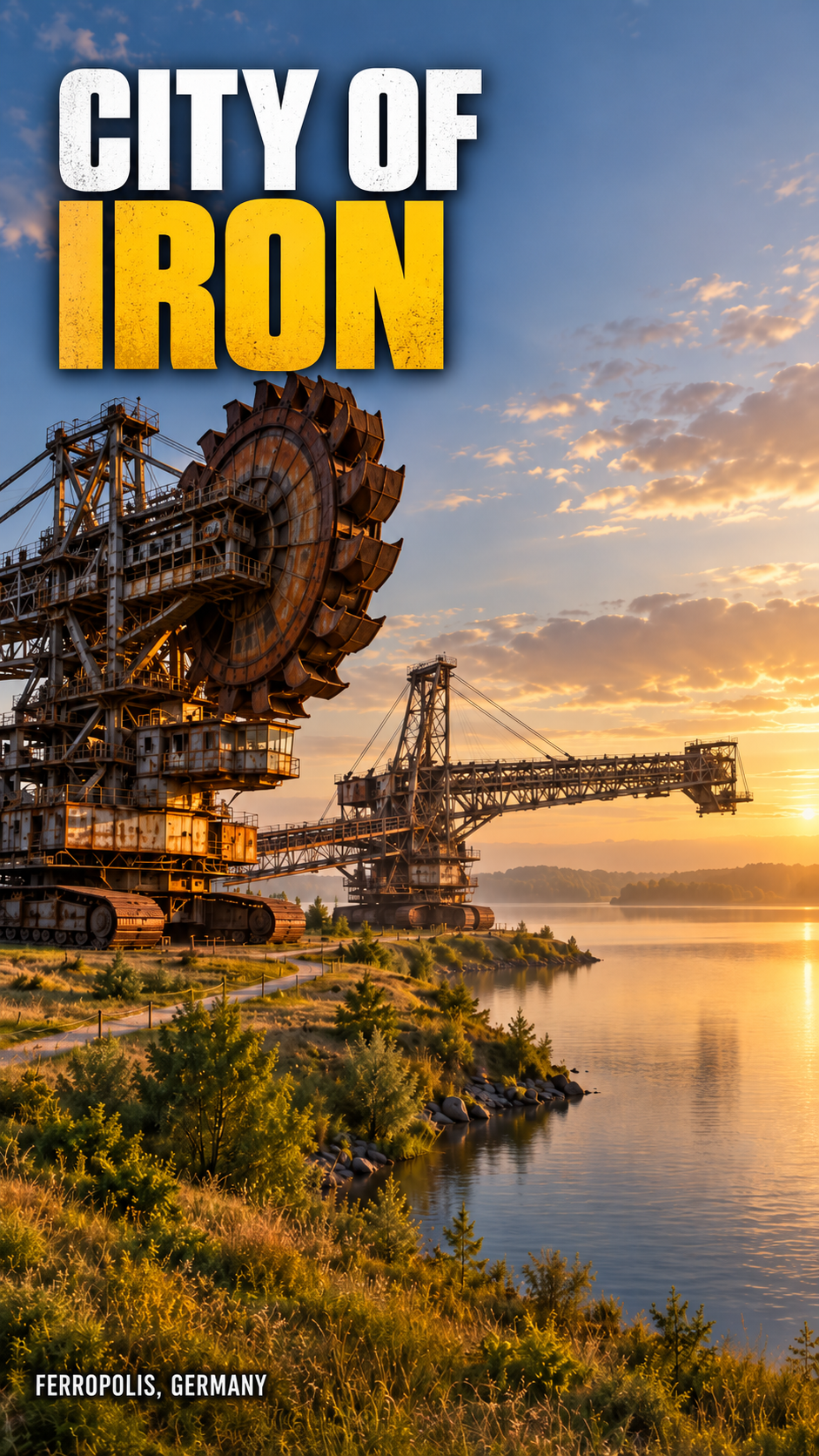
In eastern Germany, five giant mining machines, up to 125 meters long and nearly 2,000 tons, stand on a lake peninsula where their coal mine used to be.
Every claim sourced
9 claims · 9 sources
0 disagreements logged
2 editorial corrections
Last checked Oct 2, 2026
The story
The numbered claim log below connects facts in this story to their sources.
For decades, the countryside around Gräfenhainichen in eastern Germany was being eaten away. This was the heart of Central Germany's lignite industry. Lignite is a soft brown coal that lies close to the surface, so instead of tunneling for it, miners stripped the land away in enormous open pits. At the Golpa-Nord mine, up to 1,000 miners worked at peak times, and villages in the path of the pit were dug away entirely. The work was done by machines built on a scale that's hard to picture: excavators and spreaders taller than an eight-story building and longer than a football field, each crewed by a small team and creeping across the mine on rails or tracks. When East and West Germany reunified, much of the old East German coal industry shut down. Golpa-Nord closed in 1991. The pit was left behind as a scarred wasteland, along with the machines that had dug it. In 1992, the Bauhaus Dessau Foundation proposed something unusual: instead of scrapping the machines, turn them into monuments. Five of them were gathered on a peninsula in the old pit, arranged in a semicircle, and fitted with stairs and walkways for visitors. Around them, the pit was allowed to flood, forming Lake Gremmin. Altogether, the five machines add up to about 7,000 tons of industrial history. They became Ferropolis, the City of Iron. Each machine has a nickname. Gemini is the largest: a spreader built in 1958, weighing 1,980 tons, 30 meters tall and 125 meters long, with a 60-meter boom and a crew of six to eight. Big Wheel, built in 1984, is a 1,718-ton bucket-wheel excavator named for its giant digging wheel. Mad Max, from 1962, is a 1,250-ton excavator carrying forty enormous buckets. Medusa is a spreader named for its repair crane that swings a full 360 degrees. Mosquito, at 792 tons, is the "compact" one. A museum in the mine's former power station tells the history of the pits, the villages lost to them, and a remarkable discovery made during the digging: the remains of prehistoric forest elephants. Today, Ferropolis is both a museum and one of Germany's best-known open-air event venues. Mad Max forms the lakeside edge of the arena, and when concerts are held there, the old mining machines light up behind the stage.
Last corrected: Oct 3, 2026.
Grew up near here?
Get the free state guide: every Hidden Current place in the region, with what you can still see and how to get there.
State guides are coming soon. Email signup is not available yet.
Watch the short documentary
Ferropolis: Germany's City of Iron Built From Giant Mining Machines
Claim log
| # | Claim | Sources | Status |
|---|---|---|---|
| 1 | Gemini: 1958, 1,980 t, 30 × 125 m, 60 m boom, crew 6–8; Big Wheel: 1984, 1,718 t, 31 × 74.5 m; Mad Max: 1962, 1,250 t, 27.6 × 79.2 m, forty buckets; Mosquito: 792 t, 27.2 × 67.1 m; Medusa: 360-degree crane; Mad Max forms the arena edge |
| Sourced |
| 2 | Five machines total about 7,000 tons; the site is the former Golpa mine; a museum covers the mine history, lost villages and the forest elephant find; address Ferropolisstraße 1 |
| Sourced |
| 3 | Ferropolis is on a peninsula in Lake Gremmin, east of Dessau-Roßlau |
| Sourced |
| 4 | Ferropolis is on a peninsula in Lake Gremmin, east of Dessau-Roßlau |
| Sourced |
| 5 | The mine closed in 1991; the Bauhaus Dessau proposed the idea in 1992 |
| Sourced |
| 6 | Up to 1,000 miners worked the mine at peak |
| Sourced |
| 7 | Hours: April–October Mon–Fri 10:00–18:00, Sat/Sun/holidays 10:00–19:00; November–March daily 10:00–17:00; tours Sat/Sun/holidays at 11:00, 13:00 and 15:00; audio guides available |
| Sourced |
| 8 | Ferropolis closes to visitors on major event days |
| Sourced |
| 9 | Ferropolis is at 51.75896, 12.44666 and was founded in 1995 |
| Sourced |
Disagreements logged
No approved disagreements are logged on this page yet.
Submit a disagreement
Disagree with a fact in this story? Submit a source-backed note for editorial review. It stays private until approved and does not automatically become a correction.
Sources
- ferropolis.de
- museen.de
- Flickr
- Wikipedia
- Outdooractive
- Europaradweg R1
- Lutherstadt Wittenberg tourism
- Aroundus
Corrections
| # | Correction | Sources |
|---|---|---|
| 1 | Ferropolis's machines are not the largest ever built: the largest, Gemini, weighs 1,980 t |
|
| 2 | Bagger 293 holds the record as the heaviest land vehicle ever built, at 14,200 tons |
|
More Places That Shouldn't Exist places
- Parícutin: The Volcano That Was Born in a Farmer's Cornfield
- Barra Airport: Where Scheduled Flights Land on a Beach
- Reelfoot Lake: The Tennessee Lake Created by an Earthquake
- Hashima Island: Japan's Abandoned Battleship Island
- Lake Resia: The Bell Tower of the Village Beneath the Water
- Salton Sea: California's Accidental Lake and Its Fading Resorts