
Places That Shouldn't ExistHashima IslandBattleship IslandJapan history
Hashima Island: Japan's Abandoned Battleship Island
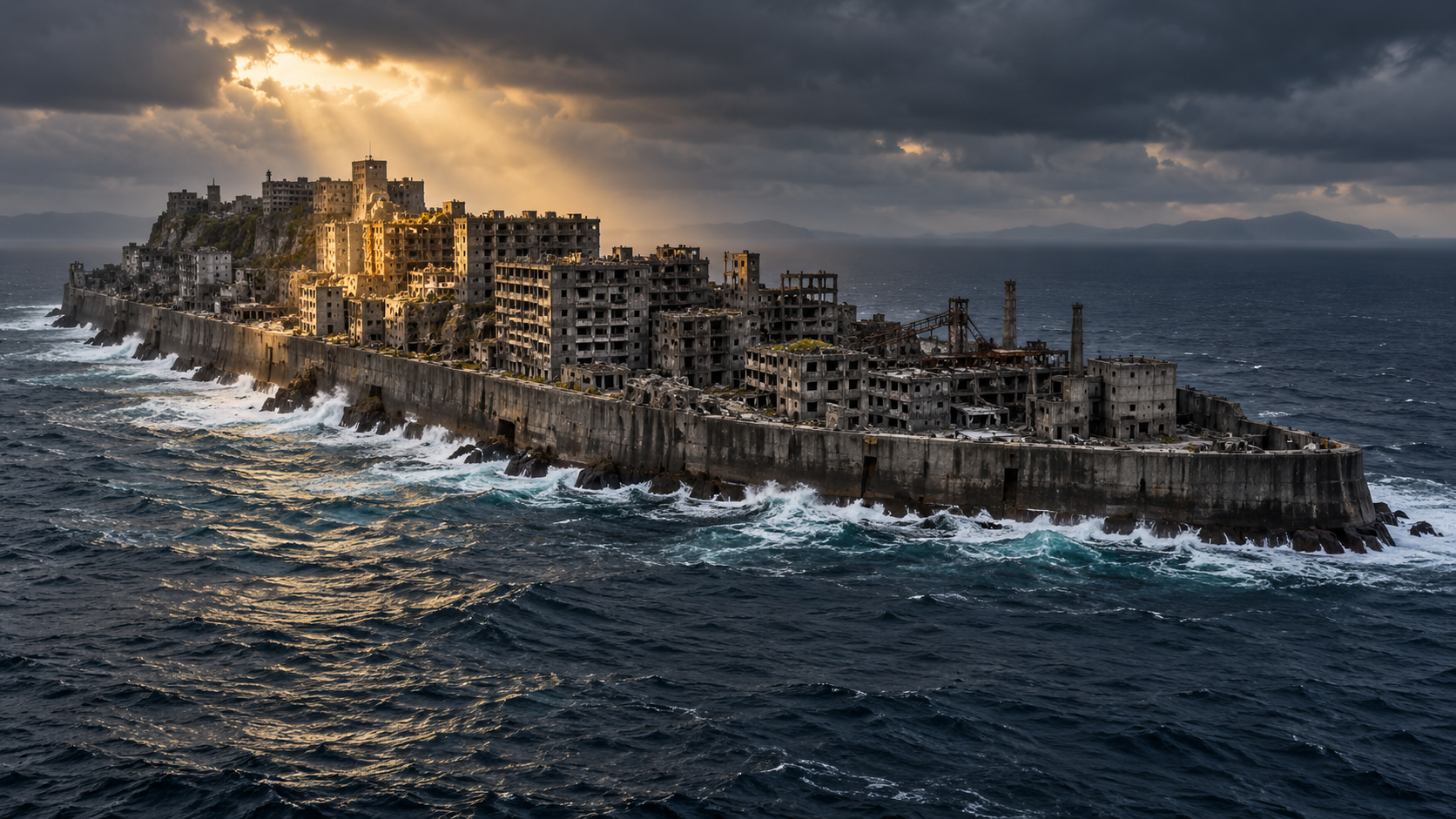
Hashima Island off Nagasaki packed 5,259 people onto 16 acres in 1959. When its undersea coal mine closed in 1974, everyone left. The concrete remains.
Every claim sourced
25 claims · 25 sources
0 disagreements logged
9 editorial corrections
Last checked Oct 6, 2026
The story
The numbered claim log below connects facts in this story to their sources.
About 15 kilometers off the coast of Nagasaki, a small island rises from the sea, lined with crumbling concrete apartment towers and ringed by a high seawall. From a distance, its outline looks like a warship, which is how it got its nickname, Gunkanjima, "Battleship Island." Its official name is Hashima. The island owes its existence as a city to coal. Coal was discovered there around 1810, and from 1887 it was continuously inhabited as an undersea coal mine. In 1890, the Mitsubishi company bought the island. Mitsubishi expanded the mine and built seawalls and landfill, enlarging the island to about 6.3 hectares, roughly 16 acres. Miners went down shafts and worked seams deep beneath the seabed. To house the workers and their families, the company built upward. In 1916, the island got Japan's first reinforced-concrete apartment building. Over the following decades, more towers went up, along with schools, shops, a hospital, a cinema and rooftop gardens. In 1959, Hashima's population peaked at 5,259 people, about 83,500 people per square kilometer, which made it one of the most densely populated places ever recorded. The island also has a darker chapter. During World War II, Korean and Chinese laborers were brought to Hashima and forced to work in its mine under harsh and dangerous conditions. After the war, Japan's energy shifted from coal to petroleum. With the coal running low, Mitsubishi closed the mine in January 1974, and by April 20 of that year, the last residents had left. The island was abandoned, and for decades its buildings were battered by typhoons and salt spray. In 2009, Nagasaki City reopened a small southern section of the island to tour groups. In 2015, Hashima was inscribed as part of UNESCO's "Sites of Japan's Meiji Industrial Revolution." The listing was controversial. South Korea objected because of the island's forced-labor history, and Japan agreed to acknowledge that history in how the sites were presented. In 2018, UNESCO's World Heritage Committee concluded that Japan had not yet done so, and a 2021 UNESCO review reached similar findings. Today the island's apartment blocks and mine buildings still stand in the sea, slowly decaying.
Last corrected: Oct 6, 2026.
Grew up near here?
Get the free state guide: every Hidden Current place in the region, with what you can still see and how to get there.
State guides are coming soon. Email signup is not available yet.
Watch the short documentary
Hashima Island: Japan's Abandoned Battleship Island
Claim log
| # | Claim | Sources | Status |
|---|---|---|---|
| 1 | Hashima Island tours start at Nagasaki Port; the island is at 32.6278, 129.7386 |
| Sourced |
| 2 | Hashima is located at latitude 32.6274° N, longitude 129.7389° E, about 15 kilometers from Nagasaki |
| Sourced |
| 3 | Hashima Island, commonly called Gunkanjima ("Battleship Island"), is an abandoned island about 15 kilometres from the centre of Nagasaki |
| Sourced |
| 4 | Coal was discovered on the island around 1810, and the island was continuously inhabited from 1887 to 1974 as a seabed coal mining facility |
| Sourced |
| 5 | In 1959, the 6.3-hectare island's population reached its peak of 5,259 |
| Sourced |
| 6 | Mitsubishi officially closed the mine in January 1974, and the island was cleared of inhabitants on 20 April |
| Sourced |
| 7 | Travel to Hashima was re-opened on 22 April 2009, after 35 years of closure |
| Sourced |
| 8 | More than 95% of the island is strictly delineated as off-limits during tours |
| Sourced |
| 9 | Mitsubishi purchased Hashima Island in 1890 and increased its landmass to 16 acres |
| Sourced |
| 10 | In July 2015, Gunkanjima became a UNESCO World Heritage site |
| Sourced |
| 11 | Japan's first reinforced-concrete apartment block was built on the island in 1916 |
| Sourced |
| 12 | At its peak the island had schools, shops, a cinema, and rooftop gardens |
| Sourced |
| 13 | When Japan switched from coal to oil, the mine closed in 1974 and the island was abandoned |
| Sourced |
| 14 | The population density at its peak was 83,500 people per square kilometer |
| Sourced |
| 15 | South Korea objected to the UNESCO listing; Japan agreed to acknowledge its use of forced labor in its presentation of the island |
| Sourced |
| 16 | A 2021 UNESCO investigation found Japan had failed to include its use of forced labor in its interpretive center or publications on Hashima |
| Sourced |
| 17 | During World War II, Mitsubishi forcibly requisitioned Korean and Chinese laborers |
| Sourced |
| 18 | In June 2018, the UNESCO World Heritage Committee concluded that Japan had failed to implement measures to ensure forced labor was discussed regarding Hashima |
| Sourced |
| 19 | Hashima was approved as part of the Sites of Japan's Meiji Industrial Revolution: Iron and Steel, Shipbuilding and Coal Mining |
| Sourced |
| 20 | The criteria for landing are determined by Nagasaki City and are the same for all tour companies |
| Sourced |
| 21 | Gunkanjima Concierge tours can be almost full 2 months in advance |
| Sourced |
| 22 | Landing rates average approximately 30–50% depending on the season; tours take approximately 2.5–3 hours |
| Sourced |
| 23 | An admission fee for Gunkanjima is required besides the tour fee; umbrellas are not allowed on the island |
| Sourced |
| 24 | Visitors are restricted to designated observation areas, and the Gunkanjima Digital Museum in Nagasaki shows areas not accessible on foot |
| Sourced |
| 25 | Skyfall used external shots of the island but was not filmed there |
| Sourced |
Disagreements logged
No approved disagreements are logged on this page yet.
Submit a disagreement
Disagree with a fact in this story? Submit a source-backed note for editorial review. It stays private until approved and does not automatically become a correction.
Sources
- Showcaves
- ports.marinelink.com
- Wikipedia
- GaijinPot Travel
- travel.japanvoyage.jp
- medium.com
- vocal.media
- abandonedspaces.com
- TripAdvisor
- japanuncharted.com
- VELTRA
- cruiseweb.com
- willflyforfood.net
Corrections
| # | Correction | Sources |
|---|---|---|
| 1 | Hashima's story includes wartime forced labor: Korean and Chinese laborers were forcibly requisitioned during World War II |
|
| 2 | The 2015 UNESCO listing was controversial; the World Heritage Committee concluded in 2018 that Japan had not implemented measures to present its forced labor history |
|
| 3 | The island is standing but decaying, and more than 95% of it is off-limits to visitors |
|
| 4 | Skyfall was not filmed on Hashima; the film used external shots of the island |
|
| 5 | Sources differ on distance: about 15 km from central Nagasaki |
|
| 6 | Sources differ on distance: about 20 kilometers from Nagasaki Port |
|
| 7 | Sources differ on the peak year and density: 5,259 people in 1959 |
|
| 8 | Sources differ on the peak year and density: over 5,000 people in 1960 at 83,600 per square kilometer |
|
| 9 | Landing is not guaranteed; tours land only when Nagasaki City's weather standards are met |
|
More Places That Shouldn't Exist places
- Parícutin: The Volcano That Was Born in a Farmer's Cornfield
- Ferropolis: Germany's City of Iron Built From Giant Mining Machines
- Barra Airport: Where Scheduled Flights Land on a Beach
- Reelfoot Lake: The Tennessee Lake Created by an Earthquake
- Lake Resia: The Bell Tower of the Village Beneath the Water
- Salton Sea: California's Accidental Lake and Its Fading Resorts