
Hidden LandscapesBlood FallsAntarcticaglacier
Blood Falls: Antarctica’s Rust-Red Glacier
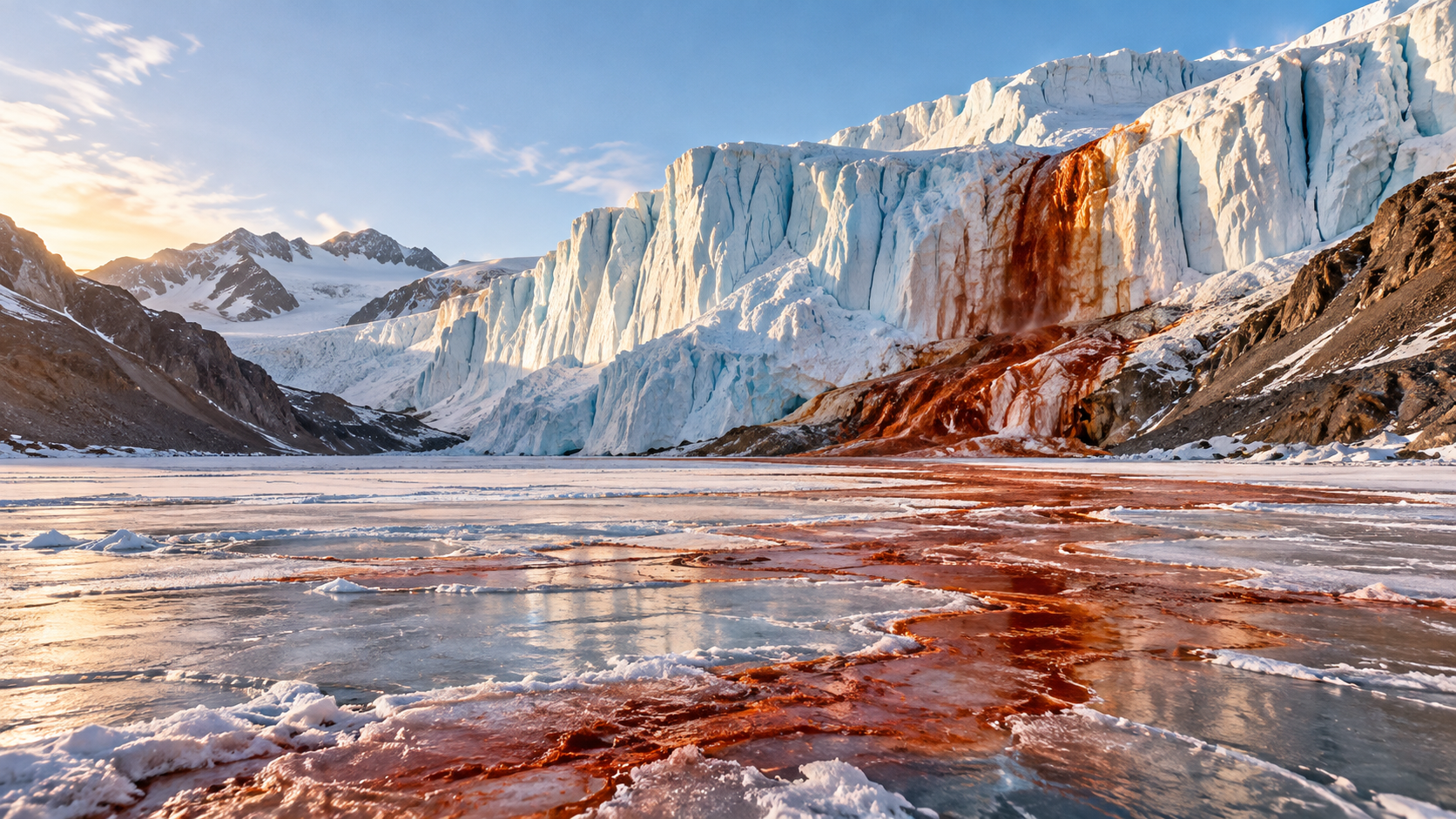
Blood Falls in Antarctica’s Taylor Valley seeps iron-rich brine from under Taylor Glacier. When it meets oxygen, the iron oxidizes and stains the ice red.
Every claim sourced
13 claims · 13 sources
0 disagreements logged
3 editorial corrections
Last checked Oct 8, 2026
The story
The numbered claim log below connects facts in this story to their sources.
In 1911, Australian geologist Thomas Griffith Taylor was exploring a valley in Antarctica when he came across something strange: a bright red stain running down the white face of a glacier. The valley and the glacier were later named after him, and the red stain became Blood Falls. Early explorers guessed the color came from red algae. The real cause is beneath the ice. Millions of years ago, seawater filled a fjord in the area. About 5 million years ago, it was cut off, and scientists estimate the pool under Taylor Glacier was sealed in roughly 1.5 to 2 million years ago. Over time, the trapped water became extremely salty, two to three times saltier than the ocean, and that salt keeps it from freezing even at about 19°F. The brine carries dissolved iron. Deep under the glacier there’s almost no oxygen, so the iron stays dissolved. When the brine seeps out at the glacier’s edge and touches the air, the iron oxidizes and leaves a rust-red stain on the ice. In 2023, Johns Hopkins researchers took a closer look. Using electron microscopes, they found the color comes from tiny iron-rich nanospheres, about 1/100 the size of a human red blood cell. Earlier studies missed them because they aren’t crystals. The brine isn’t sterile either. Researchers have found at least 17 types of microbes living in it, surviving with almost no oxygen. Scientists study them as a clue to how life might survive on other worlds, including Mars.
Last corrected: Oct 8, 2026.
Grew up near here?
Get the free state guide: every Hidden Current place in the region, with what you can still see and how to get there.
State guides are coming soon. Email signup is not available yet.
Watch the short documentary
Blood Falls: Antarctica’s Rust-Red Glacier
Claim log
| # | Claim | Sources | Status |
|---|---|---|---|
| 1 | Blood Falls is an iron-tainted saltwater outflow from Taylor Glacier onto West Lake Bonney in Taylor Valley, McMurdo Dry Valleys. |
| Sourced |
| 2 | Blood Falls was found in 1911 by Australian geologist Thomas Griffith Taylor. |
| Sourced |
| 3 | Early Antarctic explorers attributed the red color to red algae. |
| Sourced |
| 4 | Ferrous iron in the saltwater oxidizes on contact with atmospheric oxygen, forming ferric oxides. |
| Sourced |
| 5 | The water is linked to ancient seawater trapped about 5 million years ago. |
| Sourced |
| 6 | The subglacial pool was sealed roughly 1.5 to 2 million years ago. |
| Sourced |
| 7 | The brine is about two to three times saltier than mean ocean water. |
| Sourced |
| 8 | The brine temperature was about −7 °C (19 °F) in 2014 samples. |
| Sourced |
| 9 | Water samples contained at least 17 microbial types with almost no oxygen. |
| Sourced |
| 10 | The red color comes from tiny iron-rich nanospheres that oxidize. |
| Sourced |
| 11 | The nanospheres are about 1/100 the size of a human red blood cell. |
| Sourced |
| 12 | The nanospheres are not crystalline, so earlier methods did not detect them. |
| Sourced |
| 13 | The findings have implications for analyzing materials on Mars. |
| Sourced |
Disagreements logged
No approved disagreements are logged on this page yet.
Submit a disagreement
Disagree with a fact in this story? Submit a source-backed note for editorial review. It stays private until approved and does not automatically become a correction.
Sources
- Wikipedia
- hub.jhu.edu
Corrections
| # | Correction | Sources |
|---|---|---|
| 1 | The red color comes from iron-rich nanospheres that oxidize, not from a crystalline mineral as earlier studies assumed. |
|
| 2 | The red color is not from red algae, as early explorers believed, but from iron oxides. |
|
| 3 | The brine's age has two figures: seawater trapped about 5 million years ago, and the subglacial pool sealed about 1.5 to 2 million years ago. |
|
More Hidden Landscapes places
- The Desert Hidden Between These Mountains
- Lake Nyos: The Lake That Released a Deadly Cloud in One Night
- Ruby Falls: The Waterfall Hidden Inside Lookout Mountain
- Thor's Well ("the drainpipe of the Pacific")
- Lost Lake, Oregon: The Lake That Drains Into a Hole Every Summer
- Lost River, Indiana: The River That Disappears Underground