
Nature Took It BackHoutouwanShengshan Islandabandoned village
Houtouwan: The Chinese Fishing Village Swallowed by Green
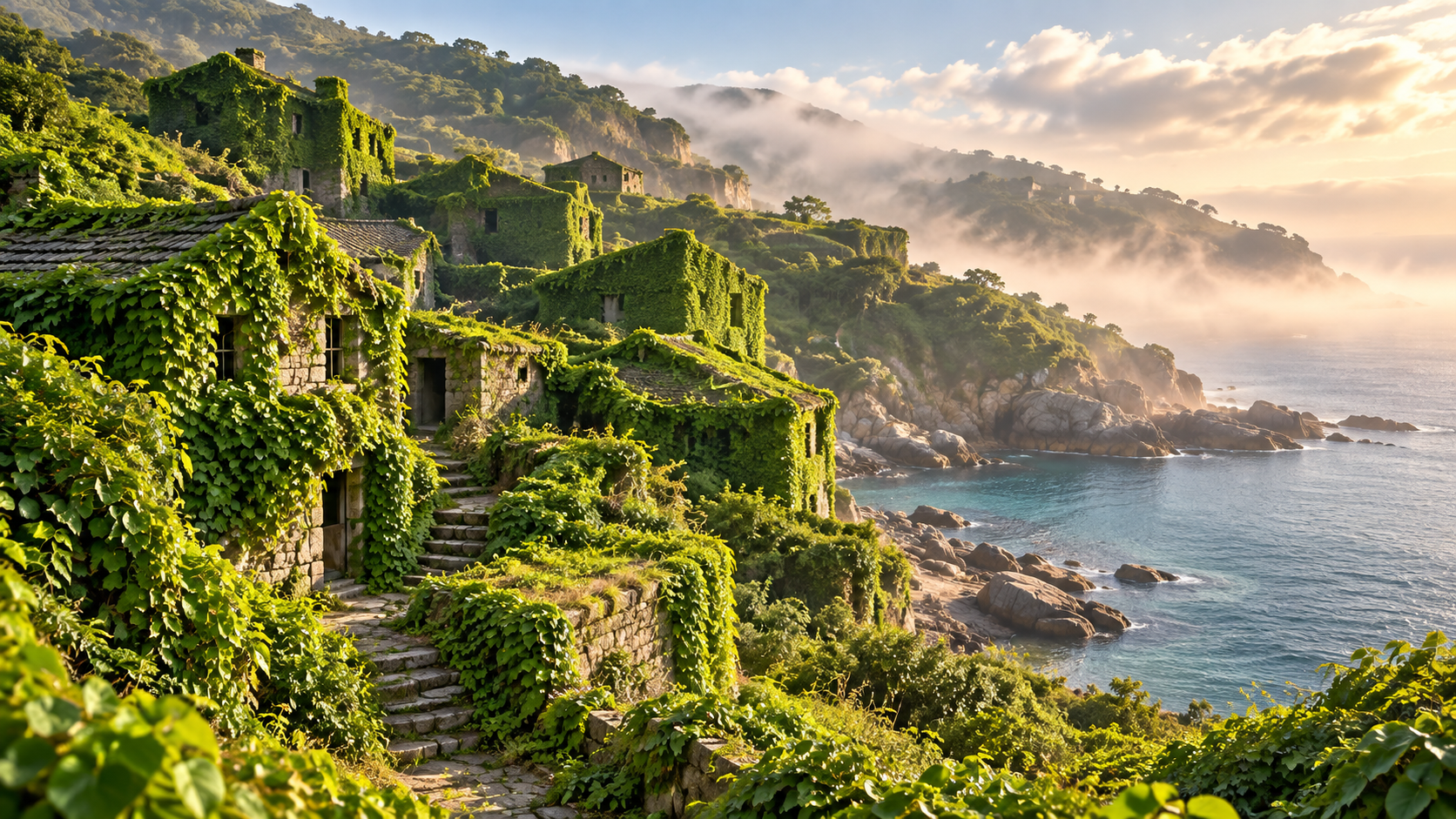
Houtouwan, a fishing village on China's Shengshan Island, emptied out through the 1990s. Today climbing vines cover its abandoned houses from wall to roof.
Every claim sourced
19 claims · 19 sources
0 disagreements logged
9 editorial corrections
Last checked Oct 6, 2026
The story
The numbered claim log below connects facts in this story to their sources.
On the northern coast of Shengshan Island, in an archipelago off China's eastern coast, a village of stone houses climbs a steep hillside above a small bay. Nearly every wall, roof and stairway is wrapped in thick green vines, so that the whole village looks as if it's been swallowed by the hill. This is Houtouwan, whose name means "back bay." It was settled in the 1950s as a fishing village, and it grew prosperous. At its height, it was home to more than 2,000 fishermen and their families, living in about 500 homes stacked up the slope. But the village had disadvantages that grew harder to live with. It was remote, poorly connected to the mainland, and short on schools and jobs. The small bay couldn't keep up with the needs of a growing fishing industry, and families began moving to the mainland in search of better work and education, as people did from many small Chinese villages in those years. The exodus picked up in the early 1990s, and by 1994 only a handful of people remained. In 2002, Houtouwan was officially depopulated and merged into a nearby village. With no one to cut them back, the plants moved in. Vines climbed the walls, crept across the roofs and filled the doorways and windows. Over the years, the empty houses turned green. In 2015, a set of photographs of the overgrown village spread across the internet, and Houtouwan suddenly became famous. Tourists started arriving in large numbers. Local officials were cautious at first, then built a viewing platform overlooking the village in 2017 and began charging admission to walk its paths. A few people still live in or around the village, and some now earn a living from the visitors, selling water and snacks to the tourists who come to photograph the green houses.
Last corrected: Oct 6, 2026.
Grew up near here?
Get the free state guide: every Hidden Current place in the region, with what you can still see and how to get there.
State guides are coming soon. Email signup is not available yet.
Watch the short documentary
Houtouwan: The Chinese Fishing Village Swallowed by Green
Claim log
| # | Claim | Sources | Status |
|---|---|---|---|
| 1 | Houtouwan is at 30°43′37″N 122°49′12″E |
| Sourced |
| 2 | The village was established in the 1950s and was once home to more than 2,000 fishermen and 500 homes |
| Sourced |
| 3 | By the 1990s, the population declined rapidly due to lack of connection to the mainland, education, and job opportunities |
| Sourced |
| 4 | Only a handful of people remained in the village by 1994, and by 2002 it had been depopulated, although in 2015 a few people were known to reside there |
| Sourced |
| 5 | Houtouwan is at 30.724012, 122.822604, about 40 miles from Shanghai |
| Sourced |
| 6 | The village was once inhabited by around 2,000 fishermen and their families |
| Sourced |
| 7 | In the early 1990s, as the small bay could not meet the growing fishing industry's needs, residents began migrating to the mainland |
| Sourced |
| 8 | Only a handful of residents remain |
| Sourced |
| 9 | Houtouwan was once home to more than 3,000 residents |
| Sourced |
| 10 | Residents started to move out in the 1990s, and the village was completely depopulated by 2002 |
| Sourced |
| 11 | In 2002, the village was officially depopulated and merged into a nearby village |
| Sourced |
| 12 | Photos of the village went viral in 2015 |
| Sourced |
| 13 | A viewing platform opened in 2017 for a ticket price of $3; visitors can hike the village for $8 |
| Sourced |
| 14 | Signs warn tourists about the danger of entering the deteriorating structures |
| Sourced |
| 15 | Houtouwan means "back bay" in Chinese, and Shengshan is one of the 400 islands in the Shengsi Archipelago |
| Sourced |
| 16 | Visitors can reach Shengshan Island by bus and ferry from Shanghai, or via Gouqi Island, which is connected by a bridge |
| Sourced |
| 17 | The few remaining residents act as guides and vendors |
| Sourced |
| 18 | Adult tickets are 60 RMB, children and seniors 30 RMB, with a recommended visit of 2–2.5 hours |
| Sourced |
| 19 | Houtouwan is approximately 64 kilometers east of Shanghai |
| Sourced |
Disagreements logged
No approved disagreements are logged on this page yet.
Submit a disagreement
Disagree with a fact in this story? Submit a source-backed note for editorial review. It stays private until approved and does not automatically become a correction.
Sources
- Wikipedia
- Atlas Obscura
- CNN Travel
- wral.com
- thebroadlife.com
- trip.com
- thedarkatlas.com
Corrections
| # | Correction | Sources |
|---|---|---|
| 1 | Residents did not leave in the early 2000s; they moved away through the 1990s, and only a handful remained by 1994 |
|
| 2 | The village was officially depopulated and merged into a nearby village in 2002 |
|
| 3 | Houtouwan is not entirely empty; a few people were known to reside there in 2015 |
|
| 4 | Sources disagree on peak population: more than 2,000 fishermen |
|
| 5 | Sources disagree on peak population: more than 3,000 residents |
|
| 6 | Sources disagree on the entrance fee: about $8 (50 yuan) |
|
| 7 | Sources disagree on the entrance fee: 60 RMB per adult in 2026 |
|
| 8 | Sources disagree on the distance from Shanghai: about 40 miles |
|
| 9 | Sources disagree on the distance from Shanghai: approximately 64 kilometers |
|
More Nature Took It Back places
- Abandoned amusement park outside New Orleans
- Craco Vecchia (old Craco), the "ghost town" of Basilicata
- Mallows Bay: The Ghost Fleet of World War I Ships in the Potomac
- Big Pit: The Welsh Coal Mine Where Ex-Miners Take You 300 Feet Down
- Kolmanskop: The Diamond Town the Namib Desert Is Swallowing
- Old Cahawba: Alabama's First Capital Lost to the Woods