
Nature Took It BackCahawbaAlabama historyghost town
Old Cahawba: Alabama's First Capital Lost to the Woods
Cahawba was Alabama's first permanent capital, where the Alabama and Cahaba rivers meet. Floods and lost status emptied it, and the woods took it back.
Every claim sourced
17 claims · 17 sources
0 disagreements logged
7 editorial corrections
Last checked Oct 6, 2026
The story
The numbered claim log below connects facts in this story to their sources.
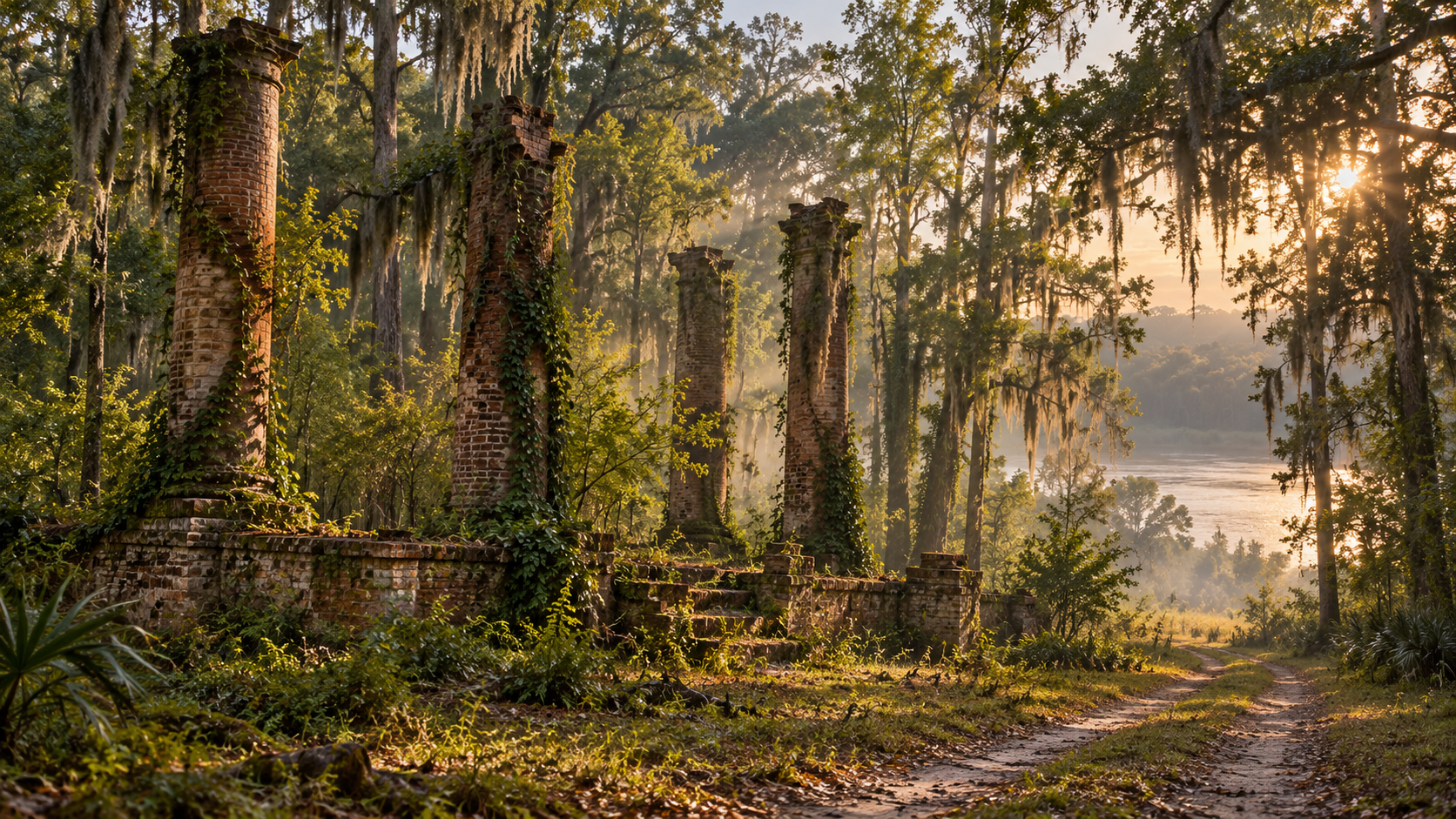
When Alabama became a state in 1819, it needed a capital. A commission meeting at St. Stephens, the old territorial capital, chose a site where the Cahaba River flows into the Alabama River. There was no town there yet. The site was an undeveloped gift from President James Monroe to the new state, so while a statehouse was being built, the legislature met in temporary quarters in Huntsville. By 1820, Cahawba was a working state capital, with a two-story brick statehouse and streets laid out on a grid. But the town sat low, right where two rivers met, and it had a reputation for flooding and for being unhealthy. Opponents of the location used that reputation against it. In 1825, a major flood damaged part of the statehouse. In January 1826, the legislature voted to move the capital to Tuscaloosa. Within weeks, Cahawba was nearly abandoned. But the town didn't die yet. It remained the seat of Dallas County, and as river traffic improved and cotton boomed, Cahawba came back to life in the 1840s and 1850s. Wealthy residents built fine homes. One of them, the Crocheron house, built around 1843, is remembered today by the brick columns that still stand. The Civil War, floods and the loss of rail service brought the town's second decline. In 1865, a major flood swept through it again, and in 1866 the legislature moved the county seat to nearby Selma. Businesses and families followed. Within 10 years, people were dismantling the houses and hauling them away. By 1900, Cahawba was a ghost town. What remained was taken back by the land. Trees grew up in the streets and over foundations, and much of the old capital disappeared under the forest. In 1973, the site was added to the National Register of Historic Places, and today the Alabama Historical Commission preserves it as Old Cahawba Archaeological Park. Visitors walk the old streets past cemeteries, columns and foundations of the town that was once the capital of Alabama.
Last corrected: Oct 6, 2026.
Grew up near here?
Get the free Alabama guide: every Hidden Current place in the region, with what you can still see and how to get there.
State guides are coming soon. Email signup is not available yet.
Watch the short documentary
Old Cahawba: Alabama's First Capital Lost to the Woods
Claim log
| # | Claim | Sources | Status |
|---|---|---|---|
| 1 | Cahaba is listed on the National Register on May 8, 1973 (#73000341), 11 miles southwest of Selma at the junction of the Cahaba and Alabama Rivers, at 32°19′07″N 87°05′57″W |
| Sourced |
| 2 | Cahaba, also spelled Cahawba, was the first permanent state capital of Alabama from 1820 to 1825, and the county seat of Dallas County until 1866 |
| Sourced |
| 3 | The legislature moved the capital to Tuscaloosa in 1826; after another major flood in 1865, the county seat moved to Selma |
| Sourced |
| 4 | A commission was formed at the old territorial capital of St. Stephens on February 13, 1818, to select the site for the state capital |
| Sourced |
| 5 | Alabama's constitutional convention took temporary accommodations in Huntsville until a statehouse could be built |
| Sourced |
| 6 | The Alabama Historical Commission maintains the site as Old Cahawba Archeological Park |
| Sourced |
| 7 | Cahawba was an undeveloped town site, a gift from President James Monroe to the new state |
| Sourced |
| 8 | Cahawba's low elevation gave it a reputation for flooding and an unhealthy atmosphere, which opponents used to move the capital to Tuscaloosa in 1826; within weeks Cahawba was nearly abandoned |
| Sourced |
| 9 | In 1865 a flood inundated the town, in 1866 the county seat was removed to Selma, and within 10 years houses were being dismantled and moved |
| Sourced |
| 10 | In January 1826, the legislature voted to relocate the seat of government to Tuscaloosa |
| Sourced |
| 11 | Old Cahawba Archeological Park was added to the National Register of Historic Places in 1973 |
| Sourced |
| 12 | In 1825, a major flood destroyed a portion of the statehouse |
| Sourced |
| 13 | The territorial capital was at St. Stephens in 1817, the state organizing convention was held in Huntsville in 1819, and the first permanent capital was designated in 1820 as Cahaba |
| Sourced |
| 14 | Cahaba boomed again during the 1840s and 1850s; the Civil War, floods, and the loss of rail transportation produced a decline, and by 1900 it had become a ghost town |
| Sourced |
| 15 | The Crocheron Columns are all that remain of the Crocheron house, built around 1843 |
| Sourced |
| 16 | From Selma, take Highway 22 west for 9 miles, turn left on County Road 9, follow it 5 miles, then turn left on County Road 2 into the park |
| Sourced |
| 17 | Old Cahawba Archaeological Park is open from 9:00 a.m. to 5:00 p.m. daily |
| Sourced |
Disagreements logged
No approved disagreements are logged on this page yet.
Submit a disagreement
Disagree with a fact in this story? Submit a source-backed note for editorial review. It stays private until approved and does not automatically become a correction.
Sources
- Wikipedia
- cahawba.com
- abandonedalabama.com
- WorldAtlas
- alabamalegacy.org
- exploresouthernhistory.com
- islands.com
Corrections
| # | Correction | Sources |
|---|---|---|
| 1 | Cahawba was Alabama's first permanent state capital, not its first capital; St. Stephens was the territorial capital and Huntsville hosted the 1819 convention |
|
| 2 | Cahawba was not abandoned immediately after losing the capital; it boomed again in the 1840s and 1850s before declining |
|
| 3 | Sources disagree on the years Cahawba served as capital: 1820 to 1825 |
|
| 4 | Sources disagree on the years Cahawba served as capital: 1820 to 1826 |
|
| 5 | Sources disagree on the years Cahawba served as capital: 1819 to 1826 |
|
| 6 | Claims that Cahawba was built on the ruins of the Native town of Mabila are not verified; Mabila's location has not been confirmed |
|
| 7 | One source states Cahawba was built on top of Mabila |
|
More Nature Took It Back places
- Abandoned amusement park outside New Orleans
- Craco Vecchia (old Craco), the "ghost town" of Basilicata
- Mallows Bay: The Ghost Fleet of World War I Ships in the Potomac
- Big Pit: The Welsh Coal Mine Where Ex-Miners Take You 300 Feet Down
- Kolmanskop: The Diamond Town the Namib Desert Is Swallowing
- Houtouwan: The Chinese Fishing Village Swallowed by Green