
Nature Took It Backshipwrecksship graveyardwooden ships
Mallows Bay: The Ghost Fleet of World War I Ships in the Potomac, Maryland
In a quiet bay of the Potomac, more than 100 burned World War I steamships still rise from the water, now overgrown with trees and full of wildlife.
Every claim sourced
17 claims · 17 sources
0 disagreements logged
0 editorial corrections
Last checked Oct 2, 2026
The story
The numbered claim log below connects facts in this story to their sources.
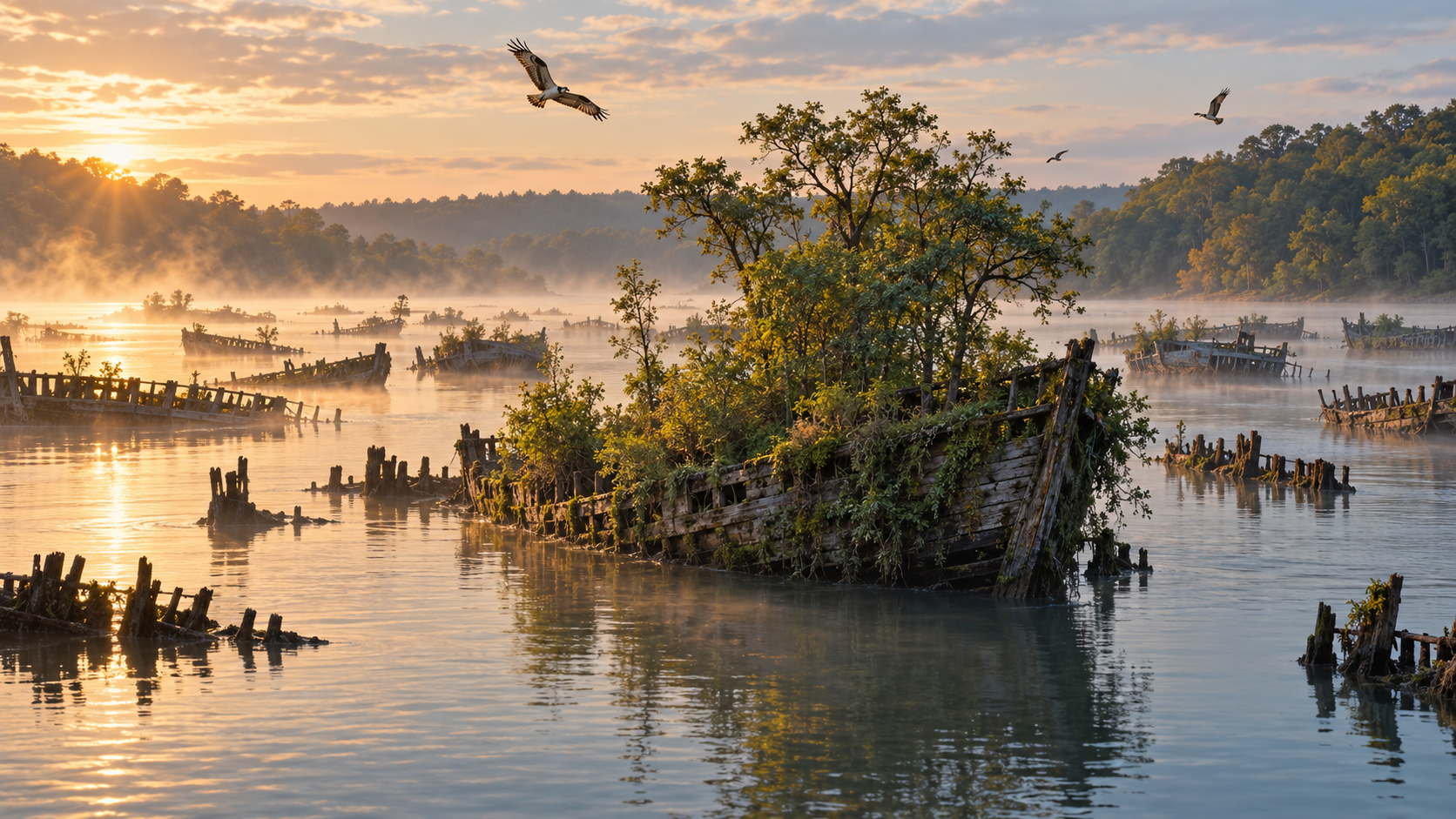
When the United States entered World War I in 1917, German U-boats were sinking Allied cargo ships faster than they could be replaced. The government's answer was to build a fleet of its own, fast. Steel was scarce, so the new Emergency Fleet Corporation turned to wood. The plan called for 1,000 wooden steamships, cheap enough and quick enough to build faster than the submarines could sink them. Shipyards sprang up across the country, more than 40 of them in 17 states. But building an ocean fleet out of wood proved harder than promised. Critics charged that the ships were badly designed, poorly built, and leaked. The program fell far behind schedule. By the time the war ended in November 1918, not one of the wooden steamships had delivered cargo to a European port. After the war, the ships were worse than useless. Steel ships were available again, and nobody wanted slow, leaky wooden freighters. In 1922, the government sold hundreds of them to the Western Marine and Salvage Company, which towed them up the Potomac to strip out their engines, boilers and metal. That left the wooden hulls, and the company decided to get rid of them by fire. On the morning of November 7, 1925, 31 ships were lashed together with steel cables and set ablaze in the river. The fire burned for hours, and the flames could be seen for miles. It was one of the largest single burnings of ships in U.S. history. The burned-out hulls were hauled into Mallows Bay, a shallow cove on the Maryland shore, and left there. By 1929, 169 ships had been brought into the bay. During World War II, with metal in short supply again, the government hired Bethlehem Steel to go back for the iron still left in more than 100 wrecks. Bethlehem dug a large basin and sealed it off with earthen berms. But the work proved too difficult and too expensive, and it stopped in 1944. More than 100 vessels were left where they lay. Then nature took over. Soil built up inside the hulls, and trees took root, turning some wrecks into small floating forests. Fish, beavers, ospreys, bald eagles and herons moved in. Other abandoned vessels joined the fleet over the years, including the steel ferry Accomac, left at the edge of the bay around 1973 after a fire. Today the bay holds about 200 known vessels spanning centuries of American shipbuilding, often called the largest shipwreck fleet in the Western Hemisphere. In 2015, Mallows Bay was listed on the National Register of Historic Places. On September 3, 2019, it became the heart of the Mallows Bay–Potomac River National Marine Sanctuary, the first new national marine sanctuary in nearly two decades. The ships built to win a war that never needed them are now protected, and some of them have trees growing out of them.
Last corrected: no editorial corrections on this page yet.
Grew up near here?
Get the free Maryland guide: every Hidden Current place in the region, with what you can still see and how to get there.
State guides are coming soon. Email signup is not available yet.
Watch the short documentary
Mallows Bay: The Ghost Fleet of World War I Ships in the Potomac, Maryland
Claim log
| # | Claim | Sources | Status |
|---|---|---|---|
| 1 | Mallows Bay is at 38.472611, -77.268583; NRHP April 24, 2015; sanctuary September 3, 2019; 18 sq mi; 0.8-mi trail; "largest shipwreck fleet" |
| Sourced |
| 2 | The boat launch is at 38.46897, -77.26362 |
| Sourced |
| 3 | The boat launch is at 38.46897, -77.26362 |
| Sourced |
| 4 | The launch is open 5:30 a.m. to dusk year-round; the Accomac was abandoned around 1973 |
| Sourced |
| 5 | Groups of 10 or more must pre-register |
| Sourced |
| 6 | The ships were built to counter U-boats; there are more than 100 steamships; they came from 40+ yards in 17 states; it was the first sanctuary since 2000 |
| Sourced |
| 7 | The ships were built to counter U-boats; there are more than 100 steamships; they came from 40+ yards in 17 states; it was the first sanctuary since 2000 |
| Sourced |
| 8 | 1,000 ships were planned; the program was criticized; 169 ships were in the bay by 1929; at least 152 were EFC ships |
| Sourced |
| 9 | No ship reached Europe with cargo |
| Sourced |
| 10 | On November 7, 1925, 31 ships were lashed together and burned, visible for miles |
| Sourced |
| 11 | Western Marine and Salvage bought the ships |
| Sourced |
| 12 | Bethlehem Steel's contract began in 1942 and was halted in September 1944 |
| Sourced |
| 13 | Bethlehem built a basin and berms |
| Sourced |
| 14 | Wildlife lives among the wrecks |
| Sourced |
| 15 | Wildlife lives among the wrecks |
| Sourced |
| 16 | The bay holds about 200 known vessels |
| Sourced |
| 17 | Some wrecks have become floating forests |
| Sourced |
Disagreements logged
No approved disagreements are logged on this page yet.
Submit a disagreement
Disagree with a fact in this story? Submit a source-backed note for editorial review. It stays private until approved and does not automatically become a correction.
Sources
- Wikipedia
- Maryland Department of Natural Resources
- HowsYourRiver
- HMDB
- Navy Times
- NOAA
- WAMU
- U.S. Maritime Administration
- Visit Maryland
- Arlington Magazine
Corrections
No editorial corrections are logged on this page yet.
Hidden Current within 100 miles
More Nature Took It Back places
- Abandoned amusement park outside New Orleans
- Craco Vecchia (old Craco), the "ghost town" of Basilicata
- Big Pit: The Welsh Coal Mine Where Ex-Miners Take You 300 Feet Down
- Kolmanskop: The Diamond Town the Namib Desert Is Swallowing
- Old Cahawba: Alabama's First Capital Lost to the Woods
- Houtouwan: The Chinese Fishing Village Swallowed by Green