
How It Really WorksMaeslant BarrierNetherlandsengineering
Maeslant Barrier: The Giant Gates That Protect Rotterdam
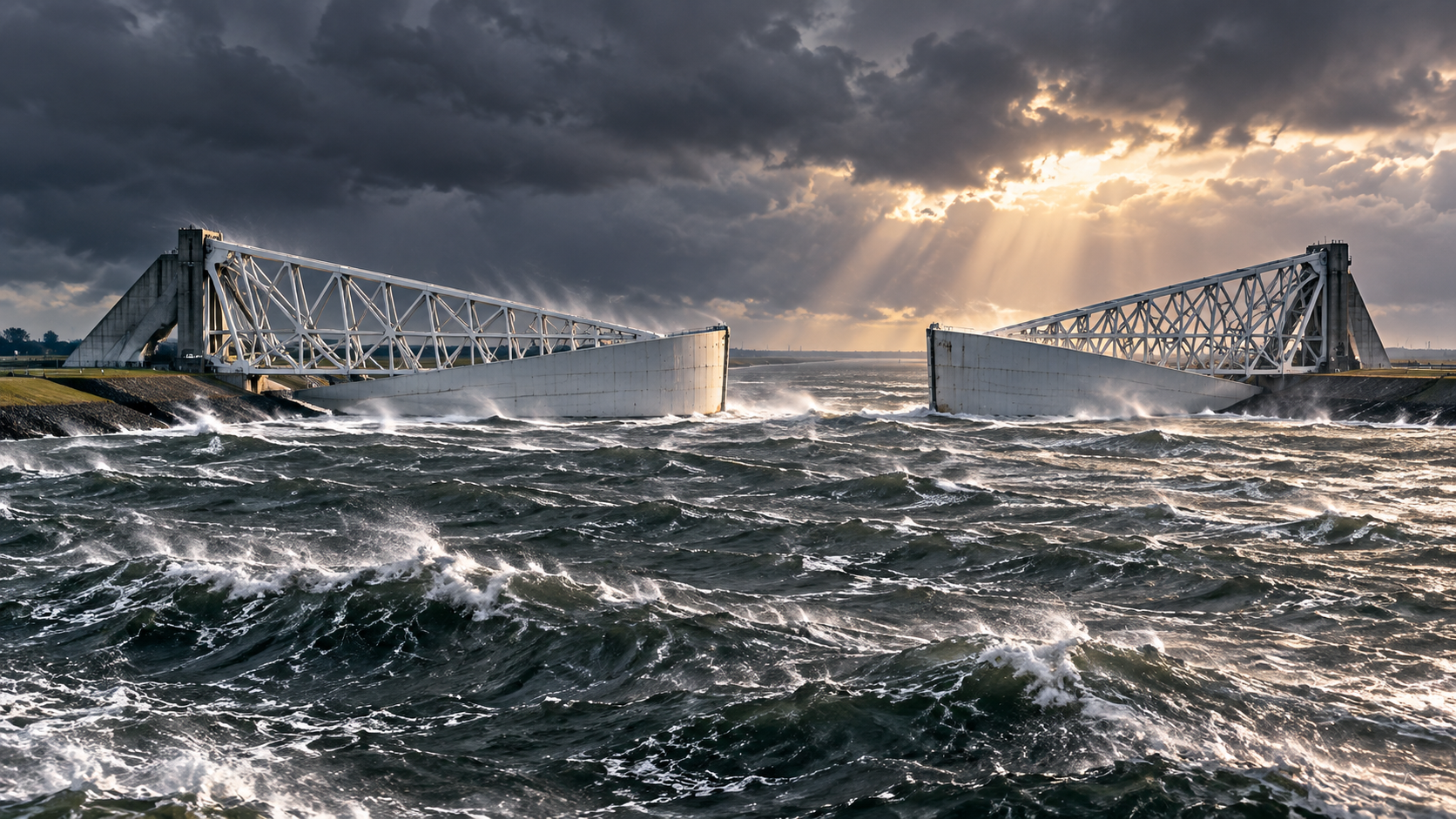
Near Rotterdam, the Maeslant Barrier's two 210-meter steel gates wait in dry docks. In a major storm surge, they swing out to seal a 360-meter channel.
1 claim needs sources
18 claims · 17 sources
0 disagreements logged
6 editorial corrections
Last checked Oct 6, 2026
The story
The numbered claim log below connects facts in this story to their sources.
In 1953, a massive North Sea storm surge overwhelmed the Netherlands' coastal defenses, killing thousands of people. The country answered with the Delta Works, a decades-long program of dams, dikes and barriers to hold back the sea. The last major piece was built to guard the Nieuwe Waterweg, the waterway connecting the Port of Rotterdam, one of the busiest ports in the world, to the North Sea. The problem was that the waterway couldn't simply be dammed. Ships needed to pass through freely almost all the time. So engineers designed a barrier that would stay out of the way until it was needed. Construction ran from 1991 to 1997, at a cost of about €450 million, and Queen Beatrix opened the Maeslant Barrier on May 10, 1997. The barrier has two huge curved steel gates, one on each bank. Each is 210 meters long and 22 meters high, and each is held by a steel truss arm 237 meters long, connected to the shore by an enormous ball joint 10 meters across. In normal weather, the gates rest in dry docks along the banks, leaving the full 360-meter width of the waterway open to ships. When a computer system forecasts that the water near Rotterdam will rise more than 3 meters above NAP, the Dutch reference sea level, the barrier closes on its own. Ships are warned hours in advance, and traffic on the waterway stops before closing begins. The dry docks are flooded, the hollow gates float, and the arms swing them out into the channel until they meet in the middle. Then the gates take on water and sink to the bottom, sealing the waterway within about two hours. A Rijkswaterstaat team stands by to monitor the process and step in manually if needed. The barrier is built to hold back a storm surge of up to 5 meters above NAP. It's tested every year, but real storm closures are rare. On November 8, 2007, during a season when its trigger level had been temporarily lowered to 2.6 meters for testing, it closed for a storm for the first time, and for the first time since 1976 the entire Dutch coast was sealed against the sea. In December 2023, Storm Pia pushed a surge high enough to close it again.
Last corrected: Oct 6, 2026.
Grew up near here?
Get the free state guide: every Hidden Current place in the region, with what you can still see and how to get there.
State guides are coming soon. Email signup is not available yet.
Watch the short documentary
Maeslant Barrier: The Giant Gates That Protect Rotterdam
Claim log
| # | Claim | Sources | Status |
|---|---|---|---|
| 1 | The Maeslantkering was constructed from 1991 to 1997 |
| Sourced |
| 2 | The Maeslantkering has two 210-metre long barrier gates, with two 237-metre long steel trusses holding each; when closed, it protects the entire 360-metre width of the Nieuwe Waterweg |
| Sourced |
| 3 | On 10 May 1997, after six years of construction, Queen Beatrix opened the barrier |
| Sourced |
| 4 | When a storm surge of 3 metres above normal sea level is anticipated in Rotterdam, the barrier is closed automatically |
| Sourced |
| 5 | During the evening of 8 November 2007, the barrier was closed due to a storm surge for the first time |
| Sourced |
| 6 | For the 2007 storm season, the closing threshold was lowered from 3.0 m above NAP to 2.6 m |
| Sourced |
| 7 | The Maeslant Barrier closes fully automatically when the water level is predicted to rise more than three meters above NAP near Rotterdam or more than 2.9 m above NAP near Dordrecht |
| Sourced |
| 8 | Each gate is 210 m wide, 22 m high and 15 m deep; when the barrier closes, the gates fill with water and sink to the bottom within two hours |
| Sourced |
| 9 | A Rijkswaterstaat operational team is on hand to monitor the automatic process and intervene manually if necessary |
| Sourced |
| 10 | The barrier was closed for the first time in 2007 |
| Sourced |
| 11 | The barrier closed in December 2023 during Storm Pia, described as its first closure during a storm in 26 years |
| Sourced |
| 12 | The barrier is designed to withstand a storm surge of five metres above NAP and is tested annually |
| Sourced |
| 13 | The construction of the barrier cost 450 million euro |
| Sourced |
| 14 | The gates swing closed using 10-m diameter ball joints |
| Sourced |
| 15 | The Keringhuis visitor center is at Vierhavensstraat 9, 3151 XA Hoek van Holland |
| Sourced |
| 16 | The Keringhuis is at 51.956775 N, 4.166988 E |
| Sourced |
| 17 | Ships are warned four hours before closing, and traffic stops two hours before closing |
| Sourced |
| 18 | In 2007, with the | Source needed | Needs source |
Disagreements logged
No approved disagreements are logged on this page yet.
Submit a disagreement
Disagree with a fact in this story? Submit a source-backed note for editorial review. It stays private until approved and does not automatically become a correction.
Sources
- Wikipedia
- Rijkswaterstaat
- Water News Europe
- allynintl.com
- visitinfrastructure.com
- peakvisor.com
- en-academic.com
Corrections
| # | Correction | Sources |
|---|---|---|
| 1 | The barrier does not close without any human oversight; a Rijkswaterstaat team monitors the automatic process and can intervene manually |
|
| 2 | Sources disagree on the first storm closure: 8 November 2007, during a season when the threshold was temporarily lowered to 2.6 m |
|
| 3 | Sources disagree on the first storm closure: December 2023 during Storm Pia, described as the first in 26 years |
|
| 4 | Sources disagree on how far in advance ships are notified: four hours before closing |
|
| 5 | Sources disagree on how far in advance ships are notified: eight hours before closure |
|
| 6 | The channel the barrier seals is 360 metres wide, about 1,180 feet |
|