
Underground & Hiddencold warmilitary baseunderground
The Military Base Buried Beneath The Ice
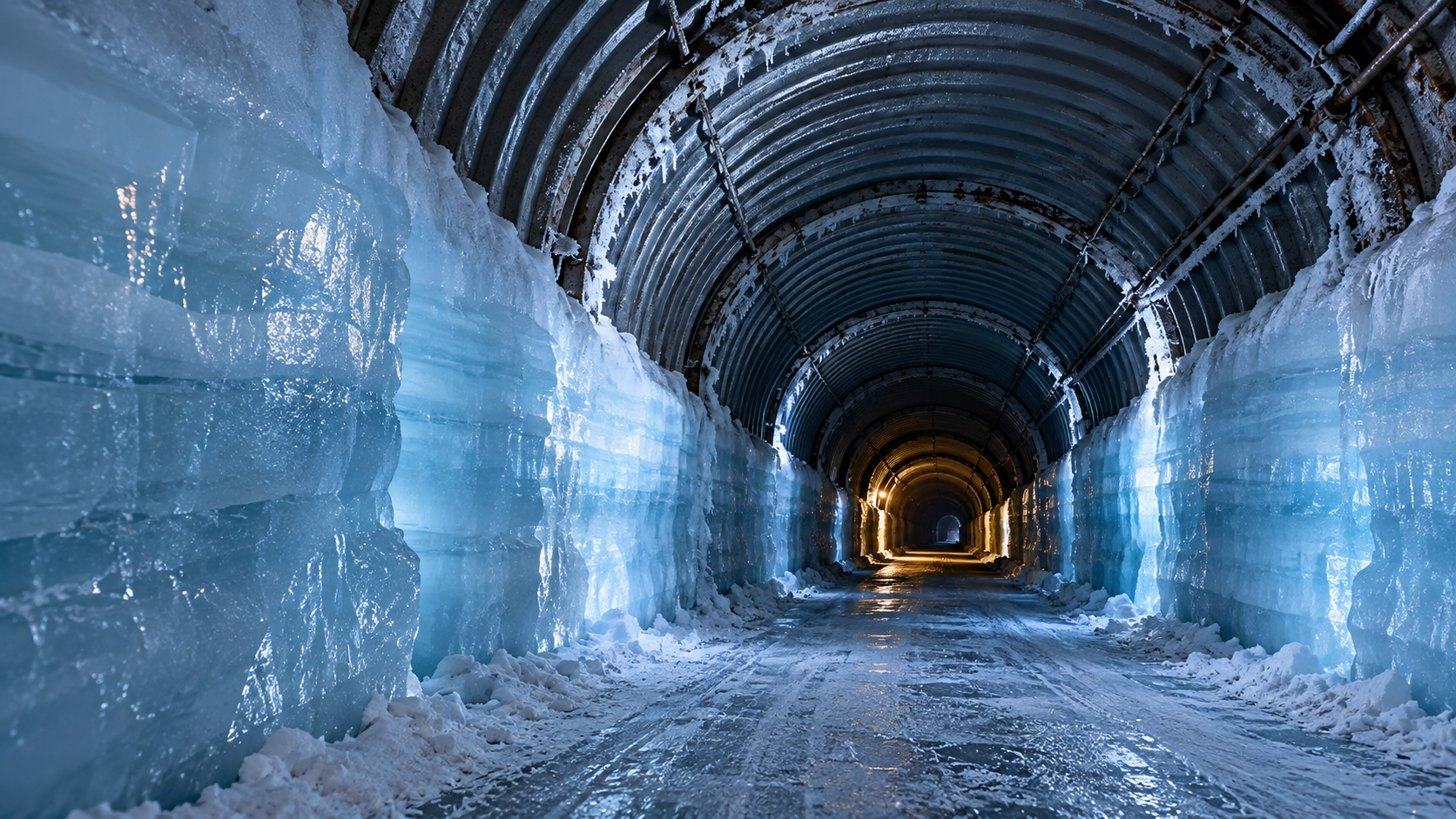
In 1959 the U.S. Army built a nuclear-powered base inside the Greenland ice sheet. Abandoned in 1967, Camp Century now lies about 100 feet under the ice.
Every claim sourced
19 claims · 19 sources
0 disagreements logged
1 editorial correction
Last checked Oct 2, 2026
The story
The numbered claim log below connects facts in this story to their sources.
In 1959, the U.S. Army began building a base inside the Greenland Ice Sheet. Crews cut long trenches into the ice, built barracks, labs and support buildings inside them, and roofed them over. The camp ran on a portable nuclear reactor, carried in piece by piece. Publicly, Camp Century was a polar research station, and the science was real. Researchers there drilled some of the first deep ice cores, and in 1966 a thermal drill at the camp bored all the way through the ice sheet. Those cores are still cited in climate research today. But the camp had a second purpose. It was the test site for Project Iceworm, a secret Army plan to build about 2,500 miles of tunnels under the ice and hide hundreds of nuclear missiles aimed at the Soviet Union. The Army didn't immediately tell the Danish government, which governed Greenland, what the project really was. The ice won. A glacier isn't solid rock. It moves and flows, and the walls of Camp Century kept creeping inward, squeezing the tunnels and forcing crews into constant repair work. Problems with the reactor led to its removal after less than three years of operation. Project Iceworm was judged unworkable, and in 1967 the Army abandoned Camp Century completely. The Army left most of the camp behind: buildings, fuel, sewage, and low-level radioactive waste from the reactor's cooling system. The assumption was that snowfall would bury all of it permanently. For decades, it did. Year after year, snow piled up on top of the camp until it lay about 100 feet down. The full story of Project Iceworm didn't come out until the 1990s, when declassified documents and a Danish government inquiry brought it to light. Then, in April 2024, a NASA team flying about 150 miles east of Pituffik Space Base was testing a new radar instrument, trying to map the bedrock beneath the ice. Instead, the radar returned the outline of Camp Century's buried structures in more detail than had ever been seen. "We were looking for the bed of the ice and out pops Camp Century," one of the scientists said. The ice sheet is now thinning. Researchers are working to estimate when melting could bring the camp and its waste back toward the surface, and NASA has projected surface ice loss around the site by 2090. A base built to hide from the world, and left to be buried forever, may eventually come back up.
Last corrected: Oct 3, 2026.
Grew up near here?
Get the free state guide: every Hidden Current place in the region, with what you can still see and how to get there.
State guides are coming soon. Email signup is not available yet.
Watch the short documentary
The Military Base Buried Beneath The Ice
Claim log
| # | Claim | Sources | Status |
|---|---|---|---|
| 1 | Camp Century is at 77°10′N 61°08′W and was in use 1959–1967 |
| Sourced |
| 2 | A climate-monitoring program has run at the site since 2017 |
| Sourced |
| 3 | A climate-monitoring program has run at the site since 2017 |
| Sourced |
| 4 | The camp was advertised as a research station and collected the first ice core samples |
| Sourced |
| 5 | A drill went through the ice cap to bedrock in 1966 |
| Sourced |
| 6 | Denmark was not told of the camp's real purpose |
| Sourced |
| 7 | Project Iceworm planned about 2,500 miles of tunnels |
| Sourced |
| 8 | Project Iceworm planned 600 missiles |
| Sourced |
| 9 | The walls and snow kept moving and squeezed the tunnels |
| Sourced |
| 10 | The reactor was carried in pieces and operated for 33 months |
| Sourced |
| 11 | Waste was abandoned on the assumption it would stay entombed |
| Sourced |
| 12 | The camp lies about 100 feet beneath the ice |
| Sourced |
| 13 | The Danish Parliament investigation in 1997 made Iceworm public |
| Sourced |
| 14 | A 2024 NASA radar flight imaged the camp |
| Sourced |
| 15 | "We were looking for the bed of the ice and out pops Camp Century" |
| Sourced |
| 16 | Researchers are studying when the camp could be re-exposed |
| Sourced |
| 17 | Researchers are studying when the camp could be re-exposed |
| Sourced |
| 18 | NASA projected surface ice loss around the site by 2090 |
| Sourced |
| 19 | NASA projected surface ice loss around the site by 2090 |
| Sourced |
Disagreements logged
No approved disagreements are logged on this page yet.
Submit a disagreement
Disagree with a fact in this story? Submit a source-backed note for editorial review. It stays private until approved and does not automatically become a correction.
Sources
- Wikipedia
- Geological Survey of Denmark and Greenland
- Smithsonian
- Space.com
- The Register
- History.com
- Yahoo News
- CBS News
- NASA
- NASA JPL
- NASA Earth Observatory
Corrections
| # | Correction | Sources |
|---|---|---|
| 1 | Camp Century lies about 100 feet beneath the ice, not 100 meters |
|