
Underground & HiddenWieliczkaPolandsalt mine
Wieliczka: The Cathedral Carved From Salt
Poland’s Wieliczka Salt Mine runs 327 metres deep. Miners carved chapels, altars and statues from rock salt, including St. Kinga’s Chapel 101 metres down.
Every claim sourced
17 claims · 17 sources
0 disagreements logged
3 editorial corrections
Last checked Oct 8, 2026
The story
The numbered claim log below connects facts in this story to their sources.
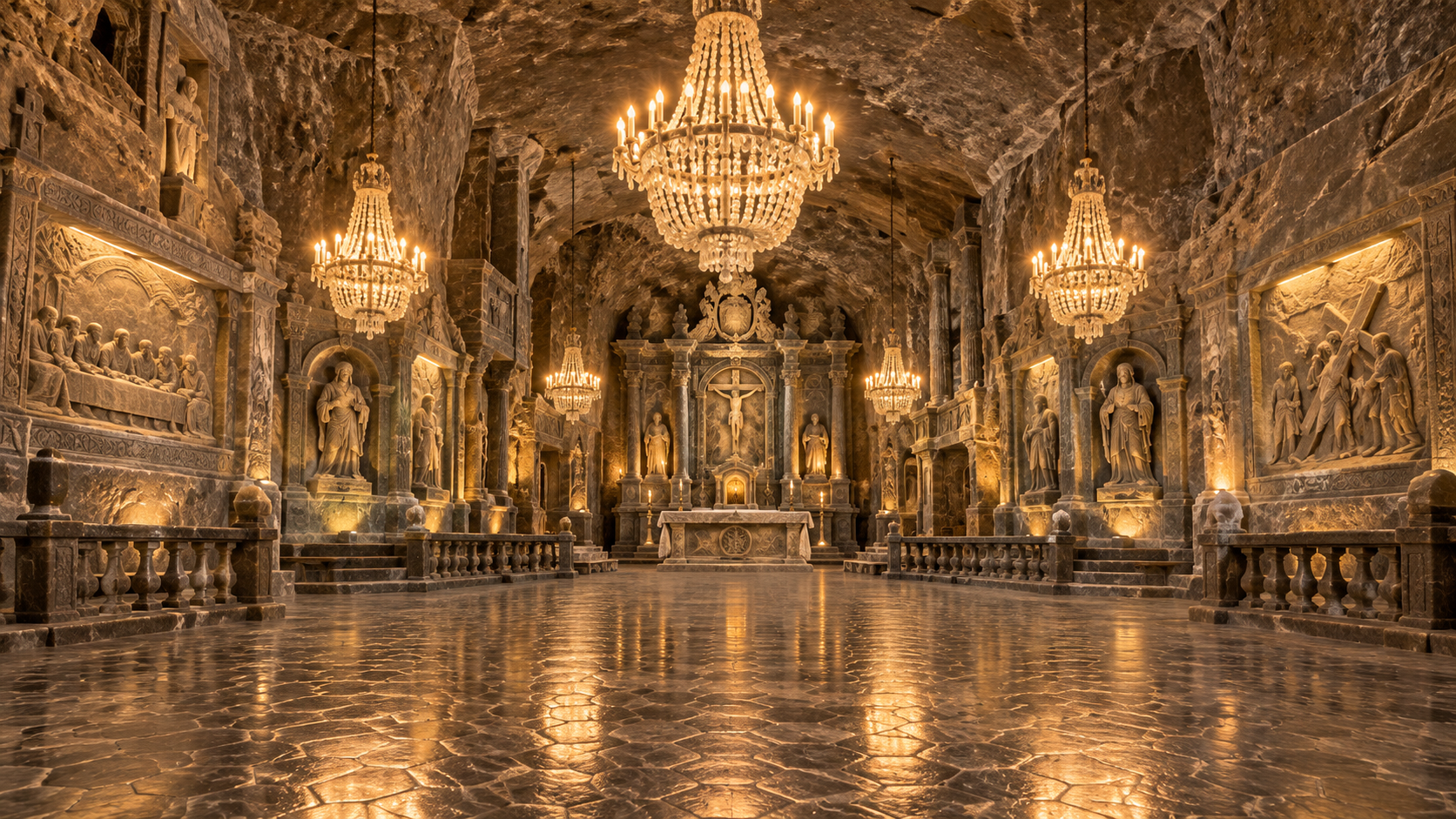
Southeast of Kraków, the town of Wieliczka sits on top of a vast underground world. People collected brine here long before anyone dug. The first written record dates to 1044. From the 13th century on, miners followed the salt deeper into the ground. Over centuries they cut more than 287 km of passages, reaching 327 meters below the surface. Salt from Wieliczka was valuable enough to help fund the Polish crown. Miners spent their lives underground, and they made the space their own. They carved statues from the gray-green rock salt and cut chapels where they could pray before their shifts. Four chapels were carved in all. The largest is St. Kinga’s Chapel, about 101 meters underground. It’s 54 meters long, 18 meters wide and 12 meters high, and everything in it is salt: the floor, the altar, the railings, wall reliefs of scenes from the New Testament, including a version of Leonardo’s Last Supper, and even the chandeliers, made from salt crystals. It was carved by Antoni Wyrodek and the brothers Józef and Tomasz Markowski. Mass is still celebrated there on Sundays. Over the centuries, visitors included Nicolaus Copernicus, Johann Wolfgang von Goethe and Frédéric Chopin. In 1978, Wieliczka was on UNESCO’s very first World Heritage list. Commercial mining ended in 1996, after salt prices fell and flooding threatened the mine. Today about 1.2 million people a year walk through its salt chambers.
Last corrected: Oct 8, 2026.
Grew up near here?
Get the free state guide: every Hidden Current place in the region, with what you can still see and how to get there.
State guides are coming soon. Email signup is not available yet.
Watch the short documentary
Wieliczka: The Cathedral Carved From Salt
Claim log
| # | Claim | Sources | Status |
|---|---|---|---|
| 1 | Wieliczka Salt Mine coordinates are 49°58′45″N, 20°3′50″E. |
| Sourced |
| 2 | The mine is in Wieliczka, near Kraków, southern Poland. |
| Sourced |
| 3 | The first documentation of brine collection dates from 1044. |
| Sourced |
| 4 | The mine was excavated from the 13th century. |
| Sourced |
| 5 | The mine is 327 m deep with passages extending over 287 km. |
| Sourced |
| 6 | The mine has four chapels carved from rock salt. |
| Sourced |
| 7 | Miners carved numerous statues, and contemporary artists added newer works. |
| Sourced |
| 8 | St. Kinga's Chapel is about 101 meters underground. |
| Sourced |
| 9 | St. Kinga's Chapel is 54 m long, 12 m high, and 18 m wide. |
| Sourced |
| 10 | The chapel is lit by chandeliers made of salt crystals. |
| Sourced |
| 11 | The chapel was carved by Antoni Wyrodek and the brothers Józef and Tomasz Markowski. |
| Sourced |
| 12 | Wyrodek carved a Last Supper inspired by a Leonardo fresco. |
| Sourced |
| 13 | Holy Mass is celebrated every Sunday and on Christmas Eve at midnight. |
| Sourced |
| 14 | Notable visitors include Copernicus, Goethe, and Chopin. |
| Sourced |
| 15 | The mine was inscribed on the original UNESCO World Heritage list in 1978. |
| Sourced |
| 16 | Commercial production ended in 1996 due to falling salt prices and mine flooding. |
| Sourced |
| 17 | About 1.2 million people visit per year. |
| Sourced |
Disagreements logged
No approved disagreements are logged on this page yet.
Submit a disagreement
Disagree with a fact in this story? Submit a source-backed note for editorial review. It stays private until approved and does not automatically become a correction.
Sources
- Wikipedia
- aleteia.org
Corrections
| # | Correction | Sources |
|---|---|---|
| 1 | The carvings are not only by miners: contemporary artists also added newer works. |
|
| 2 | Wieliczka is no longer a working mine: commercial production ended in 1996. |
|
| 3 | The number of chapels carved from rock salt is four. |
|