
Isolated PlacesGuoliang Tunnelcliff roadcarved by hand
Guoliang Tunnel: The Cliff Road Villagers Carved by Hand
In 1972, villagers in China's Taihang Mountains began carving a road through a cliff, mostly by hand. In 1977, the Guoliang Tunnel opened to traffic.
Every claim sourced
19 claims · 19 sources
0 disagreements logged
9 editorial corrections
Last checked Oct 6, 2026
The story
The numbered claim log below connects facts in this story to their sources.
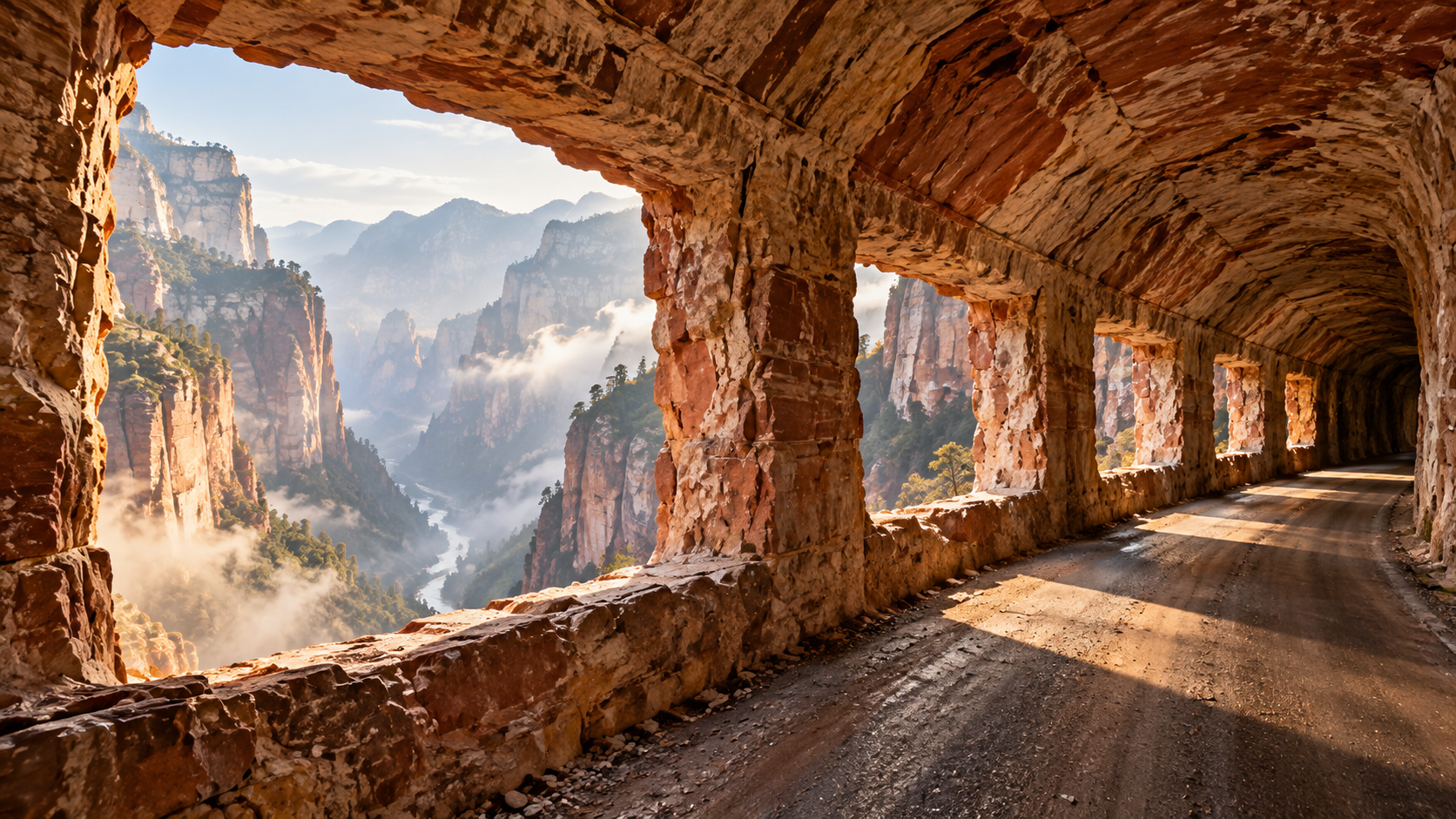
High in the Taihang Mountains of Henan Province, the village of Guoliang sits on a plateau surrounded by sheer cliffs. For generations, the only way in or out was a steep, narrow stairway cut into the mountainside, known as the "Sky Ladder," a treacherous climb for anyone carrying goods to market or bringing in supplies. In 1972, the villagers decided to change that themselves. Led by Shen Mingxin, they made a plan to carve a road through and along the face of the cliff. According to several accounts, they had asked for a government-built road and been told it wasn't worth it for a village of about 300 people. To raise money, they sold their goats and the yams they grew, and used the money to buy steel hammers and drills. Thirteen villagers led the work. With no power tools or heavy machinery, they cut into the rock mostly by hand, swinging hammers against chisels, and used explosives to blast away sections of the cliff. Openings were cut into the tunnel's outer wall as they went, so the rubble could be pushed out over the edge. At the hardest stage, they advanced about one meter every three days. Over five years, they broke about 4,000 hammers, wore down 12 tons of steel drill rods and moved about 26,000 cubic meters of rock. At least one villager died during the work. Local records name Wang Huaitang among those who gave their lives. On May 1, 1977, the Guoliang Tunnel opened to traffic, and the first motor vehicle drove into the village. The finished tunnel runs about 1.2 kilometers, about 5 meters high and 4 meters wide, curving along the cliff face with dozens of those window-like openings looking out over the valley far below. The road changed Guoliang. Its dramatic setting drew filmmakers, photographers and, eventually, tourists. The tunnel became part of the Wanxianshan Scenic Area, and today it's often listed among the world's most dangerous roads. The tool marks from the villagers' five years of hammering are still visible on its walls.
Last corrected: Oct 6, 2026.
Grew up near here?
Get the free state guide: every Hidden Current place in the region, with what you can still see and how to get there.
State guides are coming soon. Email signup is not available yet.
Watch the short documentary
Guoliang Tunnel: The Cliff Road Villagers Carved by Hand
Claim log
| # | Claim | Sources | Status |
|---|---|---|---|
| 1 | The Guoliang Tunnel is at 35°43′51.96″N 113°36′14.4″E, in Huixian, Xinxiang, Henan Province |
| Sourced |
| 2 | The tunnel opened on May 1, 1977 |
| Sourced |
| 3 | Before the tunnel, access to Guoliang Village was restricted to a difficult path carved into the mountainside |
| Sourced |
| 4 | A group of villagers led by Shen Mingxin made plans in 1972 to carve a road into the side of the mountain |
| Sourced |
| 5 | Thirteen villagers began the project, with one dying during construction; they worked mostly with hammers and chisels |
| Sourced |
| 6 | The tunnel is 1.2 kilometres long, 5 metres tall and 4 metres wide |
| Sourced |
| 7 | At the most difficult stage, the tunnel progressed at a rate of one metre every three days |
| Sourced |
| 8 | The area has also been used as a film location |
| Sourced |
| 9 | The tunnel is 1,250 meters long, 5 meters high, and 4 meters wide |
| Sourced |
| 10 | In 1972, the first blast to open the mountain was detonated |
| Sourced |
| 11 | Over five years, villagers broke over 4,000 hammers, used 12 tons of steel chisels, and excavated 26,000 cubic meters of rock |
| Sourced |
| 12 | The villagers sold sheep and Chinese yam to buy steel hammers and chisels |
| Sourced |
| 13 | The tunnel road is about 1300 meters long |
| Sourced |
| 14 | The only previous access was steep, narrow stairs called the "Sky Ladder" |
| Sourced |
| 15 | Construction began on March 9, 1972; villagers sold goats and yams to buy steel hammers; Wang Huaitang and other villagers died |
| Sourced |
| 16 | The government decided it wasn't worth investing in a road for about 300 people, so villagers built it themselves |
| Sourced |
| 17 | The windows in the tunnel were carved to push the rubble out |
| Sourced |
| 18 | Farmers worked with explosives on the steep cliffs, and some died in accidents |
| Sourced |
| 19 | Visitors can take a battery bus or walk through the tunnel; the scenic area is about 2 hours from Zhengzhou |
| Sourced |
Disagreements logged
No approved disagreements are logged on this page yet.
Submit a disagreement
Disagree with a fact in this story? Submit a source-backed note for editorial review. It stays private until approved and does not automatically become a correction.
Sources
- Wikipedia
- Baidu Baike
- topchinatravel.com
- dangerousroads.org
- chinawiki.net
- synotrip.com
- pelago.com
Corrections
| # | Correction | Sources |
|---|---|---|
| 1 | The tunnel was not carved with hammers and chisels alone; villagers also used explosives |
|
| 2 | Wikipedia says construction was done mostly with hammers and chisels |
|
| 3 | Sources disagree on the tunnel's length: 1.2 kilometres |
|
| 4 | Sources disagree on the tunnel's length: 1,250 meters |
|
| 5 | Sources disagree on the tunnel's length: about 1300 meters |
|
| 6 | Sources disagree on deaths during construction: one villager |
|
| 7 | Sources disagree on deaths during construction: some workers |
|
| 8 | The claim that the government declined to build the road comes from travel sources, not an official record |
|
| 9 | One source lists the tunnel as 6 meters wide and 4 meters high, reversing other sources' dimensions |
|
More Isolated Places places
- The Island Almost Nobody Can Reach
- Supai, Arizona: The Village With No Road Where Mail Comes by Mule
- Kiruna, Sweden: The Arctic City Moving to Escape Its Own Mine
- Whittier, Alaska: The Town That Lives in One Building
- Bluie East Two: The WWII Air Base Abandoned in Greenland
- Point Roberts: The U.S. Town You Reach by Driving Through Canada