
Isolated Placeswhittieralaska14-story building
Whittier, Alaska: The Town That Lives in One Building
Most of Whittier, Alaska's 272 residents live in one 14-story former Army building, and the only road in is a one-lane tunnel shared with trains.
Every claim sourced
33 claims · 33 sources
0 disagreements logged
4 editorial corrections
Last checked Oct 4, 2026
The story
The numbered claim log below connects facts in this story to their sources.
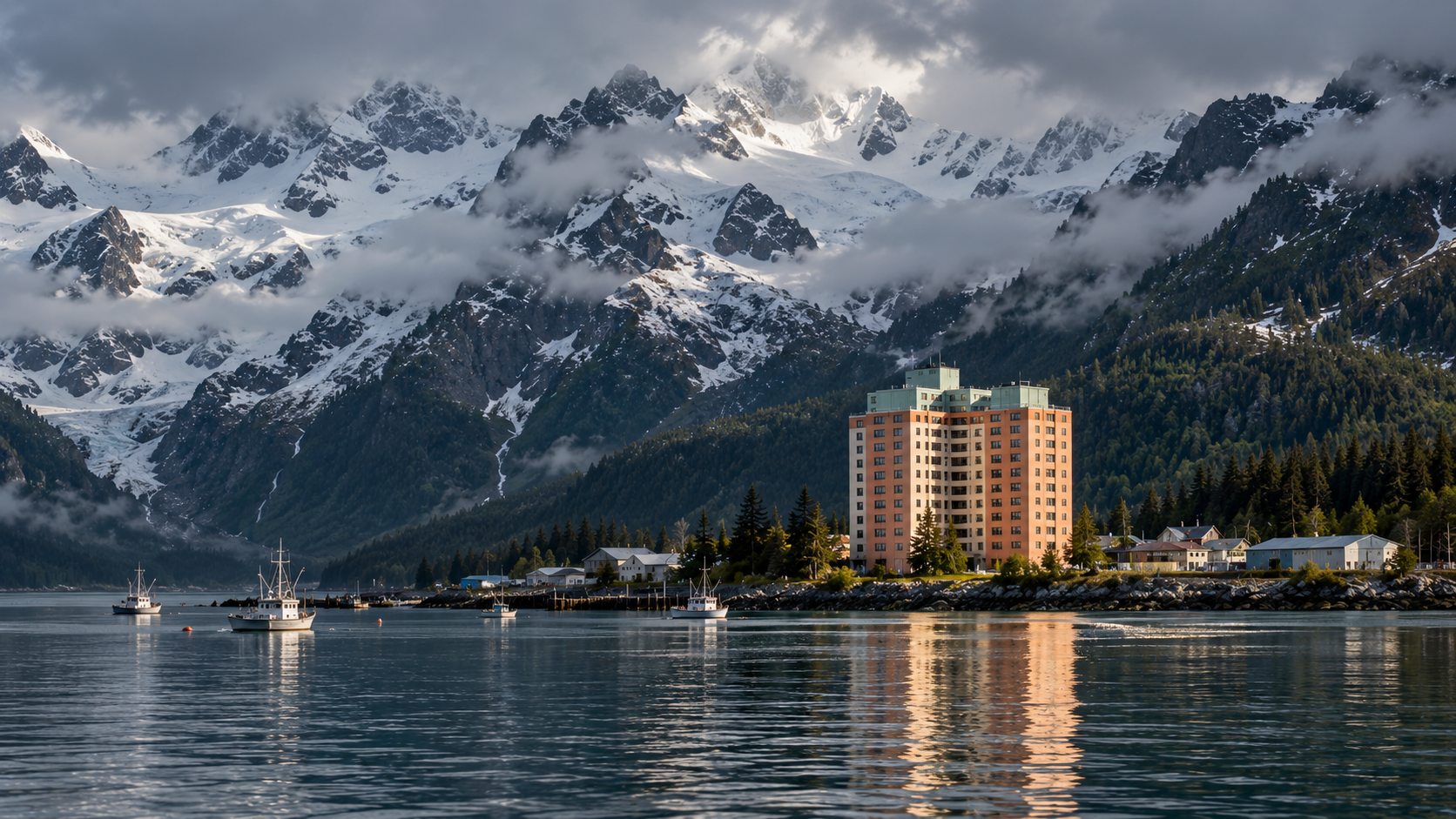
At the end of a long fjord in Prince William Sound, hemmed in by mountains and glaciers, there's a town where nearly everyone lives under one roof. Whittier started as a secret. During World War II, the U.S. Army wanted an ice-free port in Alaska that would be hard for enemy bombers to find, hidden by mountains and frequent cloud cover. Crews drove a railroad tunnel through Maynard Mountain to connect it to the rest of the territory, and the rail spur was completed in 1943. The port took its name from nearby Whittier Glacier, which had been named for the poet John Greenleaf Whittier. After the war, the Army built big. First came the Buckner Building, finished in 1953, a massive concrete structure nicknamed the "city under one roof." Then came the Hodge Building, a 14-story apartment tower made of three connected sections, built in the mid-1950s for soldiers and their families. It was the first of 12 towers the military planned. None of the others were ever built. For a time, Buckner and Hodge were the largest buildings in Alaska. The Army left in 1960. In 1972 the Hodge Building was renamed Begich Towers, in memory of Alaska congressman Nick Begich, and it was converted into condominiums. The Buckner Building was abandoned, and it still stands derelict on the hillside above town. Today Begich Towers is the town. Its roughly 150 apartments house most of Whittier's residents, and the building also holds the post office, a grocery store and city services. Children walk to school through a tunnel that connects the building to the school, so they never have to go outside in bad weather. Getting to Whittier is its own adventure. For decades, the only way in was by train, boat or plane. That changed on June 7, 2000, when the old railroad tunnel reopened for cars as well. At 2.5 miles, the Anton Anderson Memorial Tunnel is the longest highway tunnel in North America and the longest combined rail-and-highway tunnel on the continent. Cars and trains share a single lane, taking turns on a strict schedule, and the tunnel closes at night, sealing the town off until morning. Whittier has faced the sea at its most violent too. During the 1964 Alaska earthquake, a tsunami about 13 meters high struck the town and killed 13 people. Whittier is still there, with most of its people living together in a single building.
Last corrected: Oct 4, 2026.
Grew up near here?
Get the free Alaska guide: every Hidden Current place in the region, with what you can still see and how to get there.
State guides are coming soon. Email signup is not available yet.
Watch the short documentary
Whittier, Alaska: The Town That Lives in One Building
Claim log
| # | Claim | Sources | Status |
|---|---|---|---|
| 1 | Begich Towers is at 60°46′20″N 148°41′08″W |
| Sourced |
| 2 | Whittier is at 60°46′27″N 148°40′40″W |
| Sourced |
| 3 | Whittier's population was 272 at the 2020 census, up from 220 in 2010 |
| Sourced |
| 4 | Almost all of Whittier's residents live in the Begich Towers Condominium, earning it the nickname "town under one roof" |
| Sourced |
| 5 | Begich Towers and the two-story Whittier Manor house a majority of the town's residents |
| Sourced |
| 6 | The Hodge Building (renamed Begich Towers) was completed in 1957 and contains 150 two-and-three-bedroom apartments plus bachelor efficiency units |
| Sourced |
| 7 | The Hodge Building's first residents moved in during the summer of 1956 |
| Sourced |
| 8 | Begich Towers is 14 floors high and made up of three connected towers |
| Sourced |
| 9 | The military planned a complex of 12 multistory towers after the war; Begich Towers was the first, and none of the others were built |
| Sourced |
| 10 | In 1972 the building was renamed Begich Towers Condominium |
| Sourced |
| 11 | The school is connected to Begich Towers via a tunnel |
| Sourced |
| 12 | Begich Towers houses a grocery store, post office and community center |
| Sourced |
| 13 | Visitors can wander into the Begich Towers main lobby, which has a photo display of Whittier's history |
| Sourced |
| 14 | The Buckner Building was completed in 1953, was called the "city under one roof," and was eventually abandoned |
| Sourced |
| 15 | Buckner and Begich Towers were at one time the largest buildings in Alaska |
| Sourced |
| 16 | The city of Whittier has begun charging trespassers who enter the Buckner Building |
| Sourced |
| 17 | The Alaska Railroad spur to Camp Sullivan was completed in 1943, and the port became the entrance for U.S. soldiers into Alaska |
| Sourced |
| 18 | Whittier Glacier was named for the poet John Greenleaf Whittier, first published in 1915 |
| Sourced |
| 19 | The port remained an active Army facility until 1960, when the population was 1,200; the city was incorporated in 1969 |
| Sourced |
| 20 | The 1964 tsunami that hit Whittier reached 13 m and killed 13 people |
| Sourced |
| 21 | When the Anton Anderson Memorial Tunnel opened to public access in 2000, it became the first highway to Whittier; previously the only ways in were rail, boat and plane |
| Sourced |
| 22 | The Anton Anderson Memorial Tunnel is the longest highway tunnel in North America (13,300 ft or 2.5 miles) and the longest combined rail and highway tunnel in North America |
| Sourced |
| 23 | The tunnel opened to vehicle traffic on June 7, 2000, after conversion from a World War II railroad tunnel |
| Sourced |
| 24 | The tunnel was the first designed for -40° F and 150 mph winds |
| Sourced |
| 25 | The tunnel is fifty miles southeast of Anchorage near Portage Glacier |
| Sourced |
| 26 | In 1976 the tunnel was renamed for Anton Anderson, chief engineer of the Alaska Railroad |
| Sourced |
| 27 | The one-lane tunnel is shared by cars and trains traveling in both directions |
| Sourced |
| 28 | Summer schedule: cars leave for Whittier on the half hour from 5:30am to 10:30pm and leave Whittier on the hour from 6am to 11pm |
| Sourced |
| 29 | The one-way toll for a private vehicle starts at $13 |
| Sourced |
| 30 | The toll is paid only when traveling into Whittier |
| Sourced |
| 31 | The tunnel shuts down at night, leaving Whittier cut off until morning |
| Sourced |
| 32 | Pedestrians are not permitted through the tunnel except during the annual Walk to Whittier event |
| Sourced |
| 33 | Whittier is connected by road, rail, and the Alaska Marine Highway |
| Sourced |
Disagreements logged
No approved disagreements are logged on this page yet.
Submit a disagreement
Disagree with a fact in this story? Submit a source-backed note for editorial review. It stays private until approved and does not automatically become a correction.
Sources
- Wikipedia
- alaskaweb.org
- Lonely Planet
- takemytrip.com
- Alaska Department of Transportation & Public Facilities
- alaska.org
- alaskaroadtrip.com
- CBS News
- tollguru.com
- travelalaska.com
Corrections
| # | Correction | Sources |
|---|---|---|
| 1 | Not every Whittier resident lives in Begich Towers; the two-story Whittier Manor also houses residents |
|
| 2 | Whittier's population was 272 at the 2020 census, not the "about 300" often cited |
|
| 3 | The nickname "city under one roof" originally belonged to the Buckner Building, completed in 1953 and now abandoned |
|
| 4 | Sources differ on when Begich Towers was finished: the Hodge Building is listed as completed in 1957, though its first residents moved in during the summer of 1956 |
|
More Isolated Places places
- The Island Almost Nobody Can Reach
- Supai, Arizona: The Village With No Road Where Mail Comes by Mule
- Kiruna, Sweden: The Arctic City Moving to Escape Its Own Mine
- Bluie East Two: The WWII Air Base Abandoned in Greenland
- Point Roberts: The U.S. Town You Reach by Driving Through Canada
- Kentucky Bend: The Kentucky Exclave You Reach Through Tennessee