
Hidden Beneath CitiesMail RailLondon historyunderground London
Mail Rail: London's Secret Underground Railway for the Post
From 1927 to 2003, driverless electric trains carried London's mail through 6.5 miles of tunnels 70 feet below the city. Now visitors can ride part of it.
Every claim sourced
20 claims · 20 sources
0 disagreements logged
9 editorial corrections
Last checked Oct 6, 2026
The story
The numbered claim log below connects facts in this story to their sources.
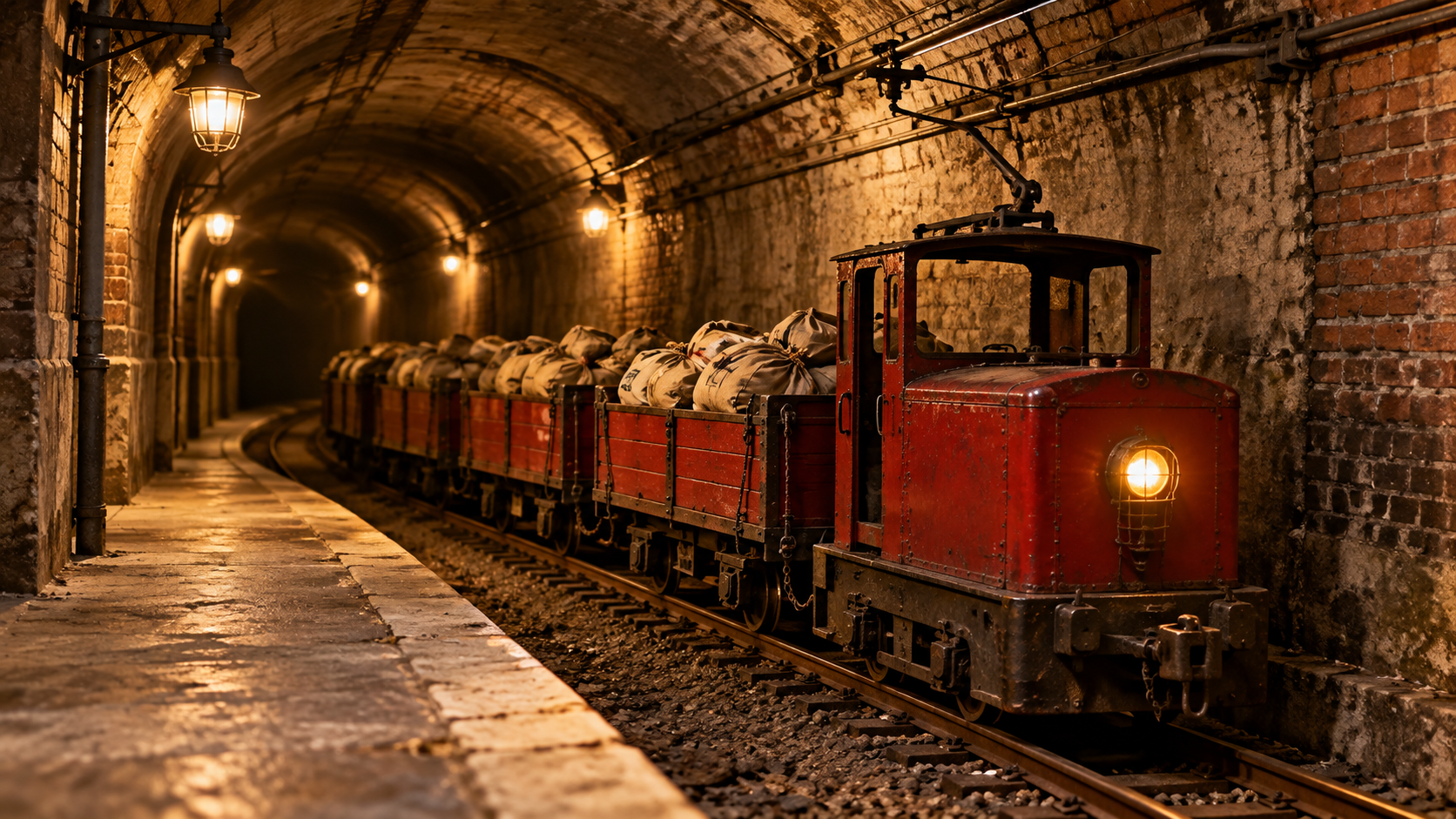
In the early 1900s, London's streets were jammed with horses, carts and early motor vehicles, and the mail was getting stuck in traffic. In 1911, the Post Office came up with a plan to get it out of the way: build a railway underground, just for post. The plan called for a narrow-gauge electric railway 6.5 miles long, running from Paddington in the west to Whitechapel in the east, with stations beneath the main sorting offices along the way. World War I delayed construction, and material costs rose afterward, but work resumed in the 1920s. The tracks were only 2 feet apart, and the tunnels ran about 70 feet below the streets. The first section opened for training in February 1927. In early December 1927, the first parcels were carried between Mount Pleasant and Paddington, just in time for the Christmas rush, and the rest of the line opened over the following weeks. The Post Office Railway is described as the world's first electric railway with driverless trains. Small electric trains ran automatically between stations, while staff underground loaded and unloaded the mailbags. For decades, the railway ran up to 22 hours a day, through eight stations beneath sorting offices and near major rail terminals. At its peak, it carried about 4 million letters a day. In 1987, it was renamed Mail Rail. But the world changed around it. Sorting offices closed, and more mail moved by road and air. Royal Mail found that Mail Rail cost several times more than using road transport for the same work. By 2003, only three of its stations were still in use, and on May 31, 2003, the last mail train ran. The system was powered up one last time in 2005 so it could be filmed, then shut down. The tunnels didn't stay dark forever. On September 5, 2017, The Postal Museum opened a new attraction: about 1 kilometer of the original line beneath Mount Pleasant, with new passenger trains built to fit the tiny tunnels. Visitors now ride where London's mail once traveled.
Last corrected: Oct 6, 2026.
Grew up near here?
Get the free state guide: every Hidden Current place in the region, with what you can still see and how to get there.
State guides are coming soon. Email signup is not available yet.
Watch the short documentary
Mail Rail: London's Secret Underground Railway for the Post
Claim log
| # | Claim | Sources | Status |
|---|---|---|---|
| 1 | The Postal Museum is at 15-20 Phoenix Place, WC1X 0DA, at 51.524751, -0.113926 |
| Sourced |
| 2 | The London Post Office Railway opened 3 December 1927 and closed 31 May 2003, with a 2 ft track gauge |
| Sourced |
| 3 | The railway's highest elevation was 70 ft below street level |
| Sourced |
| 4 | The railway was inspired by the Chicago Tunnel Company and operated for 76 years |
| Sourced |
| 5 | A one-kilometre section at Mount Pleasant was opened for passenger use in September 2017 as part of The Postal Museum |
| Sourced |
| 6 | In 1911, a plan evolved to build an underground railway 6½ miles long from Paddington to Whitechapel because road traffic congestion was causing delays |
| Sourced |
| 7 | In February 1927, the first section between Paddington and the West Central District Office was made available for training |
| Sourced |
| 8 | The London Post Office Railway was rebranded Mail Rail in 1987 and opened in 1927 as the world's first electric railway with driverless trains |
| Sourced |
| 9 | At its peak the railway carried 4 million letters a day across 22 miles of narrow gauge track spanning 6.5 miles |
| Sourced |
| 10 | It closed in May 2003 over cost concerns: the railway was 3-5 times more expensive than road transport |
| Sourced |
| 11 | On 5 September 2017 the museum opened an attraction with new passenger rail cars; bags must be left in a locker, and the ride lasts 15 minutes |
| Sourced |
| 12 | Operations began in late 1927, carrying the first parcel traffic for the Christmas pressure |
| Sourced |
| 13 | On 31 May 2003 Mail Rail carried post for the last time; by May 2003 only Mount Pleasant, Rathbone Place and Paddington District Office were still in use |
| Sourced |
| 14 | The system was powered up one last time in 2005 to film the railway for the museum's collection |
| Sourced |
| 15 | The museum is open Tuesday to Sunday 10:00–17:00, with the last Mail Rail ride at 16:00 |
| Sourced |
| 16 | The railway opened on 5 December 1927 with parcels between Mount Pleasant and Paddington |
| Sourced |
| 17 | Mail Rail closed when the Royal Mail closed its central London sorting offices and shifted mail to road or air transport |
| Sourced |
| 18 | The system operated 22 hours a day and ran through eight stations |
| Sourced |
| 19 | Following World War I, material costs had risen so much that work did not resume until 1923 |
| Sourced |
| 20 | The museum is open Wednesday to Sunday 10:00 – 17:00 |
| Sourced |
Disagreements logged
No approved disagreements are logged on this page yet.
Submit a disagreement
Disagree with a fact in this story? Submit a source-backed note for editorial review. It stays private until approved and does not automatically become a correction.
Sources
- Artsmark
- Wikipedia
- niche-museums.com
- The Postal Museum
- firstgreatwestern.info
- heritagerailway.co.uk
- scienceblog.com
- memoirsofametrogirl.com
- Art Fund
Corrections
| # | Correction | Sources |
|---|---|---|
| 1 | Mail Rail is not entirely closed; a one-kilometre section reopened to passengers in September 2017 at The Postal Museum |
|
| 2 | A section opened for training in February 1927; regular parcel service began in December 1927 |
|
| 3 | Sources disagree on the date service began: 3 December 1927 |
|
| 4 | Sources disagree on the date service began: 5 December 1927 |
|
| 5 | The 6.5 miles is the route distance; the system had about 22 miles of track |
|
| 6 | Sources disagree on peak volume: 4 million letters a day |
|
| 7 | Sources disagree on peak volume: 12 million postal items daily |
|
| 8 | Sources disagree on opening days: Tuesday to Sunday |
|
| 9 | Sources disagree on opening days: Wednesday to Sunday |
|
More Hidden Beneath Cities places
- Underground river beneath a City
- Underground City, Turkey (Derinkuyu Yeraltı Şehri)
- Cold War Military Command Center Inside a Colorado Mountain
- Chicago's Deep Tunnel: 109 Miles of Tunnels That Swallow Storms
- Kincaid's Cave: The Grand Canyon Egyptian Cave That Never Was
- Seattle Underground: The City Buried After the Great Fire of 1889