
Hidden Beneath Citiesunderground cityundergroundturkey
Underground City, Turkey (Derinkuyu Yeraltı Şehri)
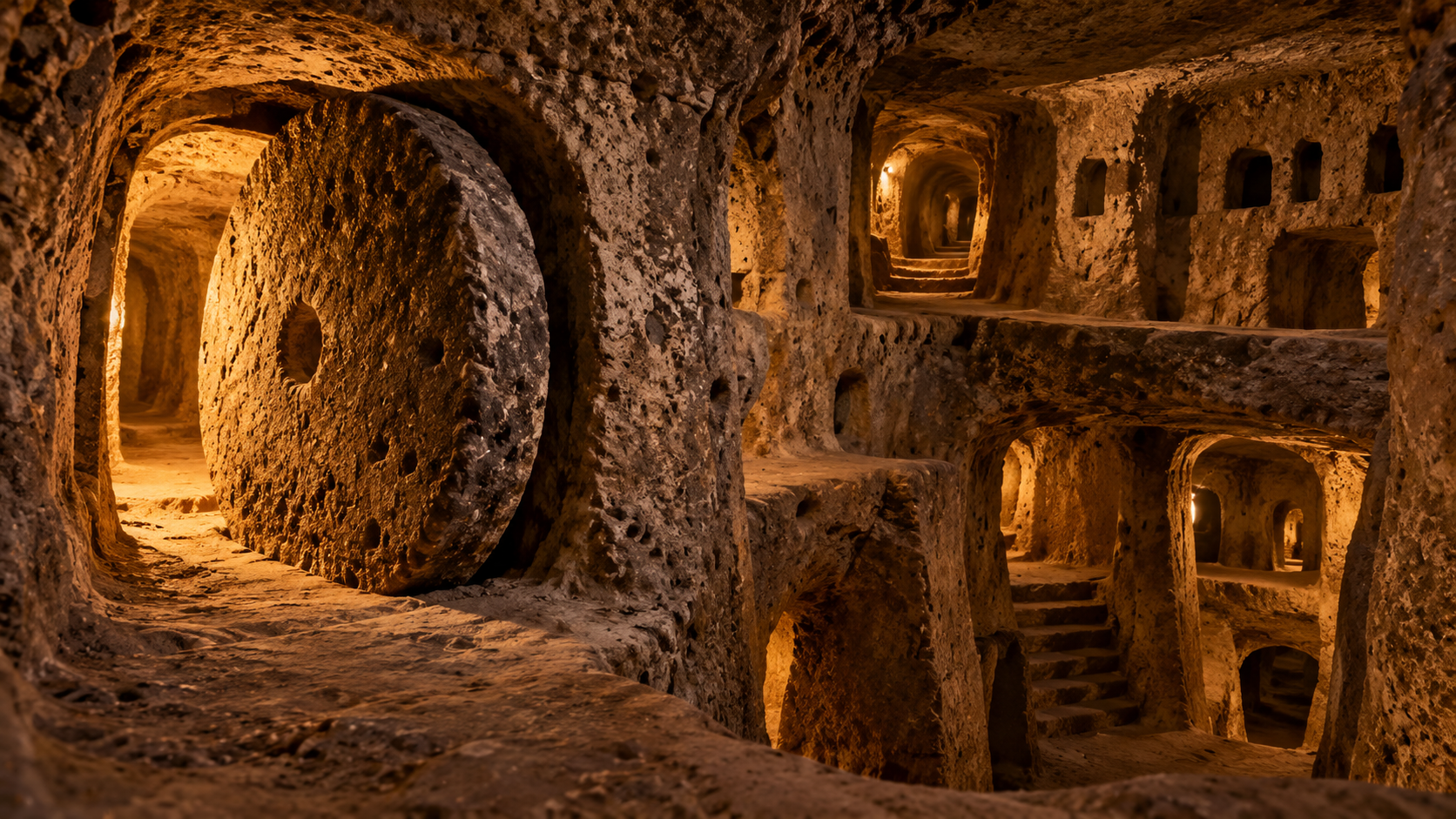
Carved 85 meters into volcanic rock, Derinkuyu could shelter up to 20,000 people. It lay forgotten until 1963, when a homeowner broke through a wall.
Every claim sourced
17 claims · 17 sources
0 disagreements logged
2 editorial corrections
Last checked Oct 2, 2026
The story
The numbered claim log below connects facts in this story to their sources.
In 1963, a man in the town of Derinkuyu was renovating his home. He knocked through a basement wall and found a room on the other side. Behind it was a passage, and behind that, another. What he'd broken into was an entire city carved into the rock beneath his town. The rock under Cappadocia is tuff, compacted volcanic ash that is soft enough to carve by hand but strong enough to hold its shape. For thousands of years, people in this region dug into it. The first chambers at Derinkuyu may have been cut by the Phrygians as early as the 8th or 7th century BC. Over the centuries, later inhabitants kept digging, deeper and wider. The city reached its full form in the Byzantine era, and it grew significantly during the Arab–Byzantine wars, roughly 780 to 1180, when raiding armies swept across the plain. When danger came, whole communities went underground, bringing their animals and food with them. At its largest, Derinkuyu reached about 85 meters (280 feet) deep and could shelter as many as 20,000 people. It was built to be lived in under siege. There were stables near the surface, along with kitchens, storerooms, wine and oil presses, chapels, and a large barrel-vaulted room on the second level that may have been a school. A network of ventilation shafts carried fresh air down through every level, and one 55-meter shaft doubled as a well. Each level could be sealed from the inside with massive round stone doors that rolled across the passages. Derinkuyu wasn't alone. More than 200 underground settlements have been found in the region, and tunnels 8 to 9 km long are believed to connect Derinkuyu with the underground city at Kaymaklı. People kept using these shelters for centuries: during the Seljuk invasions, during Timur's campaigns in the 1300s, and into the early 20th century, when local Cappadocian Greeks and Armenians still sought refuge underground. That ended in 1923, when the population exchange between Greece and Turkey sent the region's Christian population to Greece. The underground city was left empty, and memory of it faded. Forty years later, one basement wall brought it back. Since then, more than 600 separate entrances have been found, some hidden beneath the houses of the modern town above. Derinkuyu opened to visitors in the 1960s and is part of the Göreme National Park and the Rock Sites of Cappadocia UNESCO World Heritage Site, inscribed in 1985. Much of the city has still never been opened to the public.
Last corrected: Oct 3, 2026.
Grew up near here?
Get the free state guide: every Hidden Current place in the region, with what you can still see and how to get there.
State guides are coming soon. Email signup is not available yet.
Watch the short documentary
Underground City, Turkey (Derinkuyu Yeraltı Şehri)
Claim log
| # | Claim | Sources | Status |
|---|---|---|---|
| 1 | The visitor entrance is at Bayramlı, Niğde Cd., Derinkuyu (38.373376, 34.735090) |
| Sourced |
| 2 | Derinkuyu is 85 m deep, with a 55 m ventilation shaft used as a well |
| Sourced |
| 3 | Hours are April–October 08:00–19:00 and November–March 08:00–17:00 |
| Sourced |
| 4 | Foreign admission was €13 in 2025 |
| Sourced |
| 5 | The site is open every day of the week |
| Sourced |
| 6 | Eight levels are open; a visit takes 45 minutes to an hour; the temperature is 13–15°C year-round |
| Sourced |
| 7 | The city was rediscovered in 1963 during a renovation through a basement wall; entrances lie under private houses |
| Sourced |
| 8 | The city was rediscovered in 1963 during a renovation through a basement wall; entrances lie under private houses |
| Sourced |
| 9 | Tuff is compacted volcanic ash |
| Sourced |
| 10 | The first chambers date to the 8th–7th century BC; the city was fully formed in the Byzantine era |
| Sourced |
| 11 | The city grew during the Arab–Byzantine wars, 780–1180, and could shelter around 20,000 people |
| Sourced |
| 12 | The city had wine and oil presses, stables, chapels, and a barrel-vaulted room on the second level |
| Sourced |
| 13 | Each floor could be closed off separately |
| Sourced |
| 14 | A tunnel of 8–9 km is believed to link Derinkuyu with Kaymaklı |
| Sourced |
| 15 | More than 200 underground cities have been found in the region |
| Sourced |
| 16 | The city was used in the Seljuk and Timur periods and in the 20th century by Cappadocian Greeks and Armenians, until the population exchange |
| Sourced |
| 17 | Derinkuyu is part of Göreme National Park and the Rock Sites of Cappadocia, inscribed in 1985 |
| Sourced |
Disagreements logged
No approved disagreements are logged on this page yet.
Submit a disagreement
Disagree with a fact in this story? Submit a source-backed note for editorial review. It stays private until approved and does not automatically become a correction.
Sources
- Showcaves
- Ministry of Culture and Tourism MüzeKart page
- Vigo Tours
- Source needs identification
- Rotasenin
- Wikipedia
- BBC Travel
Corrections
| # | Correction | Sources |
|---|---|---|
| 1 | Derinkuyu was a refuge that could shelter people during raids, not a place where thousands lived permanently |
|
| 2 | Derinkuyu is a man-made city carved into volcanic tuff, not a natural cave system |
|
More Hidden Beneath Cities places
- Underground river beneath a City
- Cold War Military Command Center Inside a Colorado Mountain
- Chicago's Deep Tunnel: 109 Miles of Tunnels That Swallow Storms
- Kincaid's Cave: The Grand Canyon Egyptian Cave That Never Was
- Seattle Underground: The City Buried After the Great Fire of 1889
- Mail Rail: London's Secret Underground Railway for the Post