
Hidden Beneath Citiesgrand canyon1909newspaper article
Kincaid's Cave: The Grand Canyon Egyptian Cave That Never Was, Arizona
In 1909, a Phoenix newspaper reported an Egyptian-style cave hidden in the Grand Canyon. The Smithsonian has no record of it, and no one has ever found it.
Every claim sourced
20 claims · 20 sources
0 disagreements logged
5 editorial corrections
Last checked Oct 4, 2026
The story
The numbered claim log below connects facts in this story to their sources.
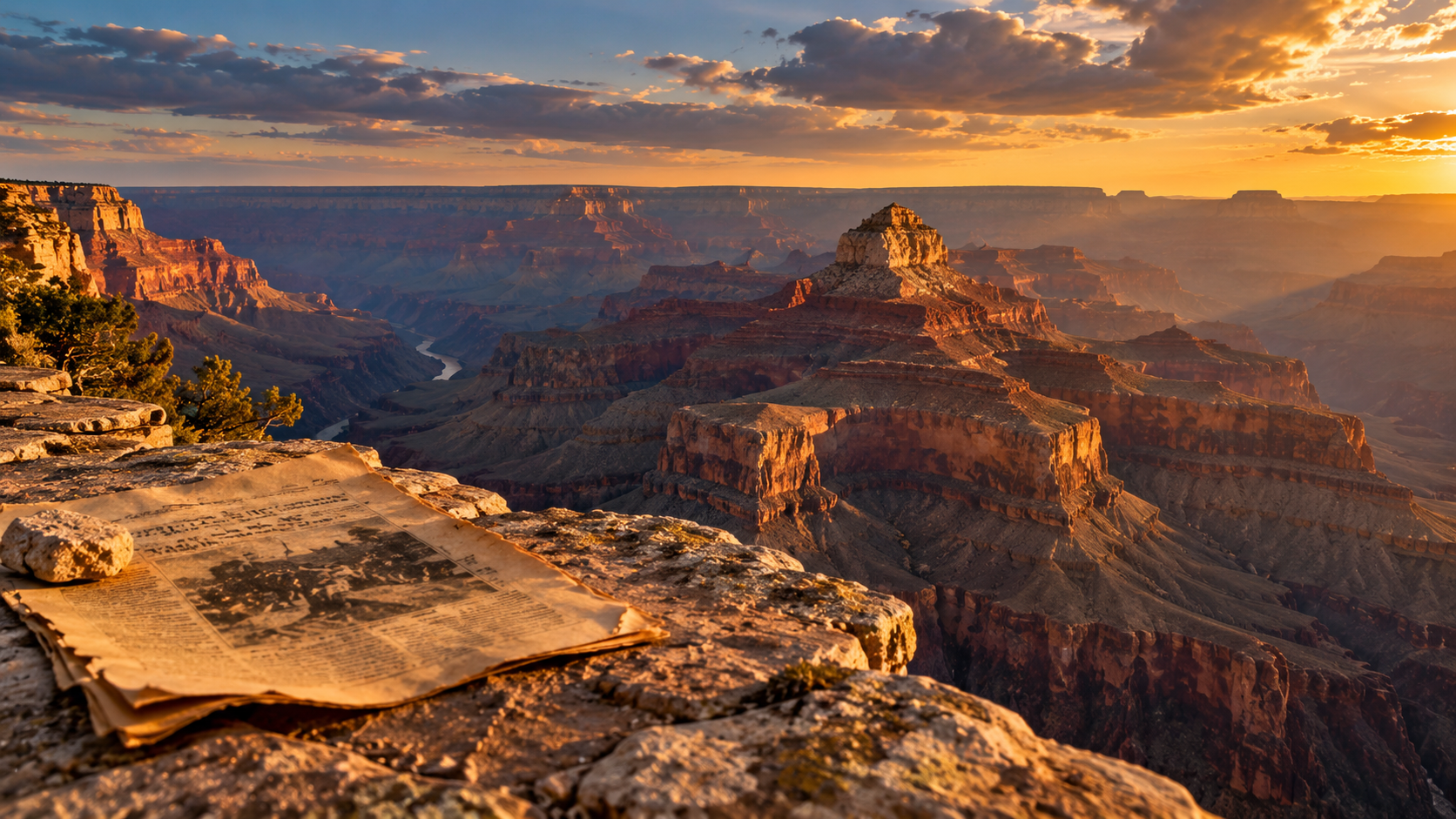
On April 5, 1909, the Arizona Gazette, a Phoenix evening paper, ran a startling story on its front page. Under the headline "Explorations in Grand Canyon," it claimed that an explorer had discovered a vast cavern complex high in the canyon walls, and that a Smithsonian-backed team was now excavating it. Inside, the paper said, were chambers, mummies, hieroglyphs and artifacts that looked Egyptian or "Oriental," evidence, it suggested, of an ancient people from across the ocean. The paper named two men. G.E. Kincaid was a river traveler who said he'd found the cave. A Professor S.A. Jordan of the Smithsonian supposedly came to excavate it. According to the article, the entrance sat about 1,500 feet down a sheer cliff, in the Marble Canyon region, roughly 42 miles from El Tovar. The Gazette had mentioned Kincaid once before, on March 12, 1909, in a story about his trip down the Colorado River. That earlier article said nothing about Egyptian artifacts or a cave. After the April 5 story, the trail goes cold. No photographs, no artifacts, no follow-up excavation report. When people later asked the Smithsonian about it, the answer was consistent. Its Department of Anthropology searched its files and found no mention of a Professor Jordan, of Kincaid, or of a lost Egyptian civilization in Arizona. There's no record that either man existed, and no Grand Canyon excavation matching the story. No verified evidence of the cave has ever been found. So why does the story survive? Partly because the Grand Canyon really does have an Egyptian connection, just not the one the Gazette described. In the 1870s and 1880s, the geologist Clarence Dutton began a tradition of naming the canyon's buttes after mythological deities from around the world, and later surveyors kept it going into the early 1900s. That's why maps of the canyon show Isis Temple, Horus Temple, Osiris Temple, the Tower of Set and Cheops Pyramid alongside Shiva, Vishnu and Brahma Temples. The Tower of Set was first named "Temple of Sett" in 1879 by the painter Thomas Moran, because a niche in its wall reminded him of temples along the Nile.
Last corrected: Oct 4, 2026.
Grew up near here?
Get the free Arizona guide: every Hidden Current place in the region, with what you can still see and how to get there.
State guides are coming soon. Email signup is not available yet.
Watch the short documentary
Kincaid's Cave: The Grand Canyon Egyptian Cave That Never Was, Arizona
Claim log
| # | Claim | Sources | Status |
|---|---|---|---|
| 1 | On April 5, 1909, the Arizona Gazette published "Explorations in the Grand Canyon" on the front page of its evening edition, claiming remnants of an Egyptian civilization had been found in a massive cave |
| Sourced |
| 2 | The Gazette article claimed a Smithsonian-backed expedition had found an immense cavern complex high in the Grand Canyon, with chambers containing mummies, hieroglyphs and artifacts of purported Egyptian or "Oriental" origin |
| Sourced |
| 3 | The article named a river traveler, G.E. Kincaid, and a Professor S.A. Jordan |
| Sourced |
| 4 | The article placed the cave in the Marble Canyon region, roughly 42 miles from El Tovar, with its entrance 1,500 feet down a sheer cliff |
| Sourced |
| 5 | There is no record of the existence of either Kincaid or Jordan |
| Sourced |
| 6 | The Gazette had reported on Kincaid in March 1909 but made no mention of Egyptian artifacts or the cave |
| Sourced |
| 7 | Kincaid's only other known reference comes in a March 12 article in the Arizona Gazette |
| Sourced |
| 8 | Kincaid and Jordan returned without artifacts or pictures, leaving the Gazette article as the sole evidence |
| Sourced |
| 9 | The Smithsonian's Department of Anthropology searched its files without finding any mention of a Professor Jordan, Kincaid or a lost Egyptian civilization in Arizona |
| Sourced |
| 10 | No record exists of Kincaid or Professor Jordan within the Smithsonian's Department of Anthropology |
| Sourced |
| 11 | The Smithsonian has no record of Kincaid, Jordan, or any Grand Canyon excavation matching the Gazette account, and lists the story as a recurring myth |
| Sourced |
| 12 | Some Grand Canyon landmarks have Egyptian names, such as Isis Temple and Horus Temple |
| Sourced |
| 13 | The survival of the myth is sometimes linked to Egyptian-themed place-names such as Isis Temple and Horus Temple on official maps |
| Sourced |
| 14 | Cheops Pyramid is at 36°07′13″N 112°07′12″W, elevation 5,401 ft, 1.7 miles south-southeast of Isis Temple |
| Sourced |
| 15 | Cheops Pyramid was named by George Wharton James, in keeping with Clarence Dutton's tradition of naming features after mythological deities |
| Sourced |
| 16 | Cheops Pyramid's name was officially adopted in 1906 by the U.S. Board on Geographic Names |
| Sourced |
| 17 | Tower of Set was originally named Temple of Sett in 1879 by Thomas Moran, because a niche in its wall evoked temples along the Nile |
| Sourced |
| 18 | Clarence Dutton started the naming convention on a mapping survey in the 1870s; the tradition lasted into the early 1900s |
| Sourced |
| 19 | 23 individual peaks were officially designated as "temples," including Buddha, Vishnu, Shiva, Brahma and Isis |
| Sourced |
| 20 | Isis Temple, Horus Temple and Osiris Temple stand opposite Hopi Point on the North Rim side, either side of Trinity Creek |
| Sourced |
Disagreements logged
No approved disagreements are logged on this page yet.
Submit a disagreement
Disagree with a fact in this story? Submit a source-backed note for editorial review. It stays private until approved and does not automatically become a correction.
Sources
- Discover Magazine
- Wikipedia
- Gizmodo
- handwiki.org
- Arizona Highways
- americansouthwest.net
Corrections
| # | Correction | Sources |
|---|---|---|
| 1 | No Smithsonian expedition found an Egyptian cave in the Grand Canyon; the Smithsonian has no record of Kincaid, Jordan, or any such excavation |
|
| 2 | The Smithsonian's Department of Anthropology found no mention of a Professor Jordan, Kincaid or a lost Egyptian civilization in Arizona |
|
| 3 | The Gazette article is the sole evidence of the claimed expedition; no artifacts or photographs exist |
|
| 4 | The Grand Canyon's Egyptian place-names come from a naming tradition started by geologist Clarence Dutton, not from any discovery |
|
| 5 | The coordinates on this page mark Cheops Pyramid, a real Egyptian-named butte, not the location of any cave |
|
Hidden Current within 100 miles
More Hidden Beneath Cities places
- Underground river beneath a City
- Underground City, Turkey (Derinkuyu Yeraltı Şehri)
- Cold War Military Command Center Inside a Colorado Mountain
- Chicago's Deep Tunnel: 109 Miles of Tunnels That Swallow Storms
- Seattle Underground: The City Buried After the Great Fire of 1889
- Mail Rail: London's Secret Underground Railway for the Post