
Hidden Beneath Citieschicagotunnelsstormwater
Chicago's Deep Tunnel: 109 Miles of Tunnels That Swallow Storms
Up to 350 feet below Chicago, 109 miles of tunnels catch storm runoff and sewage that once overflowed into rivers, sending it to vast quarry reservoirs.
Every claim sourced
13 claims · 13 sources
0 disagreements logged
2 editorial corrections
Last checked Oct 2, 2026
The story
The numbered claim log below connects facts in this story to their sources.
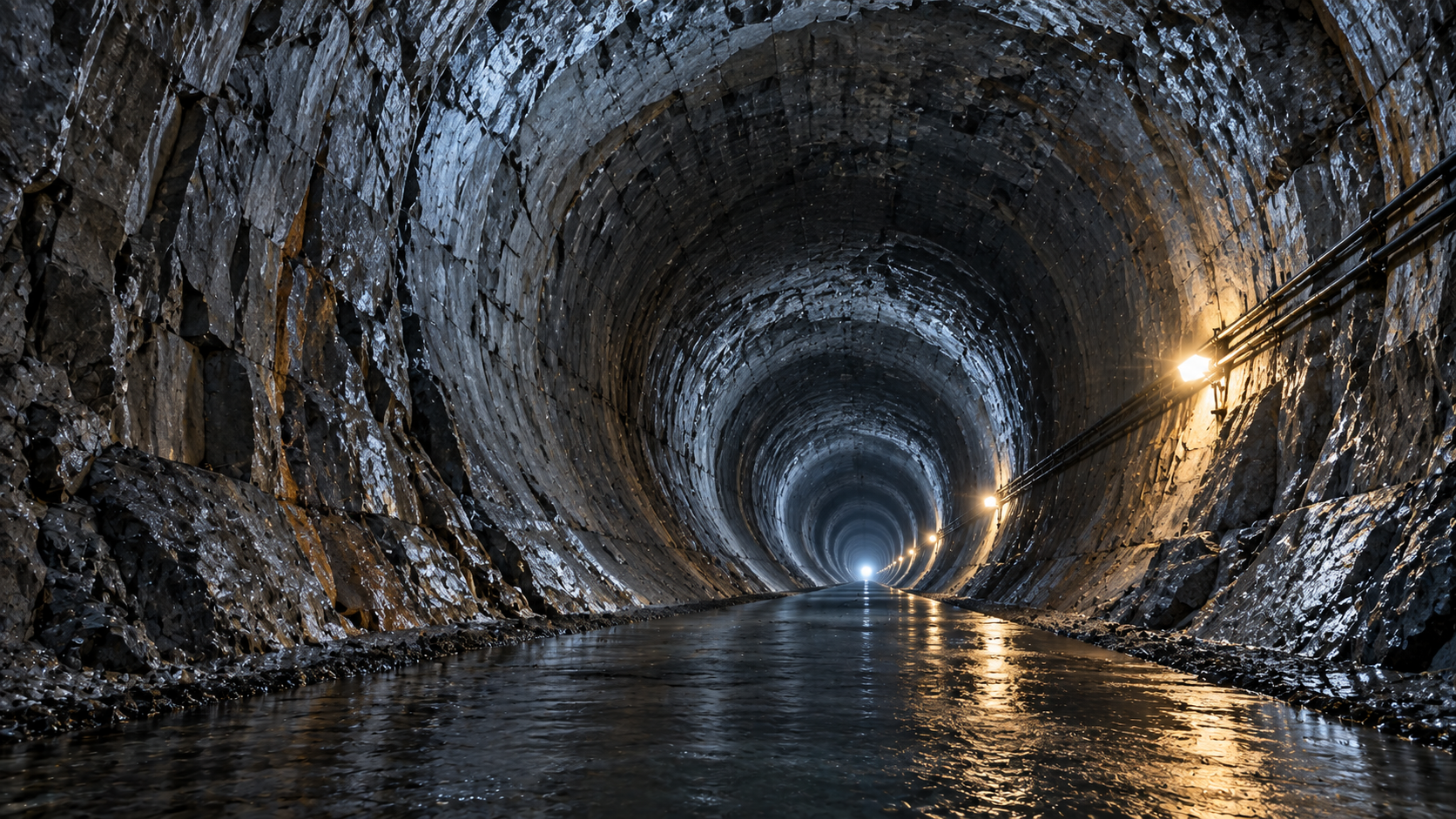
Chicago was built on flat, low ground. Like many older American cities, it uses combined sewers, which carry both sewage and rainwater in the same pipes. On a dry day, that's no problem. But in a heavy storm, the pipes fill up fast. Before 1972, the standard answer was to let the overflow pour straight into rivers and streams. In the worst storms, polluted water backed up into basements, and the rivers sometimes had to be released into Lake Michigan, the city's source of drinking water. In 1972, the agency now called the Metropolitan Water Reclamation District adopted a plan to fix that by going underground. It was called the Tunnel and Reservoir Plan, and everyone came to call it the Deep Tunnel. Construction began in 1975. Crews bored tunnels through solid rock, lined them with concrete, and connected them to the sewers above through hundreds of vertical drop shafts. The tunnels range from 9 to 33 feet across and sit up to about 350 feet below ground. When the final section was finished in 2006, the system held 109 miles of tunnels, enough to hold about 2.3 billion gallons of water. When a storm hits now, the overflow that once went into the rivers drops down the shafts into the tunnels instead. It's held there, then pumped up and treated after the storm passes. The tunnels alone weren't enough, so the second part of the plan was reservoirs, and the MWRD found them in old quarries. The Gloria Alitto Majewski Reservoir opened in 1998, holding 350 million gallons. In 2015, the Thornton Composite Reservoir opened in part of a working limestone quarry south of the city, holding 7.9 billion gallons. It's been nicknamed the "Grand Canyon of the South Suburbs," and it's the size of about 12 Soldier Fields. The McCook Reservoir, carved nearly 300 feet down in the western suburbs, opened its first stage in 2017 with 3.5 billion gallons. Its second stage will bring it to 10 billion gallons when it's finished. It has been one of the largest public works projects in U.S. history, costing an estimated $3.8 billion, about half of it federal money. The Chicago River and other waterways are measurably cleaner because of it. But it has limits. In the most extreme storms, like April 2013, the system can still fill up and neighborhoods still flood. Most Chicagoans have never seen any of it. It sits in the rock beneath their feet and fills up every time it storms.
Last corrected: Oct 3, 2026.
Grew up near here?
Get the free IL guide: every Hidden Current place in the region, with what you can still see and how to get there.
State guides are coming soon. Email signup is not available yet.
Watch the short documentary
Chicago's Deep Tunnel: 109 Miles of Tunnels That Swallow Storms
Claim log
| # | Claim | Sources | Status |
|---|---|---|---|
| 1 | TARP was adopted in 1972 and covers 375 sq mi, Chicago and 51 suburbs, with 109.4 miles of tunnels holding 2.3 billion gallons; the Majewski Reservoir opened in 1998 |
| Sourced |
| 2 | Overflow went to waterways before 1972; the tunnels are 9–33 ft in diameter and up to 350 ft deep |
| Sourced |
| 3 | Construction began in 1975 and the tunnels were finished in 2006 |
| Sourced |
| 4 | The Thornton Composite Reservoir is at 41°34′55″N 87°37′05″W and was completed in 2015 |
| Sourced |
| 5 | Thornton is nicknamed the "Grand Canyon of the South Suburbs" and equals 12 Soldier Fields; TARP's total cost is $3.8B, about half federal |
| Sourced |
| 6 | McCook Stage 1 opened December 4, 2017, with 3.5 billion gallons |
| Sourced |
| 7 | McCook Stage 1 opened December 4, 2017, with 3.5 billion gallons |
| Sourced |
| 8 | McCook is about 300 ft below ground |
| Sourced |
| 9 | McCook will hold 10 billion gallons in total |
| Sourced |
| 10 | Neighborhoods flooded in April 2013 |
| Sourced |
| 11 | Neighborhoods flooded in April 2013 |
| Sourced |
| 12 | Crowds came to the public viewing |
| Sourced |
| 13 | Waterways have improved |
| Sourced |
Disagreements logged
No approved disagreements are logged on this page yet.
Submit a disagreement
Disagree with a fact in this story? Submit a source-backed note for editorial review. It stays private until approved and does not automatically become a correction.
Sources
- MWRD
- University of Illinois Ven Te Chow Hydrosystems Lab
- Wikipedia
- Water & Wastes Digest
- Industrial History
- Municipal Water Leader
- Source needs identification
- DNAinfo
- City of Big Shoulders
- Water Online
Corrections
| # | Correction | Sources |
|---|---|---|
| 1 | The Deep Tunnel reduces flooding but does not prevent it: neighborhoods still flooded in April 2013 |
|
| 2 | The Deep Tunnel reduces flooding but does not prevent it: neighborhoods still flooded in April 2013 |
|
Hidden Current within 100 miles
More Hidden Beneath Cities places
- Underground river beneath a City
- Underground City, Turkey (Derinkuyu Yeraltı Şehri)
- Cold War Military Command Center Inside a Colorado Mountain
- Kincaid's Cave: The Grand Canyon Egyptian Cave That Never Was
- Seattle Underground: The City Buried After the Great Fire of 1889
- Mail Rail: London's Secret Underground Railway for the Post