
Hidden LandscapesRacetrack PlayaDeath Valleymoving rocks
Racetrack Playa: The Mystery of Death Valley's Moving Rocks, California
On Death Valley's Racetrack Playa, rocks slide across the lakebed leaving long trails. In 2013, researchers finally saw wind-driven ice sheets move them.
Every claim sourced
19 claims · 19 sources
0 disagreements logged
8 editorial corrections
Last checked Oct 6, 2026
The story
The numbered claim log below connects facts in this story to their sources.
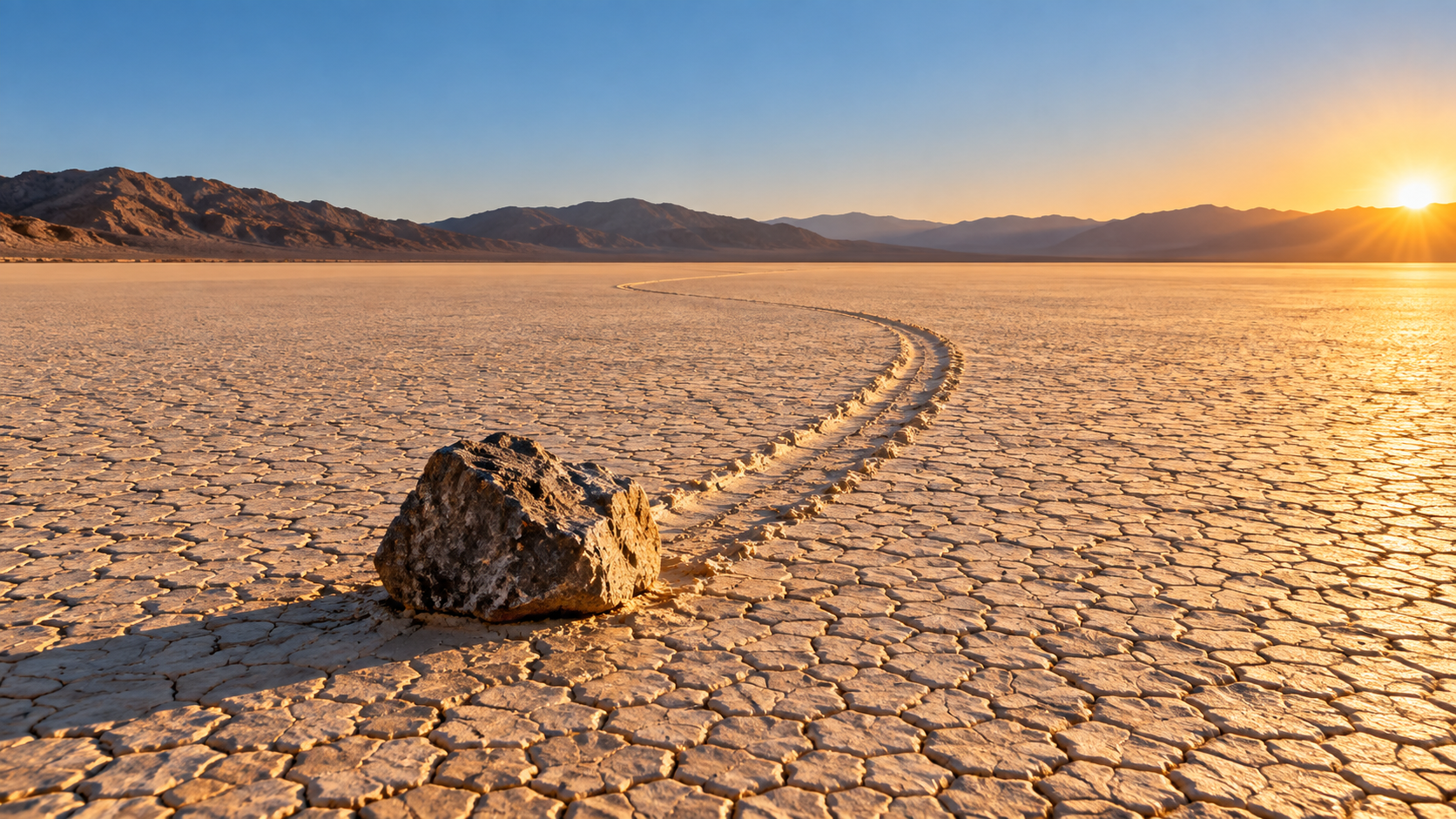
In a remote valley in the north of Death Valley National Park lies Racetrack Playa, a dry lakebed almost perfectly flat and cracked into tiles. Scattered across it are rocks, some small, some reportedly as heavy as 700 pounds, and behind many of them are long, shallow tracks carved into the mud. Some trails run straight, others curve or zigzag. The rocks seemed to have moved on their own. The rocks themselves came from the surrounding mountains. They eroded off the slopes and tumbled down onto the playa. How they moved across it was one of the desert's longest-running mysteries. Theories over the decades included powerful winds, slippery algae, thick ice and even magnetism. For years, no one had ever seen a rock move. In 2011, a team led by Scripps Institution of Oceanography paleobiologist Richard Norris, with his cousin James Norris, set out to watch. They set up a weather station near the playa, along with time-lapse cameras and GPS-equipped rocks. Their chance came in the winter of 2013–2014. Rain and snow had left a shallow pond covering part of the playa, no more than about 7 centimeters deep. On cold nights, it froze into thin sheets of "windowpane" ice, less than 5 millimeters thick. On December 21, 2013, just before noon, the ice began to break up, with popping and cracking sounds coming from all across the frozen pond. As light winds of about 3 to 5 meters per second pushed the floating ice panels, the panels shoved the rocks ahead of them. The rocks slid slowly through the mud beneath the water, a few meters per minute, carving fresh trails. Over that winter, the team saw it happen several times. In one event, more than 60 rocks moved, and some traveled more than 200 meters over multiple events. The findings were published in the journal PLOS ONE on August 27, 2014. Instead of hurricane-force winds or thick ice lifting the rocks, it turned out to be thin ice and gentle breezes. The conditions are rare, and the largest rocks weren't seen moving. Researchers have also suggested that rock movement has become less frequent since the 1970s, possibly because of a changing climate. But the trails remain on the playa, recording each time the conditions came together.
Last corrected: Oct 6, 2026.
Grew up near here?
Get the free California guide: every Hidden Current place in the region, with what you can still see and how to get there.
State guides are coming soon. Email signup is not available yet.
Watch the short documentary
Racetrack Playa: The Mystery of Death Valley's Moving Rocks, California
Claim log
| # | Claim | Sources | Status |
|---|---|---|---|
| 1 | Racetrack Playa is at 36.68167631035219, -117.56270022604872 |
| Sourced |
| 2 | Some of the Racetrack Playa rocks weigh around 700 pounds (320 kilograms) |
| Sourced |
| 3 | Until 2013, no one had actually seen or recorded the rocks moving |
| Sourced |
| 4 | The rocks come from the surrounding mountains, tumbling down onto the playa as a result of erosion |
| Sourced |
| 5 | The road to the Racetrack is rough; good tires, 4x4 and high clearance are usually required, and standard rental vehicles often get flat tires |
| Sourced |
| 6 | The road to Racetrack Valley begins near Ubehebe Crater |
| Sourced |
| 7 | As nighttime temperatures plummet, the pond freezes to form sheets of "windowpane" ice |
| Sourced |
| 8 | On December 21, 2013, ice breakup happened just before noon, with popping and cracking sounds from the frozen pond |
| Sourced |
| 9 | Rocks moved under light winds of about 3-5 meters per second, driven by ice less than 5 millimeters thick |
| Sourced |
| 10 | A team led by Scripps Institution of Oceanography paleobiologist Richard Norris reported first-hand observations in PLOS ONE on August 27, 2014 |
| Sourced |
| 11 | In December 2013, the playa was covered with a shallow pond no more than seven centimeters (three inches) deep |
| Sourced |
| 12 | The rocks moved at 2-6 meters per minute; in one event, rocks three football fields apart moved simultaneously over 60 meters |
| Sourced |
| 13 | The researchers began their investigation in 2011, establishing a weather station and adding 15 of their own stones to the playa |
| Sourced |
| 14 | The largest observed rock movement involved more than 60 rocks on December 20, 2013, and some instrumented rocks moved up to 224 meters |
| Sourced |
| 15 | The ice sheet was 3 to 6 millimeters thick, and winds were about 4–5 meters per second |
| Sourced |
| 16 | Racetrack Road is 27 miles long, and Ubehebe Crater is about 90 minutes from Furnace Creek |
| Sourced |
| 17 | Researchers observed smaller rocks moving, but none of the bigger rocks moved |
| Sourced |
| 18 | The Racetrack's stones speckle the playa floor, predominantly in the southern portion |
| Sourced |
| 19 | A 2014 study suggested climate change may have reduced the frequency of rock movement since the 1970s |
| Sourced |
Disagreements logged
No approved disagreements are logged on this page yet.
Submit a disagreement
Disagree with a fact in this story? Submit a source-backed note for editorial review. It stays private until approved and does not automatically become a correction.
Sources
- Live Science
- National Park Service
- EarthSky
- sailingstonetravel.com
- Wikipedia
- racetrackplaya.org
Corrections
| # | Correction | Sources |
|---|---|---|
| 1 | The rocks do not move across a dry lakebed; they move when the playa is covered by a shallow pond and thin sheets of ice |
|
| 2 | The largest rocks were not among those observed moving, so the mechanism is presumed rather than directly observed for them |
|
| 3 | Earlier research suggested both wind alone and wind with ice floes may move the stones |
|
| 4 | Sources disagree on ice thickness: less than 5 millimeters |
|
| 5 | Sources disagree on ice thickness: 3 to 6 millimeters |
|
| 6 | Sources disagree on ice thickness: 5 to 8 millimeters |
|
| 7 | Sources disagree on wind speed: about 3-5 meters per second |
|
| 8 | Sources disagree on wind speed: about 4–5 meters per second |
|
Hidden Current within 100 miles
More Hidden Landscapes places
- The Desert Hidden Between These Mountains
- Lake Nyos: The Lake That Released a Deadly Cloud in One Night
- Ruby Falls: The Waterfall Hidden Inside Lookout Mountain
- Thor's Well ("the drainpipe of the Pacific")
- Lost Lake, Oregon: The Lake That Drains Into a Hole Every Summer
- Lost River, Indiana: The River That Disappears Underground