Forgotten AmericaRhyolite Nevadaghost towngold rush
Rhyolite, Nevada: The Gold Rush Boomtown That Emptied in a Decade
Rhyolite boomed after a 1904 gold strike near Death Valley, then emptied within a decade. Its bank ruins and a house of bottles still stand in the desert.
Every claim sourced
27 claims · 27 sources
0 disagreements logged
10 editorial corrections
Last checked Oct 6, 2026
The story
The numbered claim log below connects facts in this story to their sources.
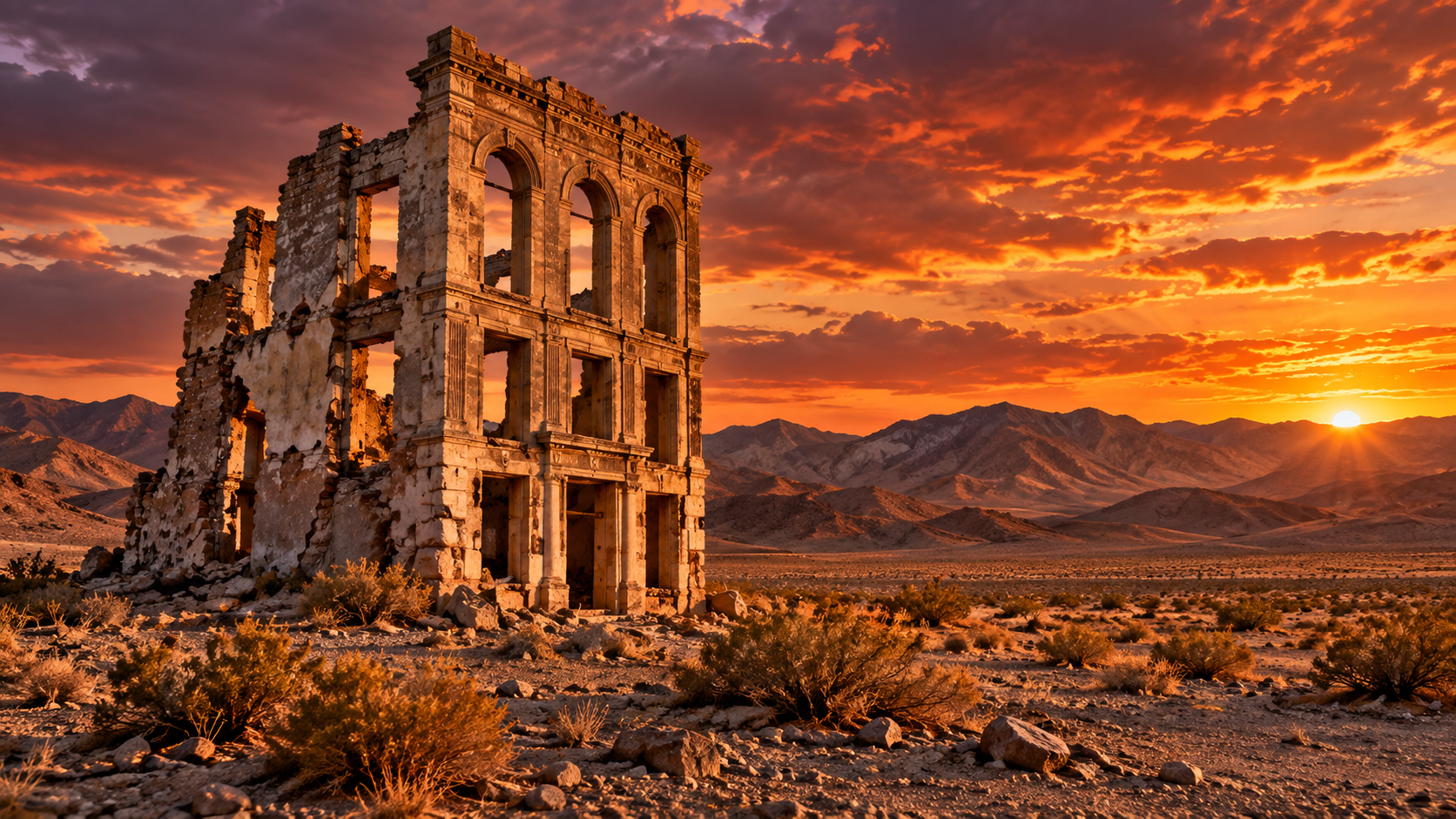
On August 9, 1904, two prospectors, Frank "Shorty" Harris and Ernest "Ed" Cross, found gold in the hills of southwestern Nevada, on the edge of the Death Valley country. The ore was spotted green, and they named their claim the Bullfrog. Word spread, and within months a gold rush was on. More than 2,000 mining claims were staked across the district. Several rival towns sprang up. The one that won was Rhyolite, platted in January 1905 and named for the silica-rich volcanic rock in the area. It sat in a sheltered basin near the district's biggest producer, the Montgomery-Shoshone Mine. In 1906, the steel magnate Charles M. Schwab bought the Montgomery-Shoshone and invested heavily, bringing piped water, electric lines and railroads that served the town as well as the mine. Rhyolite grew into a real city almost overnight. By 1907 it had concrete sidewalks, electric streetlights, telephones, a hospital, a school, an opera house, banks and a stock exchange. On May 22, 1907, the Bullfrog-Goldfield Railroad reached town. At its peak in 1907 and 1908, scholarly estimates put the population at between 3,500 and 5,000. The fall came almost as fast. The national financial Panic of 1907 made it much harder to raise money for mines. In 1908, worried investors in the Montgomery-Shoshone ordered an independent study, which found the mine was overvalued, and its stock crashed. The mine's high-grade ore was running low, and the lower-grade ore wasn't worth mining at the time. All three of Rhyolite's banks closed by March 1910, and by that year only about 611 residents remained. On March 14, 1911, the directors voted to close the Montgomery-Shoshone mine and mill. Within weeks, the town newspaper stopped publishing. The power was shut off around 1916, the post office closed in 1919, and the 1920 census counted just 14 residents. The buildings were stripped or left to the desert, but some survived. The three-story Cook Bank Building still stands as a dramatic shell. So does the Tom Kelly Bottle House, built by miner Tom Kelly in 1906 from about 50,000 glass bottles set in mud. Paramount Pictures restored it in 1925, when Rhyolite began to be used as a filming location. In 2003, the federal government withdrew 277 acres around the site from mining to protect it. Today, the town's ruins stand in the desert, and visitors on their way into Death Valley stop to walk through them.
Last corrected: Oct 6, 2026.
Grew up near here?
Get the free Nevada guide: every Hidden Current place in the region, with what you can still see and how to get there.
State guides are coming soon. Email signup is not available yet.
Watch the short documentary
Rhyolite, Nevada: The Gold Rush Boomtown That Emptied in a Decade
Claim log
| # | Claim | Sources | Status |
|---|---|---|---|
| 1 | The Rhyolite Historic Area is 4 miles west of Beatty on NV 374, at GPS coordinates 36.89028, -116.82615; phone 775-482-7800 |
| Sourced |
| 2 | The Rhyolite Historic Area is day use only, includes the Cook Bank Building and Nevada's best preserved bottle house, and is along a major road to Death Valley National Park |
| Sourced |
| 3 | The site is open to the public free of charge on land overseen by the Bureau of Land Management; most visitors spend 1 to 2 hours |
| Sourced |
| 4 | There are no modern flush restrooms at the site; the nearest services are in Beatty |
| Sourced |
| 5 | Rhyolite is a ghost town in Nye County, Nevada |
| Sourced |
| 6 | Frank "Shorty" Harris and Ernest "Ed" Cross started the Bullfrog gold rush |
| Sourced |
| 7 | Rhyolite lay in a sheltered desert basin near the region's biggest producer, the Montgomery-Shoshone Mine |
| Sourced |
| 8 | Charles M. Schwab bought the Montgomery-Shoshone Mine in 1906 and invested in piped water, electric lines and railroad transportation |
| Sourced |
| 9 | Scholarly sources generally place Rhyolite's peak population between 3,500 and 5,000 in 1907–08 |
| Sourced |
| 10 | In 1908, investors ordered an independent study of the Montgomery-Shoshone Mine; by the end of 1910 it was operating at a loss, and it closed in 1911 |
| Sourced |
| 11 | Bullfrog Mine was discovered by Frank "Shorty" Harris and Eddie Cross on August 9, 1904 |
| Sourced |
| 12 | The Bullfrog-Goldfield Railroad reached Rhyolite on May 22, 1907 |
| Sourced |
| 13 | The Rhyolite townsite was platted in January 1905 |
| Sourced |
| 14 | The lower grade ore was not profitable to mine at the time, and many mines closed |
| Sourced |
| 15 | Remaining buildings include the railroad depot, the Cook Bank building ruin, the Porter Brothers store, and the school |
| Sourced |
| 16 | The townsite was named after rhyolite, the silica-rich volcanic rock in the area; there were over 2,000 mining claims |
| Sourced |
| 17 | Rhyolite is not within the boundary of Death Valley National Park, and the ghost town is both federal and private land |
| Sourced |
| 18 | By 1910 there were only 611 residents, and on March 14, 1911 the directors closed the Montgomery Shoshone mine and mill |
| Sourced |
| 19 | By 1907 the town had concrete sidewalks, electric streetlights, a hospital, a school, an opera house and a stock exchange |
| Sourced |
| 20 | In 2003, the federal government withdrew 277 acres from mining to protect the historic site |
| Sourced |
| 21 | All three banks in the town closed by March 1910 |
| Sourced |
| 22 | The Rhyolite Herald ceased publication on 8 April 1911, the post office closed in 1919, and the 1920 census recorded 14 residents |
| Sourced |
| 23 | Tom Kelly built the bottle house from over 50,000 bottles; it was restored by Paramount Pictures in 1925 |
| Sourced |
| 24 | The electricity installed in 1907 was turned off by 1916; the train depot is privately owned; visitors should respect No Trespassing signs |
| Sourced |
| 25 | Beatty's history includes a 1988–1998 Barrick open-pit mine |
| Sourced |
| 26 | Rhyolite is about 120 miles northwest of Las Vegas |
| Sourced |
| 27 | Rhyolite is 35 miles east of the Furnace Creek Visitor Center in Death Valley |
| Sourced |
Disagreements logged
No approved disagreements are logged on this page yet.
Submit a disagreement
Disagree with a fact in this story? Submit a source-backed note for editorial review. It stays private until approved and does not automatically become a correction.
Sources
- recreation.gov
- Bureau of Land Management
- komoot.com
- Wikipedia
- Western Mining History
- theadventureportal.com
- wheninyourstate.com
- mtnmouse.com
- allaroundnevada.com
- Moon Travel Guides
- bishopvisitor.com
- rockhounding.org
Corrections
| # | Correction | Sources |
|---|---|---|
| 1 | Rhyolite did not collapse simply because the gold ran out; the financial panic of 1907 tightened capital, and the main mine was found overvalued in 1908 |
|
| 2 | Lower-grade ore remained but was not profitable to mine at the time |
|
| 3 | Gold mining later returned near Beatty with a 1988–1998 Barrick open-pit mine |
|
| 4 | Rhyolite is near Death Valley but not within the boundary of Death Valley National Park |
|
| 5 | Peak population is often cited as 10,000, but scholarly sources place it between 3,500 and 5,000 in 1907–08 |
|
| 6 | Some sources say up to 10,000 people lived in and around the town by late 1907 |
|
| 7 | The bottle house was built by Tom Kelly, not "John Kelly" as stated by one source |
|
| 8 | One source calls it the John Kelly bottle house |
|
| 9 | Sources disagree on the discovery date, August 9 or August 4, 1904 |
|
| 10 | Sources disagree on the discovery date, August 9 or August 4, 1904 |
|