
Places That Shouldn't ExistVilla EpecuénArgentina historyresort town
Villa Epecuén: The Argentine Resort Town That Rose From a Lake
Villa Epecuén was an Argentine spa resort until a 1985 flood slowly buried it under about 10 meters of salt water. In 2009 the lake began to retreat.
Every claim sourced
20 claims · 20 sources
0 disagreements logged
11 editorial corrections
Last checked Oct 6, 2026
The story
The numbered claim log below connects facts in this story to their sources.
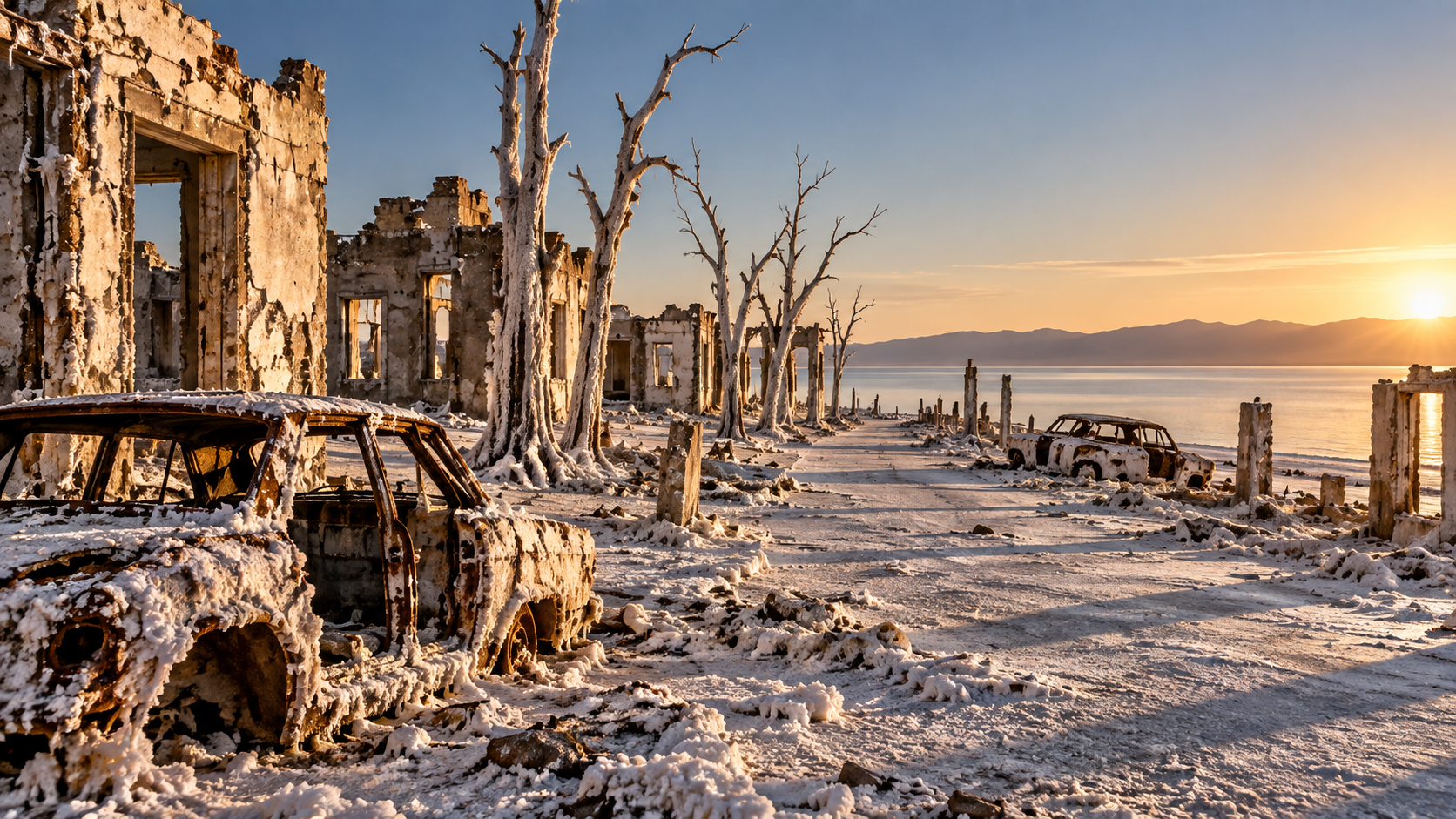
On the Pampas of Buenos Aires Province lies Lake Epecuén, a lake so salty that its water has been compared to the Dead Sea. People believed its water could heal, and in the early 20th century a resort town grew up on its shore to take advantage of it. Villa Epecuén was founded in the 1920s, and a railway line soon brought visitors from Buenos Aires. The town flourished. From the 1950s into the 1970s, as many as 25,000 tourists came each summer season to float in the salt water and stay in its hotels, guesthouses and spas. At its peak, Villa Epecuén had around 1,500 residents, room for about 5,000 visitors, and some 280 businesses. In 1938, the town even got a striking Art Deco slaughterhouse designed by the architect Francisco Salamone. The lake that made the town also threatened it. In the late 1970s and early 1980s, years of unusually heavy rain swelled Lake Epecuén, and the town depended on embankments to hold the water back. In November 1985, the embankment protecting Villa Epecuén gave way. The water poured in and rose steadily. Residents evacuated, taking what they could. The water didn't stop. It kept rising over the following years, and by around 1993, the town lay under about 10 meters of salt water. Villa Epecuén stayed underwater for more than two decades. Then, around 2009, a long dry spell set in, and the lake began to shrink. Slowly, the town reappeared, transformed. The salt water had stripped the buildings, killed the trees and coated everything in a crust of white and gray salt. Streets, rusted cars, the skeletons of hotels and the ruined slaughterhouse emerged from the lake bed. One former resident came back. Pablo Novak, born in 1930, had grown up in Villa Epecuén and stayed nearby after the flood. In 2009, as the water receded, he moved back into the ruins and lived there alone for years, becoming famous around the world as the town's only inhabitant. He died on January 22, 2024, at 93, and after his death Villa Epecuén was officially declared deserted. Today, visitors walk the salt-white ruins of the resort town.
Last corrected: Oct 6, 2026.
Grew up near here?
Get the free state guide: every Hidden Current place in the region, with what you can still see and how to get there.
State guides are coming soon. Email signup is not available yet.
Watch the short documentary
Villa Epecuén: The Argentine Resort Town That Rose From a Lake
Claim log
| # | Claim | Sources | Status |
|---|---|---|---|
| 1 | Villa Epecuén is at 37°7′51″S 62°48′27″W, in Adolfo Alsina Partido, Buenos Aires Province |
| Sourced |
| 2 | At its height, Villa Epecuén could accommodate at least 5,000 visitors |
| Sourced |
| 3 | On 6 November 1985, a seiche broke a nearby dam and the dike protecting the village; the water reached a peak of 10 metres (33 ft) |
| Sourced |
| 4 | There were up to 280 businesses, and 25,000 tourists visited between November and March, from the 1950s to the 1970s |
| Sourced |
| 5 | The town reached a population of 1,500 at its peak |
| Sourced |
| 6 | Pablo Novak, born in 1930, returned to his home in 2009 when the waters receded |
| Sourced |
| 7 | Pablo Novak lived in the ruins until his death on 22 January 2024, after which Villa Epecuén was declared a deserted village |
| Sourced |
| 8 | Many of the ruins are covered by a layer of white and grey salt |
| Sourced |
| 9 | On 10 November 1985 the water broke through the dam and inundated much of the town under four feet of water; by 1993 the town was covered in 10 meters of water |
| Sourced |
| 10 | In 2009, the wet weather reversed and the waters began to recede |
| Sourced |
| 11 | On November 10, 1985, the lake dam broke, causing a slow but devastating flood |
| Sourced |
| 12 | Villa Epecuén was established in the 1920s on the shores of salty Lake Epecuén |
| Sourced |
| 13 | In 1938, a modern slaughterhouse designed by Francisco Salamone was inaugurated |
| Sourced |
| 14 | Visitors pay an accessible entrance fee to the Municipality of Carhué to enter the ruins |
| Sourced |
| 15 | The town's former train station has been converted into a free museum with photos and salvaged items |
| Sourced |
| 16 | Carhué's Epecuén Hotel & Spa Termal offers guided tours of Villa Epecuén |
| Sourced |
| 17 | Lake Epecuén's hypersaline waters have been compared to the Dead Sea |
| Sourced |
| 18 | In the 1980s, Villa Epecuén had about 1,000 stable residents and 5,000 hotel places |
| Sourced |
| 19 | Carhué is about 520 km from Buenos Aires |
| Sourced |
| 20 | Pablo Novak died in Carhué on 22 January 2024 at the age of 93 |
| Sourced |
Disagreements logged
No approved disagreements are logged on this page yet.
Submit a disagreement
Disagree with a fact in this story? Submit a source-backed note for editorial review. It stays private until approved and does not automatically become a correction.
Sources
- Wikipedia
- Amusing Planet
- Slate
- meer.com
- islands.com
- diariouno.com.ar
- losandes.com.ar
- grokipedia.com
Corrections
| # | Correction | Sources |
|---|---|---|
| 1 | The water reached a peak of about 10 metres (33 ft), more than thirty feet, not nearly thirty feet |
|
| 2 | The town was not buried at once; it was flooded under about four feet of water in 1985, and the water rose to about 10 meters by 1993 |
|
| 3 | The water began receding in 2009, about 24 years after the flood, not exactly 25 years |
|
| 4 | Pablo Novak, often described as the town's sole living resident, died on 22 January 2024 |
|
| 5 | Sources disagree on the date the embankment failed: 6 November 1985 |
|
| 6 | Sources disagree on the date the embankment failed: 10 November 1985 |
|
| 7 | Sources disagree on the peak population: 1,500 residents |
|
| 8 | Sources disagree on the peak population: about 1,000 stable residents |
|
| 9 | One source states a population of around 5,000 residents, which other sources describe as visitor capacity |
|
| 10 | Sources disagree on the 1993 water depth: 10 meters |
|
| 11 | Sources disagree on the 1993 water depth: 7 meters |
|
More Places That Shouldn't Exist places
- Parícutin: The Volcano That Was Born in a Farmer's Cornfield
- Ferropolis: Germany's City of Iron Built From Giant Mining Machines
- Barra Airport: Where Scheduled Flights Land on a Beach
- Reelfoot Lake: The Tennessee Lake Created by an Earthquake
- Hashima Island: Japan's Abandoned Battleship Island
- Lake Resia: The Bell Tower of the Village Beneath the Water