
Forgotten AmericaAdakCold War historynaval base
Adak, Alaska: The Aleutian Navy Town Left Behind After 1997
Adak, Alaska grew from a 1942 airfield into a Navy base of 6,000 people in the Aleutians. After it closed in 1997, most of the town was left empty.
Every claim sourced
20 claims · 20 sources
0 disagreements logged
5 editorial corrections
Last checked Oct 6, 2026
The story
The numbered claim log below connects facts in this story to their sources.
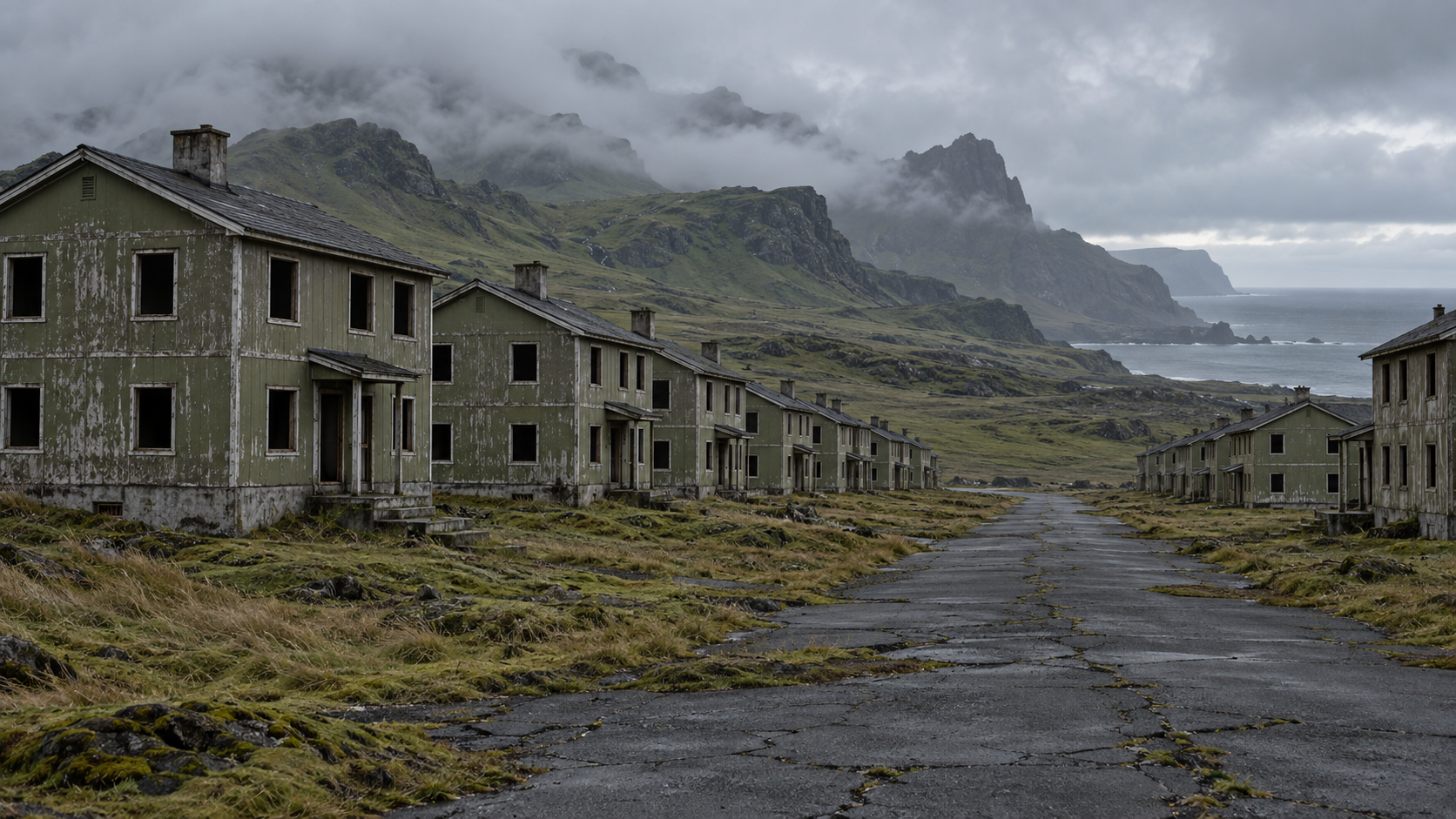
Far out in the Aleutian Islands, the chain of volcanic islands that arcs from Alaska toward Russia, lies Adak Island. It's cold, foggy and windy, with rain or snow on most days of the year. For centuries it was home to the Unangax̂, or Aleut, people, who hunted and fished around the island. World War II brought the military. In June 1942, Japanese forces occupied the islands of Attu and Kiska at the far western end of the chain, the first foreign occupation of American soil since the War of 1812. To strike back, the U.S. built an airfield on Adak in a matter of weeks. It opened on August 30, 1942, and flight operations began in September, putting American bombers within range of Kiska. About 6,000 military personnel served on Adak during the war. After the war, the base stayed. In 1950, the Navy took over, and through the Cold War, Adak became an important naval air station and a center for tracking Soviet submarines in the North Pacific. The base grew into a full town, housing more than 6,000 Navy and Coast Guard personnel and their families at its peak. It had schools, a college, stores and even a McDonald's. Then the Cold War ended. Cutbacks began in 1994, closing family housing and schools. In 1995, the base was put on the list for closure, and on March 31, 1997, the Naval Air Facility closed. Nearly everyone left. The population fell from 4,633 in 1990 to a few hundred. What remained was a ghost of a Navy town: rows of empty houses, barracks, a school and commercial buildings, many slowly decaying in the wind and rain. The Aleut Corporation acquired most of the facilities through a land transfer agreement, and in 2001 Adak incorporated as a city, the westernmost municipality in the United States. The 2020 census counted 171 residents. Today the old airfield is a public airport with jet service twice a week from Anchorage, and Adak's small community lives on among the empty streets of the base. There's even been discussion of the Navy reopening the air station.
Last corrected: Oct 6, 2026.
Grew up near here?
Get the free Alaska guide: every Hidden Current place in the region, with what you can still see and how to get there.
State guides are coming soon. Email signup is not available yet.
Watch the short documentary
Adak, Alaska: The Aleutian Navy Town Left Behind After 1997
Claim log
| # | Claim | Sources | Status |
|---|---|---|---|
| 1 | Adak is at 51°52′41″N 176°38′46″W and is the westernmost municipality in the United States and the southernmost city in Alaska |
| Sourced |
| 2 | Adak lies 1,200 miles southwest of Anchorage and 450 miles west of Dutch Harbor |
| Sourced |
| 3 | At the 2020 census, the population was 171, down from 326 in 2010 |
| Sourced |
| 4 | After the war, Adak was developed as a naval air station and played an important role during the Cold War as a submarine surveillance center |
| Sourced |
| 5 | At its peak, the station housed over 6,000 naval and Coast Guard personnel and their families |
| Sourced |
| 6 | The station officially closed on March 31, 1997, as a result of the 1995 Base Realignment and Closure Commission |
| Sourced |
| 7 | The Aleut Corporation purchased Adak's facilities under a land transfer agreement and owns substantially all of the infrastructure |
| Sourced |
| 8 | At its peak, Adak had a college and a McDonald's restaurant; by March 2003, most facilities had closed |
| Sourced |
| 9 | The Navy is considering reopening the air base at Adak |
| Sourced |
| 10 | Adak has 263 rainy days per year |
| Sourced |
| 11 | Japanese forces took control of Attu and Kiska, the first foreign enemy to occupy American soil since the War of 1812 |
| Sourced |
| 12 | Flight operations on Adak began in September 1942; about 6,000 American military men served on Adak during World War II |
| Sourced |
| 13 | Adak has an average of 341 days per year with measurable precipitation |
| Sourced |
| 14 | Adak Army Airfield was established on 30 August 1942 as a forward base to attack Japanese forces on Kiska |
| Sourced |
| 15 | The facility was used by the US Army Air Forces 1942–1947, the US Air Force 1947–1950, and the US Navy 1950–1997, and was designated a National Historic Landmark for its role in World War II |
| Sourced |
| 16 | In July 1950, the U.S. Air Force transferred the facility to the U.S. Navy, and it was used throughout the Cold War |
| Sourced |
| 17 | Alaska Airlines provides scheduled jet service to Adak every Wednesday and Saturday from Anchorage |
| Sourced |
| 18 | In 1994, military cutbacks closed family housing and schools |
| Sourced |
| 19 | Adak's population was 4,633 in 1990 |
| Sourced |
| 20 | Adak became a city in April 2001 |
| Sourced |
Disagreements logged
No approved disagreements are logged on this page yet.
Submit a disagreement
Disagree with a fact in this story? Submit a source-backed note for editorial review. It stays private until approved and does not automatically become a correction.
Sources
- Wikipedia
- National Museum of the U.S. Navy
- usacitiesonline.com
- Kiddle
Corrections
| # | Correction | Sources |
|---|---|---|
| 1 | Adak was not built as a Cold War base; it began as an Army airfield in 1942 during World War II, and the Navy took over in 1950 |
|
| 2 | Adak is not fully abandoned; it incorporated as a city in 2001 and had 171 residents in 2020 |
|
| 3 | Sources disagree on wet days: 263 rainy days per year |
|
| 4 | Sources disagree on wet days: 341 days per year with measurable precipitation |
|
| 5 | The Navy's departure began with cutbacks in 1994 before the station officially closed on March 31, 1997 |
|