
Forgotten AmericaTimes BeachRoute 66dioxin
Times Beach, Missouri
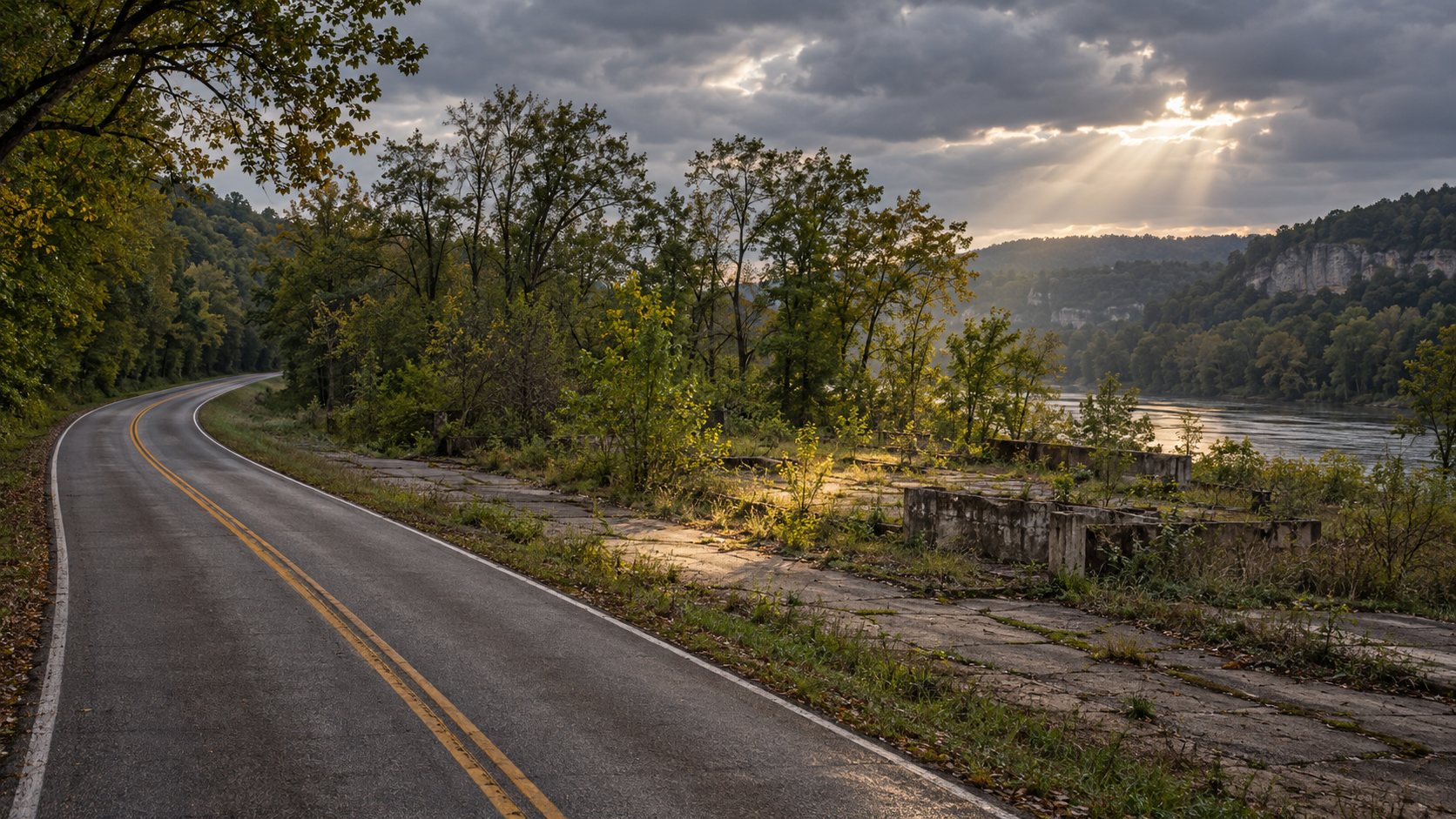
Times Beach was a Route 66 town in Missouri that was abandoned after contaminated waste oil sprayed on its dirt roads caused a major dioxin disaster. After a 1982 flood spread the contamination, the government bought out the town.
Every claim sourced
38 claims · 38 sources
0 disagreements logged
3 editorial corrections
Last checked Oct 2, 2026
The story
The numbered claim log below connects facts in this story to their sources.
Times Beach began in 1925 as a real-estate promotion. The *St. Louis Times* offered readers a six-month subscription and a small lot beside the Meramec River for $67.50. The lots were sold as a summer resort; people built permanent homes on them instead. When a new Meramec bridge opened in the early 1930s, Route 66 was routed through the town. By the early 1980s more than two thousand people lived there. The roads were unpaved. Between 1972 and 1976 Times Beach paid a waste-oil hauler, Russell Bliss, to spray them with oil to keep the dust down. The oil was not only oil. Bliss had also contracted to remove waste from a chemical plant at Verona, Missouri, operated by the Northeastern Pharmaceutical and Chemical Company, which had produced Agent Orange during the Vietnam War. That waste contained dioxin. Bliss mixed it with waste motor oil and sprayed the mixture at sites across eastern Missouri, Times Beach among them. Animals died first. At one breeding stable 62 horses died between 1971 and 1973, along with dogs and cats. It took another decade to establish why. In December 1982 the Meramec flooded the town. On 23 December, with residents still displaced by the water, the EPA announced it had found dioxin in Times Beach soil — up to roughly 127 parts per billion, against a CDC threshold of one. Residents did not return. In February 1983 the federal government used the newly created Superfund to buy the town; by the end of that month some $36 million had bought every house in Times Beach but one. Between two and three thousand people were relocated, depending on whose count you take. Times Beach was disincorporated in 1985. The soil stayed until the mid-1990s. A high-temperature incinerator built on the site burned 265,374 tons of contaminated soil — from Times Beach and 24 other eastern Missouri sites — between March 1996 and June 1997. The incinerator was dismantled and the land handed to the State of Missouri. Route 66 State Park, 419 acres, opened on the site on 11 September 1999. The EPA removed Times Beach from the Superfund list on 25 September 2001. Whether the evacuation was necessary is still argued. Vernon Houk, the CDC official who recommended it, said in 1991 that the risk had been overstated — a remark he made at a convention sponsored by Syntex, a company tied to the contamination's liability. The World Health Organization's cancer agency classified the dioxin TCDD a known human carcinogen in 1997 and has not withdrawn that finding.
Last corrected: Oct 3, 2026.
Grew up near here?
Get the free Missouri guide: every Hidden Current place in the region, with what you can still see and how to get there.
State guides are coming soon. Email signup is not available yet.
Watch the short documentary
Times Beach, Missouri
Claim log
| # | Claim | Sources | Status |
|---|---|---|---|
| 1 | The Route 66 State Park visitor center/museum is at 38.50575, -90.59092 |
| Sourced |
| 2 | Route 66 State Park is at 38.50861, -90.60250 |
| Sourced |
| 3 | The visitor center is at 97 N. Outer Road, Suite 1, Eureka, MO 63025 |
| Sourced |
| 4 | Times Beach was founded in 1925 |
| Sourced |
| 5 | Times Beach was founded in 1925 as a summer resort |
| Sourced |
| 6 | Route 66 was rerouted through Times Beach in 1933 |
| Sourced |
| 7 | Times Beach had 2,240 residents and 23 miles of dirt roads |
| Sourced |
| 8 | Between February and October 1971, waste oil hauler Russell Bliss collected six truckloads, nearly 18,500 US gallons, of chemical waste heavily contaminated with dioxin |
| Sourced |
| 9 | Independent Petrochemical Corporation paid Bliss to dispose of its hazardous dioxin waste |
| Sourced |
| 10 | Bliss brought the dioxin-contaminated waste to his facility in Frontenac, Missouri, and mixed it into tanks of used motor oil |
| Sourced |
| 11 | In 1972, town officials hired Russell Bliss to spray oil on the roads to keep the dust down |
| Sourced |
| 12 | Between 1972 and 1976, Bliss sprayed waste oil on the town's roads |
| Sourced |
| 13 | The town paid Bliss 6 cents per gallon to spray its roads |
| Sourced |
| 14 | Bliss also sprayed the dioxin-laced oil on several dozen other sites in the area |
| Sourced |
| 15 | Bliss later claimed he was unaware the waste contained dioxin |
| Sourced |
| 16 | Times Beach experienced a devastating flood in December 1982 |
| Sourced |
| 17 | In December 1982, the Meramec River flooded Times Beach |
| Sourced |
| 18 | A soil sample taken December 3, 1982, showed dioxin levels some 100 times higher than the one part per billion considered hazardous to humans |
| Sourced |
| 19 | On December 23, 1982, the Missouri Department of Health and the CDC informed residents the town was contaminated and would have to be evacuated and demolished |
| Sourced |
| 20 | On December 23, 1982, the CDC labeled Times Beach uninhabitable |
| Sourced |
| 21 | In February 1983, the EPA announced a buyout of all properties in the town, using money from the newly created Superfund |
| Sourced |
| 22 | On February 23, 1983, the EPA announced the town's buyout for $32 million |
| Sourced |
| 23 | In early 1983, the EPA announced a $32 million buyout for the town |
| Sourced |
| 24 | The 1983 federal buyout of Times Beach was the first of its kind in the nation |
| Sourced |
| 25 | In 1985, the State of Missouri officially disincorporated Times Beach |
| Sourced |
| 26 | In 1996 and 1997, the government removed 265,000 tons of contaminated soil and debris from Times Beach and 28 other sites in eastern Missouri for $110 million |
| Sourced |
| 27 | In 2001, the EPA removed Times Beach from its Superfund list |
| Sourced |
| 28 | Route 66 State Park opened in 1999 on the former site of Times Beach |
| Sourced |
| 29 | In 1999, the bulldozed and cleaned-up Times Beach reopened as Route 66 State Park |
| Sourced |
| 30 | Route 66 State Park encompasses 424 acres one mile east of Eureka |
| Sourced |
| 31 | The 419-acre Route 66 State Park opened in October 1999 |
| Sourced |
| 32 | The visitor center is in the Bridgehead Inn, a roadhouse built in 1935 |
| Sourced |
| 33 | The visitor center is housed in a 1935 roadhouse once called Steiny's Inn |
| Sourced |
| 34 | The visitor center is at I-44 exit 266 and is cut off from the park it serves |
| Sourced |
| 35 | The old Route 66 bridge over the Meramec River is closed because of safety concerns |
| Sourced |
| 36 | Route 66 State Park is a day-use park with free admission |
| Sourced |
| 37 | The visitor center is closed December through February |
| Sourced |
| 38 | In 2012, the EPA returned to Times Beach at the request of the Missouri Department of Natural Resources to test for dioxin |
| Sourced |
Disagreements logged
No approved disagreements are logged on this page yet.
Submit a disagreement
Disagree with a fact in this story? Submit a source-backed note for editorial review. It stays private until approved and does not automatically become a correction.
Sources
- mostateparks.com
- Wikipedia
- visitmo.com
- legendsofamerica.com
- en-academic.com
- nvdatabase.swarthmore.edu
- fox2now.com
- stlpr.org
- history.com
- missouriresources.mo.gov
Corrections
| # | Correction | Sources |
|---|---|---|
| 1 | Russell Bliss did not create the dioxin: Independent Petrochemical Corporation paid him to dispose of its hazardous dioxin waste |
|
| 2 | The dioxin waste Bliss collected in 1971 was chemical waste heavily contaminated with dioxin from a chemical company, not ordinary used oil |
|
| 3 | Bliss claimed he was unaware the waste contained dioxin, so the record does not support saying he knowingly poisoned the town |
|