
Forgotten Americaminingiron orerelocation
Hibbing, Minnesota: The Town That Moved for an Iron Mine
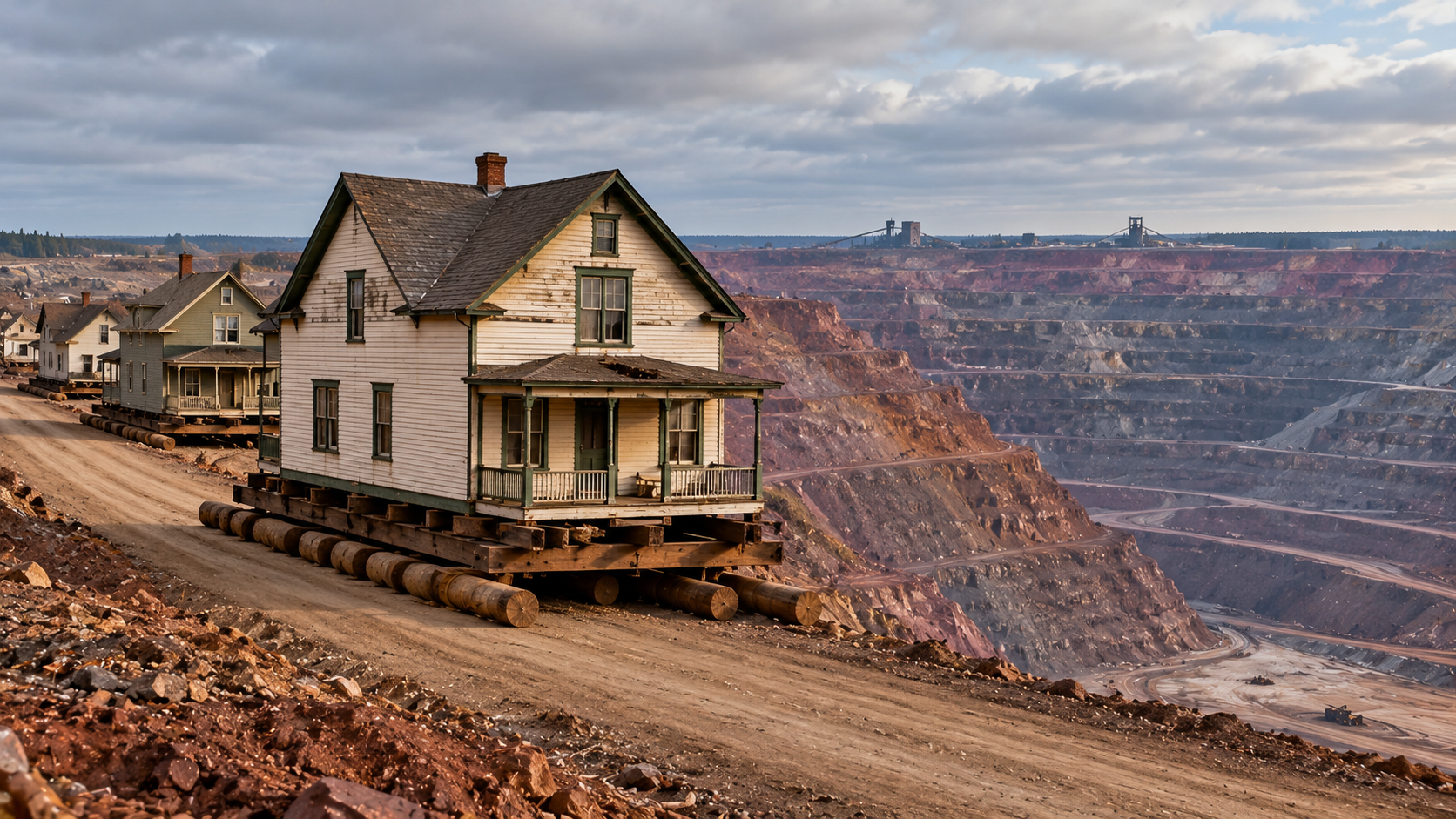
When iron ore turned up under Hibbing, Minnesota, the mining company moved the town. From 1919, houses and stores rolled south on wheels and logs.
Every claim sourced
16 claims · 16 sources
0 disagreements logged
0 editorial corrections
Last checked Oct 2, 2026
The story
The numbered claim log below connects facts in this story to their sources.
Hibbing was founded in 1893 by Frank Hibbing, a German-born miner who found iron ore on Minnesota's Mesabi Range. He reportedly believed the richest ore lay right under where the town was being built, and urged that it go farther south. Nobody listened. He turned out to be right. Starting in 1895, separate open-pit mines around the town, the Hull, the Rust, the Mahoning and others, began digging, and over time they merged into one enormous pit. In 1901 the Oliver Iron Mining Company, part of the new U.S. Steel, became the major operator. The pit grew until it surrounded Hibbing on three sides, and the ore the company wanted was underneath the town itself. In 1918, the company proposed a solution: move the town. It would pay for new infrastructure in a new location to the south, near the neighboring community of Alice. The plan was approved, though not everyone agreed. In 1919, about 150 residents filed an injunction to try to stop it. The move began in 1919. Buildings were lifted onto steel wheels and timbers, then pulled south by horses, tractors and a steam crawler the company supplied. About 185 houses and 20 businesses made the trip, and some of the largest buildings had to be cut in half to move them. The company paid for a new high school, a hospital, a village hall and a hotel, the Androy, along with sewer and electric lines. The main relocation took about two years and cost about $16 million. A few holdouts stayed in old Hibbing for another decade, until the company bought their properties for a fraction of their value and tore them down. The move even gave rise to an American institution. In 1914, Carl Wickman and Andrew Anderson started a bus line carrying miners between Hibbing and Alice. It grew into Greyhound, and Hibbing is home to the Greyhound Bus Museum. Where the old town stood, the pit kept growing. During its peak years in the two World Wars, the Hull–Rust–Mahoning Mine supplied as much as one-fourth of all the iron ore mined in the United States. It became a National Historic Landmark in 1966, and it's still being mined today. From the overlook, the foundations of the town that moved are still visible at the edge of the pit.
Last corrected: no editorial corrections on this page yet.
Grew up near here?
Get the free Minnesota guide: every Hidden Current place in the region, with what you can still see and how to get there.
State guides are coming soon. Email signup is not available yet.
Watch the short documentary
Hibbing, Minnesota: The Town That Moved for an Iron Mine
Claim log
| # | Claim | Sources | Status |
|---|---|---|---|
| 1 | The Hull–Rust–Mahoning Mine is at 47.45833, -92.95000; NHL 1966; NRHP #66000904 |
| Sourced |
| 2 | The Hull–Rust–Mahoning Mine is at 47.45833, -92.95000; NHL 1966; NRHP #66000904 |
| Sourced |
| 3 | The East Howard Street Historic District is at 47.42750, -92.93917 and was built by Oliver 1919–1925 |
| Sourced |
| 4 | Hibbing was founded in 1893 by Frank Hibbing, a German miner; buildings moved on steel wheels and logs; foundations and signs remain; the move cost $16M |
| Sourced |
| 5 | Frank Hibbing suggested a southern site; 150 residents filed an injunction; the company funded buildings and utilities; holdouts were demolished |
| Sourced |
| 6 | The mine began in 1895, with merged pits |
| Sourced |
| 7 | Oliver became the operator in 1901 |
| Sourced |
| 8 | The pit surrounded the town on three sides; the move was proposed in 1918; horses, tractors and a steam crawler moved the buildings |
| Sourced |
| 9 | About 185 houses and 20 businesses moved, some cut in half, over about two years |
| Sourced |
| 10 | The Androy Hotel was built in 1921 |
| Sourced |
| 11 | Greyhound began in 1914 with Wickman and Anderson running buses between Hibbing and Alice |
| Sourced |
| 12 | The mine supplied one-fourth of U.S. iron ore during both World Wars |
| Sourced |
| 13 | The mine supplied one-fourth of U.S. iron ore during both World Wars |
| Sourced |
| 14 | Hibbing Taconite still mines the pit |
| Sourced |
| 15 | The Mine View is open May–September, closing at 9 p.m./dusk or 8 p.m. per two city pages |
| Sourced |
| 16 | The museum has a diorama of the old town |
| Sourced |
Disagreements logged
No approved disagreements are logged on this page yet.
Submit a disagreement
Disagree with a fact in this story? Submit a source-backed note for editorial review. It stays private until approved and does not automatically become a correction.
Sources
- Wikipedia
- National Park Service
- City of Hibbing
- Forgotten Minnesota
- HMDB
- TheTravel
- Source needs identification
- Iron Range Tourism
Corrections
No editorial corrections are logged on this page yet.