
Forgotten AmericaOscarvilleLake LanierGeorgia history
The Town Hidden Beneath The Lake, Georgia
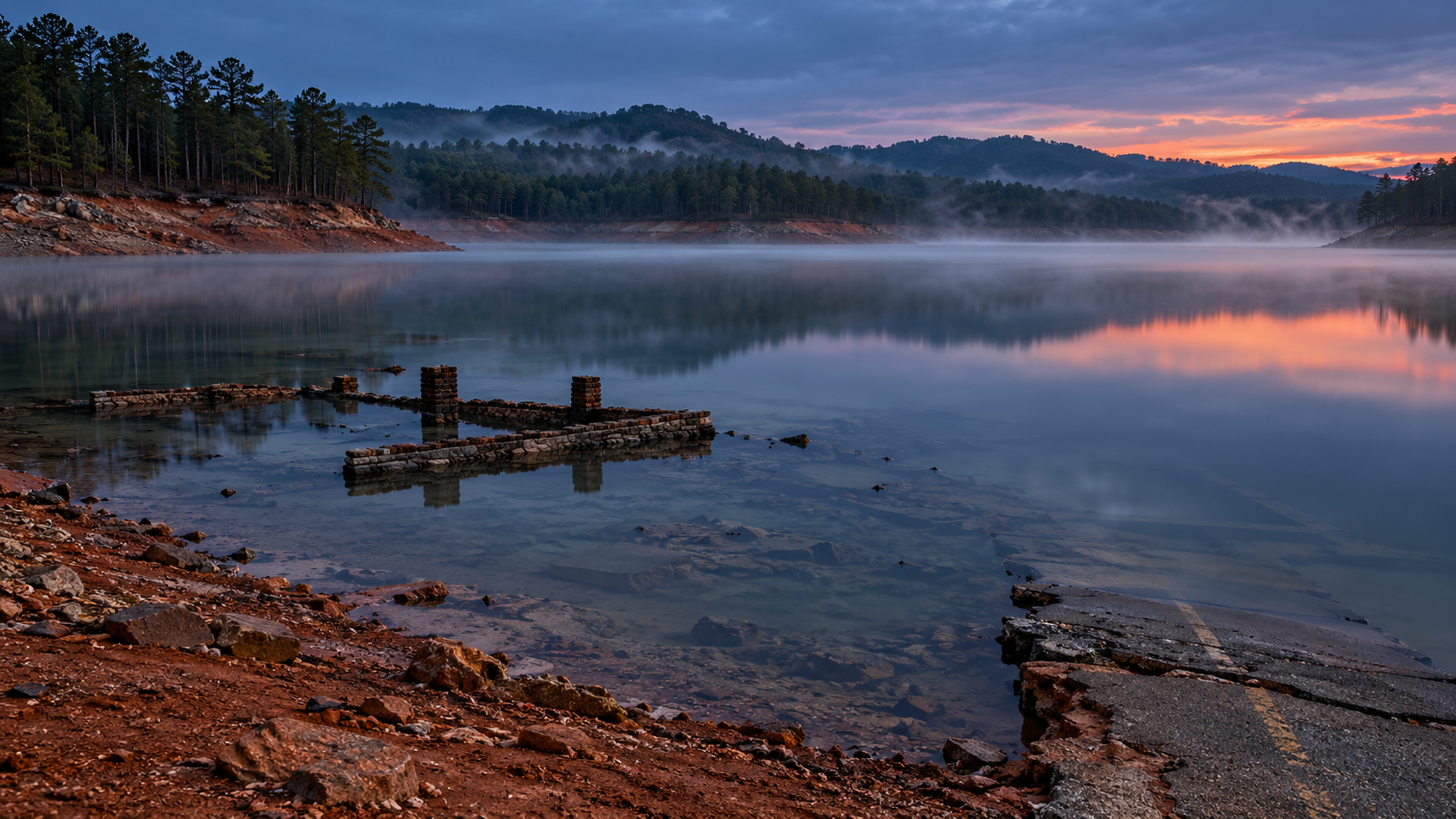
Oscarville, Georgia is known online as the town beneath Lake Lanier. The video says the real history differs from that legend: the area was part of the 1912 expulsion of Black residents from Forsyth County, and only part of it was later covered by the reservoir.
Every claim sourced
20 claims · 20 sources
0 disagreements logged
4 editorial corrections
Last checked Oct 2, 2026
The story
The numbered claim log below connects facts in this story to their sources.
Oscarville, Georgia is known online as "the town beneath Lake Lanier." The video argues that the real history is different from the legend. In September 1912, an 18-year-old white woman named Mae Crow was attacked near Oscarville. [GAP: what the video establishes about the attack itself.] A white mob lynched Rob Edwards in the Cumming town square. Two Black teenagers, Ernest Knox and Oscar Daniel, were hanged after one-day trials before all-white juries. [GAP: when and where the hangings took place.] Within weeks, nearly all of Forsyth County's 1,098 Black residents had been driven out. The county stayed almost entirely white into the 1980s. [GAP: how Oscarville's own residents and land were affected, and Oscarville's relationship to Forsyth County, which the video implies but does not state.] Lake Lanier came more than 40 years later. The Army Corps of Engineers began filling the reservoir behind Buford Dam in 1956, covering farms, roads and cemeteries across several counties [GAP: which counties], including part of the Oscarville area. According to the video, historians say the lake was not built to flood a Black town [GAP: which historians], and most of Oscarville's land still sits above the waterline. ## Sources cited Atlanta History Center (Forsyth 1912 project), Equal Justice Initiative, U.S. Army Corps of Engineers, USGS Geographic Names Information System, Forsyth County News.
Last corrected: Oct 3, 2026.
Grew up near here?
Get the free Georgia guide: every Hidden Current place in the region, with what you can still see and how to get there.
State guides are coming soon. Email signup is not available yet.
Watch the short documentary
The Town Hidden Beneath The Lake, Georgia
Claim log
| # | Claim | Sources | Status |
|---|---|---|---|
| 1 | Oscarville is at 34.2484331 N, -83.9749056 W, about 1,191 ft elevation |
| Sourced |
| 2 | Oscarville's GNIS Feature ID is 326442 |
| Sourced |
| 3 | Oscarville was a small community in the Newbridge district of Forsyth County |
| Sourced |
| 4 | In 1912, Forsyth County had about 12,000 residents, 1,098 of them Black |
| Sourced |
| 5 | Mae Crow was an 18-year-old Oscarville resident, found badly beaten in the woods a few miles east of Cumming |
| Sourced |
| 6 | Mae Crow died of her injuries some days after the attack |
| Sourced |
| 7 | On September 10, 1912, 24-year-old Rob Edwards was lynched in downtown Cumming; the mob stormed the jail, beat and shot him, and hung his body in the square |
| Sourced |
| 8 | Knox and Daniel were convicted by all-white juries after one-day trials |
| Sourced |
| 9 | Knox and Daniel were publicly hanged |
| Sourced |
| 10 | Night riders gutted homes and burned Black-owned property; within weeks nearly every Black resident had left, and the county stayed virtually all-white until the 1980s |
| Sourced |
| 11 | Black residents' abandoned homes and property were later absorbed into white ownership |
| Sourced |
| 12 | The Corps established Lake Lanier through eminent domain |
| Sourced |
| 13 | Lake Lanier began filling on February 1, 1956 |
| Sourced |
| 14 | The story that the lake was built to flood a Black town is a myth; Oscarville was predominantly white; the expulsion happened across Forsyth County |
| Sourced |
| 15 | Local historians say only parts of Oscarville may be under the lake and most remains in Forsyth County |
| Sourced |
| 16 | Crews felled treetops before filling, leaving tall stumps near the surface in places |
| Sourced |
| 17 | Rooftops, foundations, cemeteries, and the Gainesville Speedway remain beneath the lake |
| Sourced |
| 18 | Drownings are attributed to submerged hazards, temperature stratification, and lack of swimmer training |
| Sourced |
| 19 | Lake Lanier is almost entirely owned and operated by the Corps |
| Sourced |
| 20 | The Rob Edwards marker was dedicated in 2021 on the 109th anniversary of his lynching and unveiled by his descendants |
| Sourced |
Disagreements logged
No approved disagreements are logged on this page yet.
Submit a disagreement
Disagree with a fact in this story? Submit a source-backed note for editorial review. It stays private until approved and does not automatically become a correction.
Sources
- USGS Flowery Branch topo map data
- Wikidata
- Atlanta History Center
- Source needs identification
- U.S. Army Corps of Engineers
Corrections
| # | Correction | Sources |
|---|---|---|
| 1 | The story that Lake Lanier was built to flood a Black town is a myth; the 1912 expulsion happened across Forsyth County decades before the lake |
|
| 2 | Oscarville is described as predominantly white, not majority-Black |
|
| 3 | Most of Oscarville remains on land in Forsyth County; only parts may be under the lake |
|
| 4 | Lake Lanier did not flood in 1950; it began filling on February 1, 1956 |
|