Forgotten AmericaBidwell BarLake OrovilleOroville Dam
Bidwell's Bar: The Gold Rush Town Under Lake Oroville, California
Bidwell's Bar was one of the first Gold Rush camps in California. Its site now lies under Lake Oroville, and its 1850s bridge was moved to higher ground.
Every claim sourced
13 claims · 13 sources
0 disagreements logged
2 editorial corrections
Last checked Oct 2, 2026
The story
The numbered claim log below connects facts in this story to their sources.
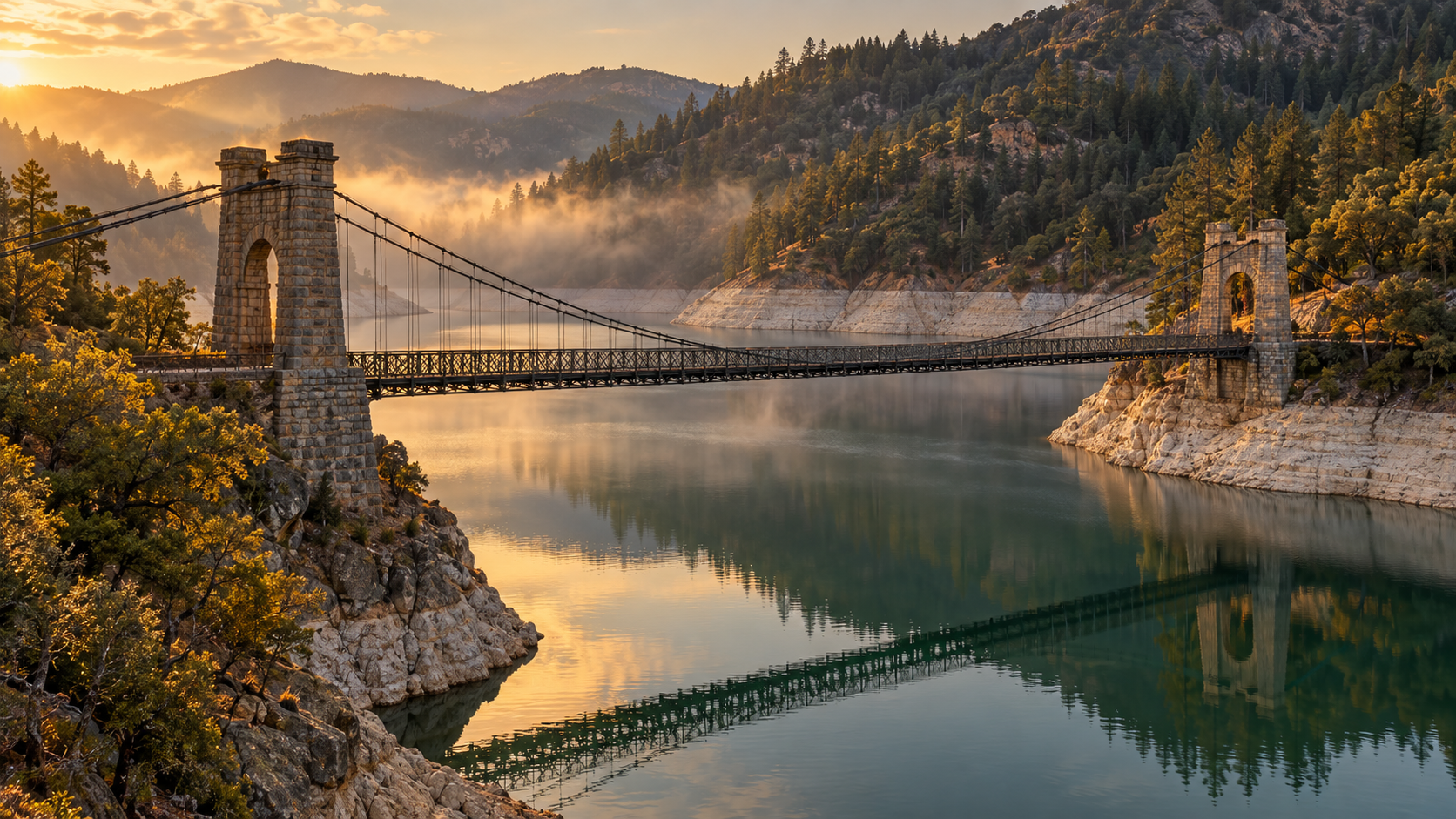
On July 4, 1848, just months after gold was found at Sutter's Mill, a pioneer named John Bidwell found gold on the Middle Fork of the Feather River in Northern California. Word spread, and the miners came. A tent camp grew on the riverbank and took his name: Bidwell's Bar. It grew fast. By 1853, the camp was putting up real wood-frame buildings, and in August of that year it became the seat of Butte County, with a courthouse of its own. The county's first newspaper, the Butte Record, was founded there that November. The population was said to be at least 2,000. Crossing the river was a constant problem, so the town invested in a bridge. An earlier crossing was destroyed in a flood, and the replacement was ambitious: an iron suspension bridge, its parts made in Troy, New York, and shipped all the way around Cape Horn to California. Completed in the mid-1850s at a cost of about $35,000, it was 240 feet long and the first suspension bridge in California. Bidwell's Bar faded almost as fast as it rose. By around the time the bridge was finished, the easy gold was running out and miners were moving on to a nearby camp called Ophir, the town that became Oroville. In 1856, the county seat moved to Oroville too. That year, the San Francisco Bulletin called Bidwell's Bar "Another Deserted Village." The town never came back, but the bridge kept working. It carried traffic across the Middle Fork for about a century, until 1954. In the 20th century, the old site became a popular park and swimming hole. Then came Oroville Dam. Construction began in 1961 on what would become the tallest dam in the United States, and the canyon behind it was going to flood. Preservationists weren't willing to lose the bridge. In the mid-1960s, it was taken apart and rebuilt on higher ground at Bidwell Canyon, along with its stone tollhouse. In 1968, the waters of Lake Oroville rose over what remained of Bidwell's Bar. Today the townsite of one of California's first Gold Rush camps sits somewhere beneath the reservoir. Above it, the bridge its miners crossed still stands, and people can walk across it.
Last corrected: Oct 3, 2026.
Grew up near here?
Get the free California guide: every Hidden Current place in the region, with what you can still see and how to get there.
State guides are coming soon. Email signup is not available yet.
Watch the short documentary
Bidwell's Bar: The Gold Rush Town Under Lake Oroville, California
Claim log
| # | Claim | Sources | Status |
|---|---|---|---|
| 1 | The Bidwell's Bar townsite is California Historical Landmark #330 |
| Sourced |
| 2 | The relocated bridge is at 39.5375, -121.454167 |
| Sourced |
| 3 | The relocated bridge is at 39.5375, -121.454167 |
| Sourced |
| 4 | The HMDB marker is at 39°32.256′N 121°27.292′W |
| Sourced |
| 5 | Gold was discovered July 4, 1848; the site is 6.5 mi ENE of Oroville; the town declined in 1856; it was called "Another Deserted Village"; the county seat moved in 1856; the site was submerged in 1968; the clock tower survives |
| Sourced |
| 6 | Wood buildings went up in 1853; the town became county seat in August 1853; the Butte Record was founded; population was 2,000+; the site later became a park and swimming hole |
| Sourced |
| 7 | The bridge cost $35,000, was 240 ft, came from Troy NY via Cape Horn, was the first suspension bridge in California, and carried vehicles until 1954 |
| Sourced |
| 8 | An earlier bridge was lost to a flood |
| Sourced |
| 9 | Dam construction began in 1961 |
| Sourced |
| 10 | The bridge was relocated with its tollhouse |
| Sourced |
| 11 | The bridge was relocated with its tollhouse |
| Sourced |
| 12 | The landmark markers are in the boat launch parking lot |
| Sourced |
| 13 | The clock tower is at the Butte County Historical Museum |
| Sourced |
Disagreements logged
No approved disagreements are logged on this page yet.
Submit a disagreement
Disagree with a fact in this story? Submit a source-backed note for editorial review. It stays private until approved and does not automatically become a correction.
Sources
- Wikipedia
- Invention & Technology
- HMDB
- Butte County Historical Society
- Atlas Obscura
- California Historical Landmark #314
Corrections
| # | Correction | Sources |
|---|---|---|
| 1 | The claim that the town reappears when Lake Oroville's water drops could not be verified |
|
| 2 | Bidwell's Bar was largely deserted by 1856, more than a century before the lake covered the site in 1968 |
|