
Nature Took It BackCity Methodist ChurchGary Indianaabandoned church
City Methodist Church: Gary’s Cathedral Ruin, Indiana
City Methodist Church in Gary, Indiana, opened in 1926 with U.S. Steel’s help and closed in 1975. The decaying Gothic ruin is now slated for demolition.
Every claim sourced
24 claims · 24 sources
0 disagreements logged
5 editorial corrections
Last checked Oct 8, 2026
The story
The numbered claim log below connects facts in this story to their sources.
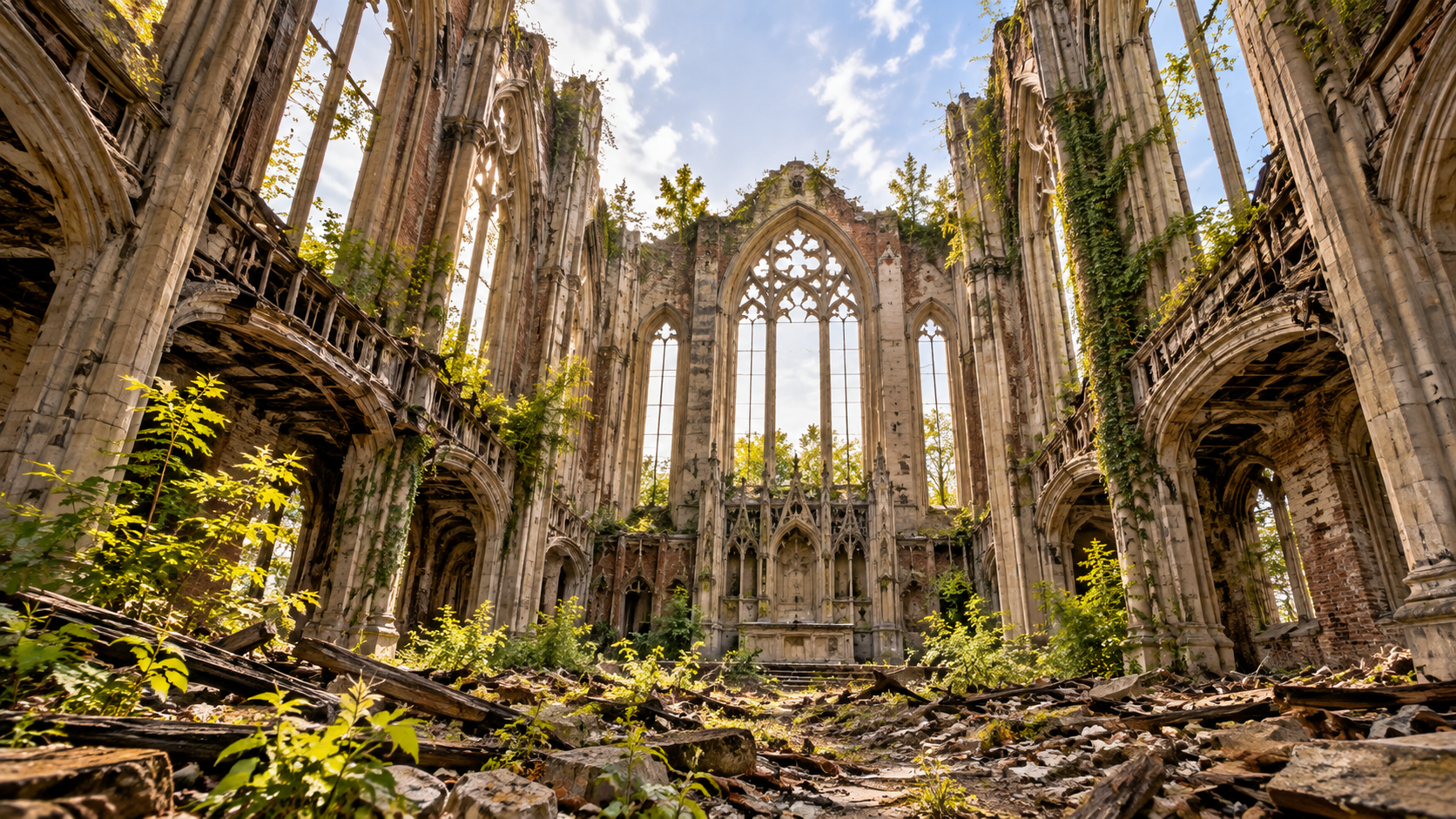
Gary, Indiana, was built by U.S. Steel and named after its chairman, Elbert Gary. In the 1920s, the steel company helped the city build a church to match its ambitions. Ground was broken in January 1925. U.S. Steel donated the land and about half the $800,000 cost, and Elbert Gary gave the organ. The church held its first service on October 3, 1926. It was Gothic Revival in limestone and terra cotta, with a sanctuary that could hold 3,000 people and a connected nine-story complex with a 1,000-seat theater, offices, a gym, a Sunday school and a dining hall. The Chicago Sun-Times described it as, at one time, the largest Methodist church in the Midwest. Membership passed 3,000 in the 1950s. As the steel industry shrank and the city’s population shifted, the congregation dwindled. A merger with a Black congregation was considered, but community interviews revealed deep distrust. The church closed on October 5, 1975. Indiana University used part of the complex for a time. Then the building was left empty. A severe fire in 1997 sped up the decay, and the sanctuary was left open to the sky. Photographers, urban explorers and even goth wedding parties came to see the ruin. Indiana Landmarks listed it among the state’s 10 most endangered places. Plans came and went: a park, a ruins garden, a stabilized bell tower. A 2026 estimate put stabilization at $4.2 million, and no funding partner came forward. In September 2026, the regional development authority awarded a $5.3 million demolition contract. The city called the building “unsafe and unrecoverable.”
Last corrected: Oct 8, 2026.
Grew up near here?
Get the free Indiana guide: every Hidden Current place in the region, with what you can still see and how to get there.
State guides are coming soon. Email signup is not available yet.
Watch the short documentary
City Methodist Church: Gary’s Cathedral Ruin, Indiana
Claim log
| # | Claim | Sources | Status |
|---|---|---|---|
| 1 | City Methodist Church coordinates are 41°36′02″N 87°20′18″W. |
| Sourced |
| 2 | The address is 577 Washington St., Gary, Indiana. |
| Sourced |
| 3 | Groundbreaking was January 25, 1925, and the church was completed in 1926. |
| Sourced |
| 4 | The first service was held October 3, 1926. |
| Sourced |
| 5 | The church cost $800,000. |
| Sourced |
| 6 | U.S. Steel donated the site and about half the cost. |
| Sourced |
| 7 | U.S. Steel provided $350,000 for the original construction. |
| Sourced |
| 8 | Elbert Gary, after whom the city was named, donated the organ. |
| Sourced |
| 9 | The church is Gothic Revival in style. |
| Sourced |
| 10 | The building has limestone and terra cotta detailing. |
| Sourced |
| 11 | The infobox lists capacity as 3,000. |
| Sourced |
| 12 | Membership surpassed 3,000 in the 1950s. |
| Sourced |
| 13 | Seaman Hall was a 1,000-seat theatre within a nine-story complex with offices, a gymnasium, a Sunday School, and a dining hall. |
| Sourced |
| 14 | The church was at one time the largest Methodist church in the Midwest. |
| Sourced |
| 15 | The church closed on October 5, 1975. |
| Sourced |
| 16 | Leaders closed the church after a merger with a Black church was considered and community interviews revealed distrust. |
| Sourced |
| 17 | The structure passed to Indiana University, which used part of Seaman Hall. |
| Sourced |
| 18 | A severe fire in 1997 accelerated the building's deterioration. |
| Sourced |
| 19 | The church is on Indiana Landmarks' 10 Most Endangered Places in Indiana list. |
| Sourced |
| 20 | The church has hosted goth weddings. |
| Sourced |
| 21 | Stabilization was estimated at $4.2 million and failed because no funding partner was found. |
| Sourced |
| 22 | The ruins garden plan was dropped. |
| Sourced |
| 23 | Demolition was awarded to Homrich Wrecking at an estimated cost of $5.3 million. |
| Sourced |
| 24 | The city deemed the church "unsafe and unrecoverable." |
| Sourced |
Disagreements logged
No approved disagreements are logged on this page yet.
Submit a disagreement
Disagree with a fact in this story? Submit a source-backed note for editorial review. It stays private until approved and does not automatically become a correction.
Sources
- Wikipedia
- chicago.suntimes.com
Corrections
| # | Correction | Sources |
|---|---|---|
| 1 | The church is no longer simply standing as a ruin: as of September 2026 it is slated for demolition. |
|
| 2 | Plans for a ruins garden and to preserve the bell tower and cathedral were dropped. |
|
| 3 | The church is Gothic Revival with limestone and terra cotta detailing. |
|
| 4 | U.S. Steel's contribution is given as about half the $800,000 cost in one source and $350,000 in another. |
|
| 5 | U.S. Steel's contribution is given as about half the $800,000 cost in one source and $350,000 in another. |
|
Hidden Current within 100 miles

More Nature Took It Back places
- Abandoned amusement park outside New Orleans
- Craco Vecchia (old Craco), the "ghost town" of Basilicata
- Mallows Bay: The Ghost Fleet of World War I Ships in the Potomac
- Big Pit: The Welsh Coal Mine Where Ex-Miners Take You 300 Feet Down
- Kolmanskop: The Diamond Town the Namib Desert Is Swallowing
- Old Cahawba: Alabama's First Capital Lost to the Woods