
Forgotten AmericaHanfordWhite BluffsHanford Site
Hanford & White Bluffs: The Towns Erased for the Bomb, Washington
Hanford and White Bluffs were Columbia River farm towns emptied in 1943 for the Manhattan Project. Plutonium made there fueled the Nagasaki bomb.
Every claim sourced
24 claims · 24 sources
0 disagreements logged
6 editorial corrections
Last checked Oct 8, 2026
The story
The numbered claim log below connects facts in this story to their sources.
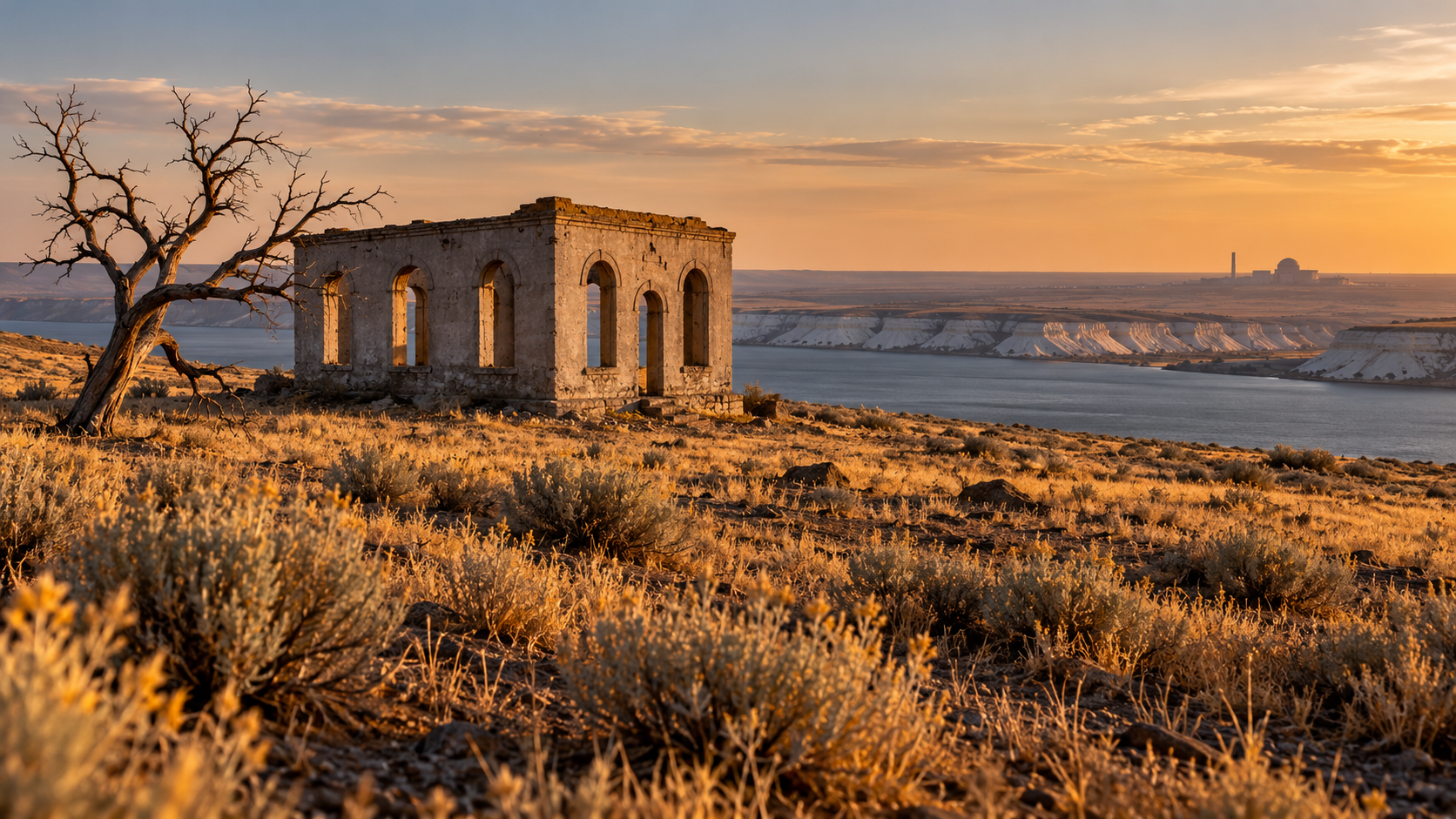
For decades before World War II, the land along this bend of the Columbia River was farm country. White Bluffs began in 1861 as a ferry crossing for miners heading to the British Columbia gold rush. Hanford followed in 1907. By the 1930s, both towns had orchards of pears and apples, vineyards, banks and schools. Long before the settlers came, this was tribal land. The Wanapum lived in the nearby Priest Rapids Valley, and the Yakama, Umatilla and Nez Perce peoples fished and gathered along the river. In March 1943, the federal government arrived with a secret project and eminent domain. Hanford residents received a 30-day notice dated March 9. In White Bluffs, people had anywhere from three days to two months to leave. About 1,500 residents of the two towns and nearby settlements were relocated, and the Wanapum lost access to their valley. Homes and orchards were burned to clear the land. In May 1943, about 177 sets of remains were moved from the White Bluffs Cemetery to a cemetery about 30 miles away. On the cleared ground, the Manhattan Project built B Reactor, the world’s first full-scale plutonium production reactor. It produced its first plutonium in November 1944. Hanford plutonium was used in the Trinity test and in the Fat Man bomb dropped on Nagasaki on August 9, 1945. Today the Hanford Site is the focus of the largest environmental cleanup in the country. Of the old towns, the White Bluffs Bank and Hanford High School still stand. Since 2015, they’ve been part of Manhattan Project National Historical Park.
Last corrected: Oct 8, 2026.
Grew up near here?
Get the free Washington guide: every Hidden Current place in the region, with what you can still see and how to get there.
State guides are coming soon. Email signup is not available yet.
Watch the short documentary
Hanford & White Bluffs: The Towns Erased for the Bomb, Washington
Claim log
| # | Claim | Sources | Status |
|---|---|---|---|
| 1 | Hanford townsite coordinates are 46°35′01″N 119°23′16″W. |
| Sourced |
| 2 | White Bluffs coordinates are 46°39′59″N 119°29′05″W. |
| Sourced |
| 3 | White Bluffs' first white settlement came in 1861, with a ferry built for traffic to the British Columbia gold rush. |
| Sourced |
| 4 | Hanford was settled in 1907. |
| Sourced |
| 5 | By 1925 Hanford had a hotel, a bank, and elementary and high schools. |
| Sourced |
| 6 | Pears, apples, vegetables, and grapes were the main sources of livelihood in White Bluffs. |
| Sourced |
| 7 | Hanford residents received a thirty-day notice dated March 9, 1943. |
| Sourced |
| 8 | White Bluffs residents had three days to two months to leave. |
| Sourced |
| 9 | The government burned homes and orchards to clear the site. |
| Sourced |
| 10 | About 177 sets of remains from the White Bluffs Cemetery were moved on May 6, 1943, to East Prosser Cemetery, about 30 miles away. |
| Sourced |
| 11 | About 1,500 residents of Hanford, White Bluffs, and nearby settlements were relocated. |
| Sourced |
| 12 | The Wanapum lived in the Priest Rapids Valley until 1943. |
| Sourced |
| 13 | The Manhattan Project acquired the towns and farms through eminent domain in 1943, displacing Tribes, farmers, and townsfolk. |
| Sourced |
| 14 | B Reactor was the world's first full-scale plutonium production reactor. |
| Sourced |
| 15 | B Reactor produced its first plutonium on November 6, 1944. |
| Sourced |
| 16 | Hanford plutonium was used in the Trinity test and the Fat Man bomb dropped on Nagasaki on August 9, 1945. |
| Sourced |
| 17 | The Hanford Site is the focus of the nation's largest environmental cleanup. |
| Sourced |
| 18 | The White Bluffs Bank was built around 1908 and is the only surviving building from the community. |
| Sourced |
| 19 | Hanford High School still stands. |
| Sourced |
| 20 | Hanford was designated part of Manhattan Project National Historical Park in 2015. |
| Sourced |
| 21 | Pre-War Historic Sites Tours visit White Bluffs Bank, Bruggemann Ranch, and Hanford High School. |
| Sourced |
| 22 | The tours are free and last about 4 hours. |
| Sourced |
| 23 | The 2026 tour dates ran from May 1 through September 26. |
| Sourced |
| 24 | Visitors who cannot take a tour can view the former community from the White Bluffs Overlook. |
| Sourced |
Disagreements logged
No approved disagreements are logged on this page yet.
Submit a disagreement
Disagree with a fact in this story? Submit a source-backed note for editorial review. It stays private until approved and does not automatically become a correction.
Sources
- Wikipedia
- nps.gov
- tours.hanford.gov
Corrections
| # | Correction | Sources |
|---|---|---|
| 1 | Not only farm residents were forced out: Tribes, including the Wanapum, were also displaced in 1943. |
|
| 2 | Not only farm residents were forced out: Tribes, including the Wanapum, were also displaced in 1943. |
|
| 3 | Eviction timelines varied: Hanford residents received a thirty-day notice, while White Bluffs residents had three days to two months. |
|
| 4 | Hanford plutonium was used in both the Trinity test and the Nagasaki bomb, not only the Nagasaki bomb. |
|
| 5 | The towns are not entirely gone: the White Bluffs Bank and Hanford High School still stand. |
|
| 6 | The towns are not entirely gone: the White Bluffs Bank and Hanford High School still stand. |
|