
Forgotten AmericaKennecottcopper miningWrangell Mountains
Kennecott, Alaska: The Copper Town Left Standing in the Mountains
Kennecott, Alaska was a copper town deep in the Wrangell Mountains. When the mines closed in 1938, the last train left and the town was left standing.
Every claim sourced
20 claims · 20 sources
0 disagreements logged
0 editorial corrections
Last checked Oct 6, 2026
The story
The numbered claim log below connects facts in this story to their sources.
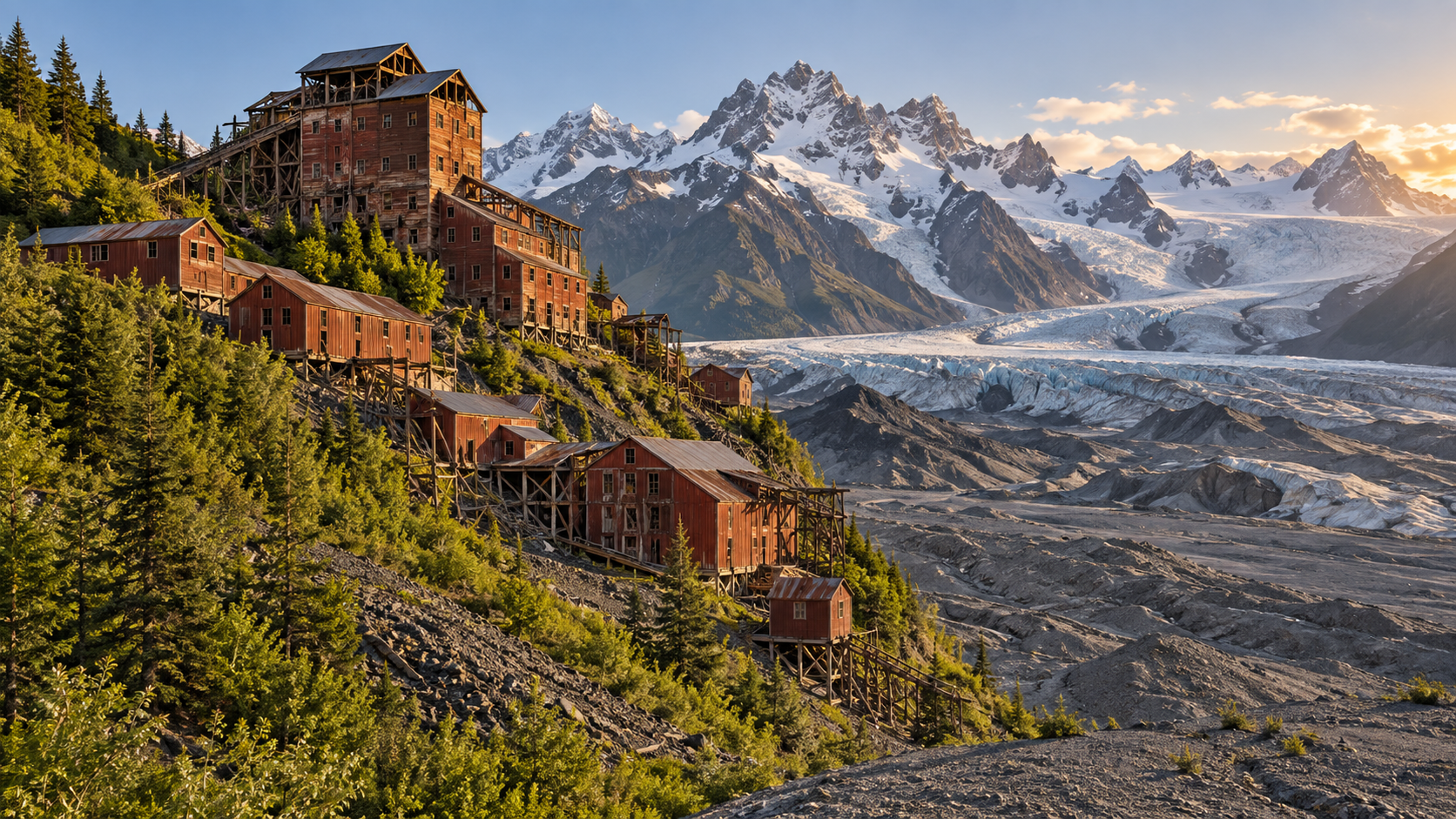
In the summer of 1900, two prospectors in the Wrangell Mountains of Alaska spotted green streaks on the cliffs high above a glacier. The green was copper, part of one of the richest copper deposits ever found. The deposit drew the attention of two of America's wealthiest families, the Morgans and the Guggenheims. Their syndicate bought the claims and built the Copper River and Northwestern Railway, 196 miles of track through the mountains and across glaciers and rivers to the port of Cordova. In 1911, the first shipment of ore went out by train. The mine company's name, Kennecott, came from an early misspelling of the nearby Kennicott Glacier. The mining town grew beside the glacier, with the mines higher up on the mountains above. At the center stood a huge timber mill building 14 stories tall, painted red, where ore was crushed and concentrated before shipment. Kennecott was a company town, with a hospital, a general store, a school, a skating rink, a tennis court, a recreation hall and a dairy. At its peak, it employed 500 to 600 men. Drinking and gambling weren't allowed, so a separate town, McCarthy, grew up about 5 miles away to provide them. The richest ore didn't last forever. In 1925, a company geologist predicted that the high-grade ore bodies would run out. Copper prices fell during the Depression, and the operation shut down temporarily in the early 1930s. The Glacier Mine closed in 1929, the Mother Lode in July 1938, and the last three, Erie, Jumbo and Bonanza, in September 1938. In its run, Kennecott produced about $200 million worth of copper. On November 10, 1938, the last train left Kennecott. Most of the town's residents left with it, though one family stayed behind as watchmen, and the railroad was soon abandoned. Because the site was so remote, nearly everything was left behind: the mill, the houses, the bunkhouses, even the machinery. For decades, Kennecott sat almost untouched in the mountains. In 1986, it was designated a National Historic Landmark, and in June 1998, the National Park Service bought the mill town and much of the surrounding land. Today, the red buildings still stand on the mountainside above the glacier, and the Park Service is stabilizing and restoring them.
Last corrected: no editorial corrections on this page yet.
Grew up near here?
Get the free Alaska guide: every Hidden Current place in the region, with what you can still see and how to get there.
State guides are coming soon. Email signup is not available yet.
Watch the short documentary
Kennecott, Alaska: The Copper Town Left Standing in the Mountains
Claim log
| # | Claim | Sources | Status |
|---|---|---|---|
| 1 | Kennecott Mines National Historic Landmark is at latitude 61.481048, longitude -142.885231 |
| Sourced |
| 2 | At its peak, Kennecott employed 500 to 600 men on three 8-hour shifts; it included over seventy-six buildings, including a 14-story timber frame mill |
| Sourced |
| 3 | By 1938, the Kennecott mines extracted 591,535 short tons of copper from 4,525,909 tons of ore, valued at $200,000,000 in 1938 dollars |
| Sourced |
| 4 | In June 1998, the National Park Service acquired significant buildings and lands of Kennecott; it was listed on the National Register in 1978 and designated a National Historic Landmark in 1986 |
| Sourced |
| 5 | The 2,839 acres purchased by the NPS includes the historic mill town |
| Sourced |
| 6 | Kennecott is at 61°31′09″N 142°50′29″W and was designated a National Historic Landmark District on June 23, 1986 |
| Sourced |
| 7 | Ore was hauled to Cordova, 196 rail miles away, via the Copper River and Northwestern Railway; the first shipment by train came in 1911 |
| Sourced |
| 8 | The Glacier Mine closed in 1929; Erie, Jumbo and Bonanza closed in September 1938 |
| Sourced |
| 9 | The last train left Kennecott on November 10, 1938, leaving it a ghost town |
| Sourced |
| 10 | Kennecott mines operated from 1909 until 1938, except for a temporary closure in 1932 |
| Sourced |
| 11 | The Mother Lode closed in July 1938 |
| Sourced |
| 12 | The last train left on November 10, 1938, with only a family of three that had been serving as the town's security remaining |
| Sourced |
| 13 | In 1925, Kennecott's geologist predicted a depletion of copper |
| Sourced |
| 14 | On November 11, 1938, the last train left Kennecott, carrying its final residents to Cordova |
| Sourced |
| 15 | In 1900, two prospectors found the copper; the Morgans and Guggenheims built 196 miles of private railroad; the mine opened in 1911 with 600 miners, a hospital, general store, schoolhouse, skating rink, tennis court, recreation hall and dairy |
| Sourced |
| 16 | An early misspelling named the mine and company Kennecott, while the town, river and glacier are spelled Kennicott; no gambling or drinking were allowed at Kennicott, so McCarthy developed nearby |
| Sourced |
| 17 | Kennecott is about 7 to 8 hours by car from Anchorage; the McCarthy Road is a 59-mile gravel road; there is no public vehicle access to the mill town, 5 miles from McCarthy |
| Sourced |
| 18 | Two private parking areas near the Kennicott River Footbridge require a fee; in summer, private shuttles transport visitors for a fee |
| Sourced |
| 19 | In winter, access is only by hiking or skiing 5 miles; the shuttle does not operate and there are no services |
| Sourced |
| 20 | Most rental car companies do not allow their cars on the McCarthy Road |
| Sourced |
Disagreements logged
No approved disagreements are logged on this page yet.
Submit a disagreement
Disagree with a fact in this story? Submit a source-backed note for editorial review. It stays private until approved and does not automatically become a correction.
Sources
- National Park Service
- Wikipedia
- WorldAtlas
- westernmininghistory.com
- alaska.org
- explorenorth.com
Corrections
No editorial corrections are logged on this page yet.