
Forgotten AmericaSafeguard ComplexNorth DakotaCold War history
Safeguard Complex: North Dakota's Cold War Missile Pyramid
North Dakota's Safeguard Complex and its radar pyramid were built to stop Soviet warheads. Fully operational in October 1975, it shut down in 1976.
Every claim sourced
23 claims · 23 sources
0 disagreements logged
9 editorial corrections
Last checked Oct 6, 2026
The story
The numbered claim log below connects facts in this story to their sources.
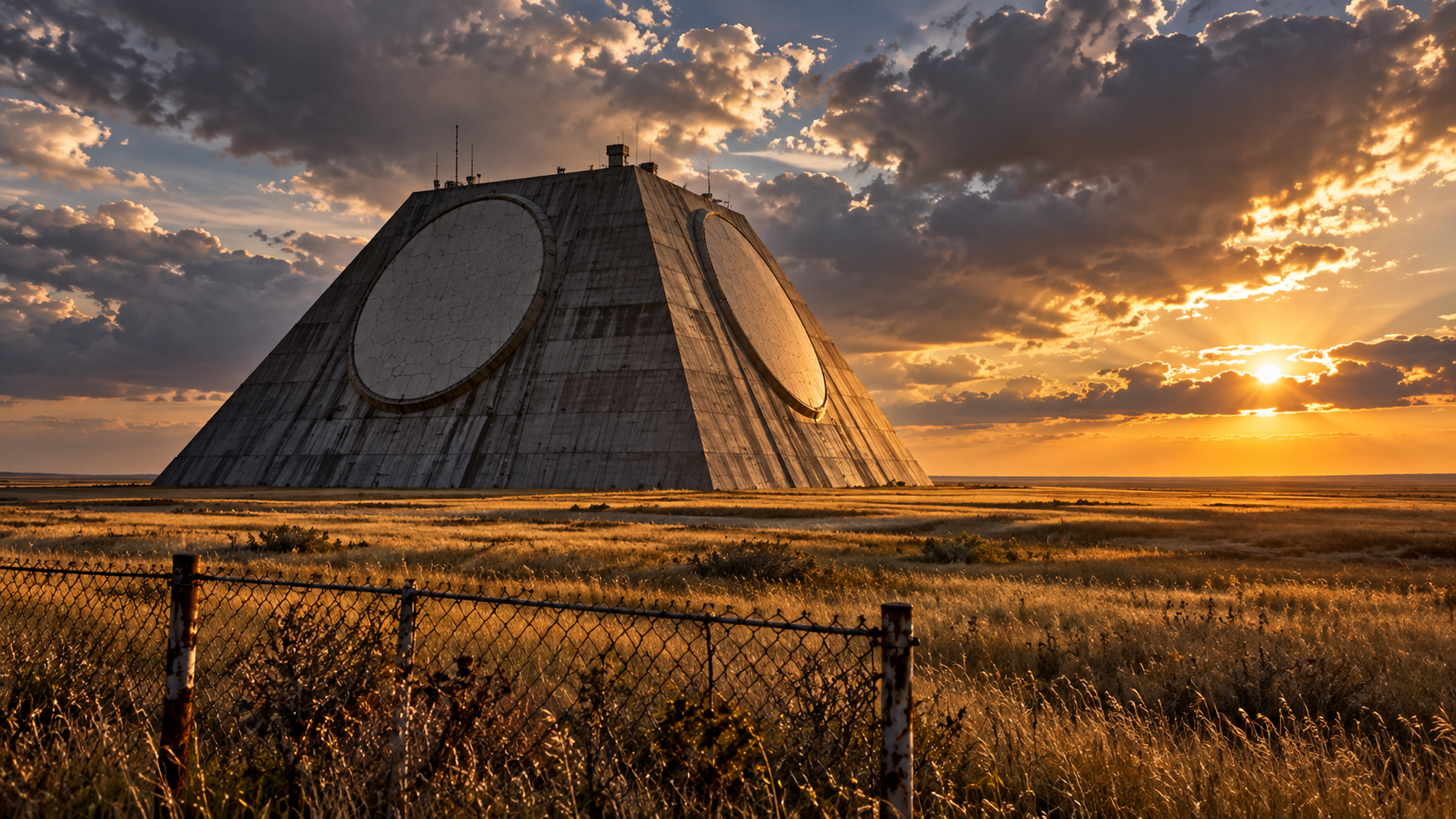
In the late 1960s, the U.S. faced a new Cold War fear: that the Soviet Union might launch a first strike to destroy America's nuclear missiles in their silos. The Army's answer was the Safeguard Program, a system of radars and interceptor missiles designed to protect the Minuteman missile fields. One of the sites chosen was in the farmland of northeastern North Dakota, guarding the missiles of Grand Forks Air Force Base. Construction began in April 1970 near the small town of Nekoma, and more than 1,000 workers poured in. The 1972 Anti-Ballistic Missile Treaty with the Soviet Union limited each country to two ABM sites, and work at other planned Safeguard sites stopped. Nekoma, the furthest along, was finished. Its centerpiece was the Missile Site Radar, housed in a massive concrete pyramid with large round radar faces on its sides, visible for miles across the prairie. About 25 miles to the northeast, near Cavalier, the Perimeter Acquisition Radar would watch for incoming missiles over the North Pole. The pyramid would then track them and guide the interceptors. Around it, underground launchers held 30 long-range Spartan missiles and 16 short-range Sprint missiles, with about 54 more Sprints at four remote launch sites. Both types carried nuclear warheads. Rather than hitting incoming warheads directly, they were designed to destroy them with nuclear explosions overhead. The complex reached initial operating capability on April 1, 1975, and full operational capability on October 1, 1975. The cost was about $6 billion. The very next day, October 2, 1975, the House voted to deactivate it. Critics argued it was too costly and too limited, and that the blasts from its own nuclear interceptors could blind its radars. The complex was shut down in early 1976. The closing hit the region hard. Unemployment in nearby counties rose sharply, and surrounding towns lost much of their population; Nekoma lost nearly half. In 1979, the pyramid's doors were welded shut. The long-range radar near Cavalier kept working, and it still operates today as Cavalier Space Force Station. But the pyramid sat empty for decades. In 2012, the Spring Creek Hutterite Colony bought the complex at auction for $530,000. In 2020, the pyramid and part of the property were sold to the Cavalier County Job Development Authority. In 2026, the state announced agreements to redevelop the pyramid as a high-security data center.
Last corrected: Oct 6, 2026.
Grew up near here?
Get the free North Dakota guide: every Hidden Current place in the region, with what you can still see and how to get there.
State guides are coming soon. Email signup is not available yet.
Watch the short documentary
Safeguard Complex: North Dakota's Cold War Missile Pyramid
Claim log
| # | Claim | Sources | Status |
|---|---|---|---|
| 1 | The Missile Site Radar is at 48°35′21.91″N 98°21′24.26″W |
| Sourced |
| 2 | The Stanley R. Mickelsen Safeguard Complex is at 48.589419, -98.356739, near Nekoma in Cavalier County, North Dakota |
| Sourced |
| 3 | The site achieved initial operating capability on 1 April 1975 and full operational capability on 1 October 1975, costing $6 billion |
| Sourced |
| 4 | The complex was deactivated in April 1976 |
| Sourced |
| 5 | The complex was fully operational with missiles on October 1, 1975, and the next day the US House voted to deactivate it |
| Sourced |
| 6 | Both the Spartan and Sprint missiles were designed to carry nuclear warheads |
| Sourced |
| 7 | Unemployment in Cavalier and Pembina counties rose, and nearby towns lost population, including Nekoma at 49% |
| Sourced |
| 8 | The doors to the pyramid were welded shut in 1979 |
| Sourced |
| 9 | In 2012, the site was purchased for $530,000 by a Hutterite colony |
| Sourced |
| 10 | The complex provided launch and control for 30 Spartan and 70 shorter-range Sprint anti-ballistic missiles |
| Sourced |
| 11 | The complex was deactivated on 10 February 1976 |
| Sourced |
| 12 | In December 2012, the Spring Creek Hutterite Colony purchased the complex at auction for $530,000; in 2020, portions including the Pyramid were sold to the Cavalier County Job Development Authority for $462,900 |
| Sourced |
| 13 | The Missile Site Radar site held 30 Spartan missiles and 16 Sprints |
| Sourced |
| 14 | The complex included four Remote Sprint Launcher sites holding an additional 54 Sprint missiles |
| Sourced |
| 15 | Construction began in April 1970, and more than 1,000 workers came to Nekoma |
| Sourced |
| 16 | The Perimeter Acquisition Radar was located 25 miles northeast in Cavalier, North Dakota |
| Sourced |
| 17 | The electromagnetic pulse from the interceptors' nuclear detonations would blind the system's own radars |
| Sourced |
| 18 | The 1972 Anti-Ballistic Missile Treaty limited the US and USSR to two ABM sites each |
| Sourced |
| 19 | The Perimeter Acquisition Radar is now operated by the 10th Space Warning Squadron at Cavalier Space Force Station |
| Sourced |
| 20 | The SRMSC protected the Minuteman missile fields at Grand Forks Air Force Base |
| Sourced |
| 21 | The complex is at 81st St. NE, 1 mile northeast of Nekoma |
| Sourced |
| 22 | The pyramid can be viewed just off North Dakota Highway 1 in Nekoma |
| Sourced |
| 23 | In 2026, North Dakota announced binding agreements with Bitzero Blockchain to acquire and redevelop the complex |
| Sourced |
Disagreements logged
No approved disagreements are logged on this page yet.
Submit a disagreement
Disagree with a fact in this story? Submit a source-backed note for editorial review. It stays private until approved and does not automatically become a correction.
Sources
- Wikipedia
- fortwiki.com
- Clio
- military-history.fandom.com
- prairiepast.com
- ndstudies.gov
- Amusing Planet
- wearethemighty.com
- sah-archipedia.org
- nationalinterest.org
- Datacenter Dynamics
Corrections
| # | Correction | Sources |
|---|---|---|
| 1 | The complex was not operational for only 24 hours; it reached initial operating capability on April 1, 1975 and full operational capability on October 1, 1975 |
|
| 2 | One source states the complex was operational for only 24 hours |
|
| 3 | One source states the system was operational for not more than three days |
|
| 4 | Sources disagree on the shutdown date: 10 February 1976 |
|
| 5 | Sources disagree on the shutdown date: April 1976 |
|
| 6 | The House voted to deactivate the complex on October 2, 1975, not February 10, 1976 as one source states |
|
| 7 | One source states the House Appropriations Committee voted to deactivate it on 10 February 1976 |
|
| 8 | The complex is no longer the only operational anti-ballistic missile system the US has deployed; the Ground-Based Midcourse Defense system followed |
|
| 9 | The Bitzero redevelopment was announced in 2026 but has not been confirmed as completed |
|